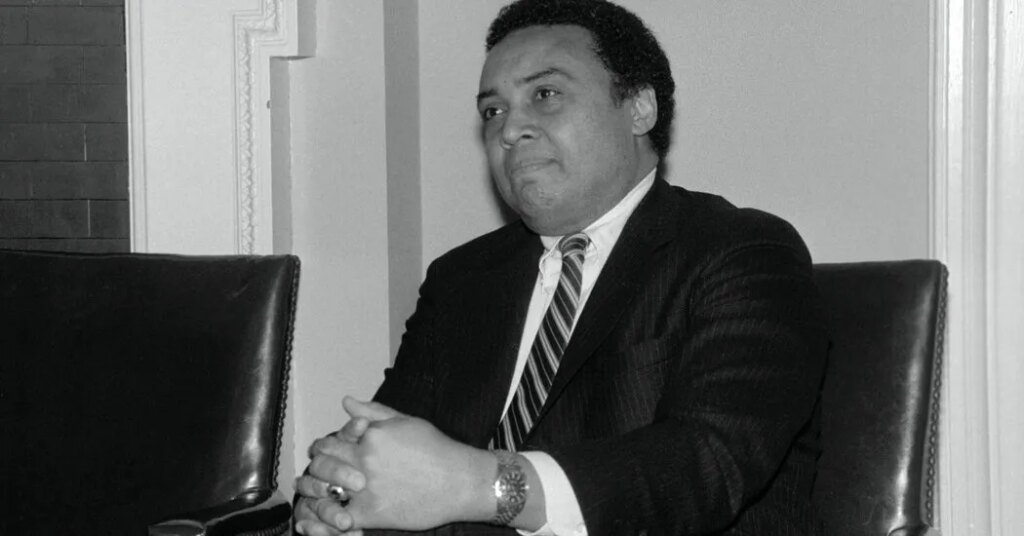
Justice Milton L. Williams, who over several decades in public service in New York had an active role in some of the city’s major flash points — including investigations into police corruption and the Attica prison riots and the judicial proceedings for the infamous Central Park jogger case — died on Oct. 2 in New York City. He was 93.
The cause of his death, in a nursing home, was complications of a urinary tract infection, his son, Milton L. Williams Jr., said.
Justice Williams, a former police officer, in 1985 became the first Black man appointed as the administrative head of New York City’s vast criminal and civil court system.
Before serving on the bench for three decades, he played a prominent role on two commissions that investigated politically explosive scandals in the city and state in the early 1970s.
He was an associate general counsel to the Knapp Commission, chaired by Whitman Knapp, later a federal judge, that confirmed reports in The New York Times of systemic corruption in the New York City Police Department.
Justice Williams was also the executive director of an inquiry, headed by Robert B. McKay, the dean of New York University Law School, into the inmate rebellion at the Attica Correctional Facility in upstate New York in 1971, which claimed 43 lives.
The McKay Commission blamed the riot on abysmal conditions at the prison. It found that contrary to earlier reports, all 10 of the guards and civilian employees who died as a result of the revolt were killed not by inmates but by gunfire from law enforcement personnel who were deployed to end the siege.
As the deputy chief administrative judge for New York City courts from 1985 to 1993, he sought to bring a modicum of order to a system in which 600 judges and another 6,000 nonjudicial employees handled as many as a million cases annually. He established special drug courts to deal with the proliferation of narcotics cases.
But in 1989 Justice Williams drew criticism over a decision, as a deputy chief administrative judge, involving the trial of the Central Park Five, five young Black and Latino teenagers who were accused of raping a jogger in Central Park.
In assigning a judge to preside over the trial, Justice Williams made the provocative decision to bypass the standard, random selection process and instead chose someone with a reputation for being tough on defendants: Justice Thomas B. Galligan.
The decision to circumvent the lottery selection, which involved spinning a wheel, was unusual but not unprecedented. Justice Williams said court rules empowered him to do so.
He selected Justice Thomas B. Galligan over of Justice Howard E. Bell, who had been criticized for laxly presiding, in 1988, at the trial of Robert E. Chambers. In a tabloid sensation known as the Preppy Killer case, Mr. Chambers pleaded guilty to manslaughter in the strangling death of Jennifer Levin in Central Park.
Colin Moore, the lawyer for the defendant Kharey Wise in the Central Park jogger case, said that assigning Justice Galligan was “arbitrary and capricious” and that it violated his client’s right to a fair trial. He added that Justice Galligan’s “law and order image” had led some prisoners and guards to refer to the city jail on Rikers Island as Galligan’s Island.
“I don’t think anyone has been acquitted in his court in the last two years,” Mr. Moore said at the time.
In weeks of contentious hearings and during the trials, Justice Galligan delivered a number of tactical victories to prosecutors. Most notably, he ruled that the defendants’ videotaped confessions were admissible. The defense lawyers argued that the confessions were coerced and were obtained despite the absence of their parents or non-English speaking guardians.
The jury wrestled with the validity of the youths’ statements to the police and ultimately convicted the five of charges that included assault, rape, robbery, riot and sexual abuse. Justice Galligan sentenced them to prison terms that ranged from 7 to 13 years.
Those convictions were officially vacated in 2002 after the young men were exonerated by DNA evidence and a confession from a serial rapist. The defendants were awarded more than $40 million to settle their civil rights lawsuits.
The case became a cause célèbre as an example of police coercion and a miscarriage of justice rooted in racial prejudice.
“It’s impossible to say whether the outcome could have been different with a different judge,” Sarah Burns, the author of “The Central Park Five: The Untold Story Behind One of New York City’s Most Infamous Crimes,” said in an interview. “Galligan certainly had a reputation as being pro-prosecution, but I also think the climate in the city was such that an acquittal would have been unlikely, short of a judge preventing the defendants’ statements from being admitted as evidence.”
Other judges largely defended Justice Williams’s decision to enlist Justice Gilligan on the basis of his expertise for efficiently presiding over trials rather than for his reputation for keeping defense lawyers in check.
“He chose Justice Galligan because he could manage a courtroom — not to get someone who was pro-prosecution,” said his son, Milton Williams Jr., who is a lawyer.
Milton Lawrence Williams was born on Nov. 14, 1932, in Augusta, Ga. His mother was Helen (Riley) Williams. His father, Richard, was an Amtrak conductor.
His family moved to New York City when he was about 4 years old. “For a while, they lived in a one-room in a boardinghouse where they had to share the bathroom with, like, five other families,” his son said in an interview.
After graduating from De Witt Clinton High School in the Bronx, where he played football and was an All-City halfback, Justice Williams declined football scholarships to several universities and joined the Navy to help support his family. He served as a radioman during the Korean War, stationed in the Caribbean, the Mediterranean and U.S. ports until he was discharged in 1955.
“In the Navy,” said his son, “my father was subject to segregation and not allowed to use the same quarters or facilities as his fellow radio men.”
While serving as a police officer beginning in 1957, he earned a bachelor’s degree from New York University in 1960 and a law degree from N.Y.U. Law School in 1963.
“He became a lawyer, because he watched the injustices and despicable treatment that his parents endured, and wanted to make a difference, and also be in a position to financially help his family,” his son said.
In addition to Milton Jr., a lawyer, Justice Williams is survived by his wife, Rose (King) Williams; a daughter, Darrie Williams; and six grandchildren. He lived in Manhattan.
After graduating from law school, Justice Williams worked as a lawyer for the Allstate Insurance Company, served as regional counsel for the Small Business Administration and was a trial attorney for the Transit Authority; he ran unsuccessfully for New York City Council from the Bronx in 1973. He was commissioner of the city’s Division of Veterans Affairs from 1974 to 1977 when he was named a Criminal Court judge by Mayor Abraham D. Beame.
He rose through the ranks of New York City’s courts system until being promoted to the top position overseeing the city’s courts and served as deputy chief administrative judge to 1993. He later served for 15 years as a justice on the prestigious Appellate Division of State Supreme Court in Manhattan.
Justice Williams retired from the bench at the end of 2008.
“He was smart, street-savvy and knew the trial judges’ talents and weaknesses for efficient assignment and fair management,” Joseph W. Bellacosa, the state’s chief administrative judge who appointed Williams as deputy, said in an interview.
The post Milton L. Williams Has Died. His Legal Career Touched Major N.Y.C. Events. appeared first on New York Times.