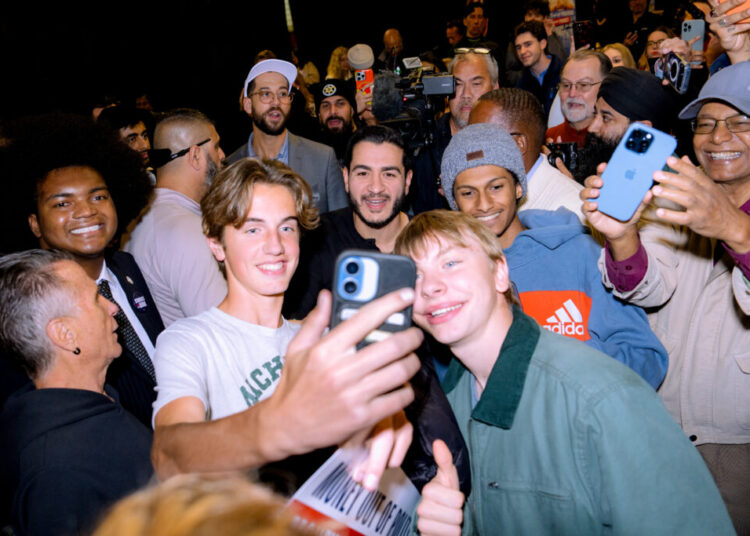
Bret Stephens: What an amazing election night, Frank. As Mark Twain might have said, reports of democracy’s death seem to have been greatly exaggerated. We’re still a country that knows how to throw the bums out.
Frank Bruni: That’s exactly right. And that’s the main source of my elation, which is not too strong a word. Am I happy Democrats have a significant congressional majority? Absolutely, given President Trump’s incompetence, incoherence, lawlessness and autocratic pretensions — and Republicans’ indulgence of all of that. But I’m ecstatic that despite the pollution of our information ecosystem, despite Trump’s attempts to corrupt the voting process, despite epically shameless gerrymanders and despite all this crazy money sloshing through the midterms, Americans were able to identify correctly the agents of their economic distress and to oust them.
Bret: My elation is like Ivory soap: 99.44 percent pure. Aside from the Senate race in Michigan — about which I don’t need to regurgitate my views — I think this was a great night for America. Including, inshallah, Republicans themselves, at least if they’re willing to take the lesson about what their slavish devotion to Trump and Trumpism has meant for their political brand. Parties can thrive if they’re willing to learn from their defeats, just as Clinton-era Democrats learned from the licking they took in the 1994 midterms, or the Obama-era ones did from the shellacking of 2010.
Frank: Democrats can and should learn from this election, too. I hope, for example, that they take note of all the milestones that just occurred because of candidates who did not market themselves as milestones in the making. Keisha Lance Bottoms, the Democrat who was just elected governor of Georgia, will be the first woman and first Black person in that role. Gina Hinojosa isn’t just the first Democrat elected governor in Texas in more than 35 years; she’ll also be the state’s first Hispanic governor. Abdul El-Sayed, the Democrat who won in Michigan, will be America’s first Muslim senator. Byron Donalds, a Republican, will be Florida’s first Black governor. None of those politicians styled themselves primarily as trailblazers. It turns out that our increasingly diverse country is happy to celebrate that diversity when it doesn’t degenerate into shrill identity politics.
Bret: Did you forget Chris Pappas in New Hampshire, the first openly gay man to win a U.S. Senate seat? The fact that it’s hardly worth mentioning is a tribute to 60 years of progress thanks to courageous leaders like Harvey Milk and Barney Frank and Elaine Noble and Annise Parker, and to a national culture that, over time, elevated acceptance above hate. It also means that a great many stereotypes about American life can now be tossed out the window. For instance: all the stereotypes about Kansas, which will now have a Democratic senator for the first time since Franklin D. Roosevelt was in the White House.
Frank: Pappas of course joins Senator Tammy Baldwin, Democrat of Wisconsin, who became the first openly gay person in the Senate after her election in 2012. Let’s call them the Stonewall caucus!
Bret: I do think that what happened Tuesday night now sets up both parties to try to figure out what they are really about. Like the Republican victory two years ago, the Democratic sweep on Tuesday is largely about the politics of rejection. The country came to hate the people in power and chose to send a big fat message about what it didn’t like, especially high prices in everyday places and everyday liars in high places. But an election that says “not this” is very different from one that clearly signals “this.” And I think Democrats and Republicans alike don’t have any clear fix on what their “this” is.
Frank: I think voters in both parties are clear on wanting, um, this much: a government that’s a lot more creative and assertive in its efforts to raise their standard of living. They may not reach any consensus, though, on how. As Democrats fashion and move legislation through Congress — legislation, of course, that Trump has already bragged about his ability to veto — they need to be careful about internal fights and divisions. Progressives like El-Sayed are feeling emboldened, but Democrats won their Senate majority with less progressive candidates, too, and if Adam Hamilton in Kansas and Annie Andrews in South Carolina and Josh Turek in Iowa don’t want to be one-term wonders, they won’t be marching in lock step with El-Sayed and Bernie Sanders. Those tensions, of course, will be mirrored in — and intensified by — the quickly accelerating contest for the party’s 2028 presidential nomination, which is guaranteed to attract a cast of thousands.
Bret: Similar story when it comes to Republicans. On Wednesday morning, I got two opposite messages from two smart conservative friends. One was that the results meant that JD Vance would definitely be the Republican nominee in 2028. The other was that the results meant that Vance was definitely finished. Republicans are going to need to figure out if the election was a repudiation of, say, the war with Iran, which Vance plainly opposed (and which he now openly blames for Tuesday’s wipeout); or whether it was a repudiation of Trump’s tariffs and the tactics of ICE, which Vance clearly embraces. They’ll need to decide if the election was a rejection of Trump as a man or of populist conservatism more generally. And they’re going to have to alight on some other national Republican figure who can plausibly bring the party together under a unifying and aspirational message that can appeal beyond the party’s narrow base.
Frank: I want to make one more point — or inject one bit of data into — the looming debate in the Democratic Party about whether its immediate future lies in greater progressivism or in something more centrist. Yes, El-Sayed just won one of the nation’s crucial battleground states by emphasizing Medicare for All. His impressive margin of victory was about eight percentage points. But in nearby Pennsylvania, the most populous battleground state, the moderate Democratic governor, Josh Shapiro, just won re-election by 22 points. So any Democrat who says the midterms are about an ascendant left is reading the map and the results in a highly selective way.
Bret: Shapiro’s stroll to victory was one of the high points of the night for me. The problem he has — one he shares with nearly every other sensible, governance-minded politician in either party — is that what devoted party activists who show up to vote in primaries want tends to be quite different from what voters in the general election want. I have no doubt, for instance, that if Shapiro were to become the Democratic nominee in 2028, he would handily defeat nearly any conceivable Republican opponent. But I have a lot of doubt that Shapiro, despite his obvious electability, could overcome progressive opposition in the primaries. Am I too pessimistic?
Frank: No, you’re absolutely right — all the more so because progressives have increasingly turned on Israel and been drawn to politicians who strongly condemn Israel. Shapiro isn’t one of those politicians. He takes a more nuanced position.
Bret: A depressing reality that leaves Jewish Americans like me feeling politically homeless.
Frank: Since we’re talking about 2028, let’s note that a charismatic young Democrat whose profile rose sharply over the past six months and who is frequently mentioned as a presidential candidate got a huge break. I speak of Senator Jon Ossoff, who won re-election in purple Georgia by a gobsmacking 18 percentage points. Had Bottoms’s Republican opponent, Rick Jackson, won the governor’s race in the state, he would have had the power to appoint a Republican as Ossoff’s temporary replacement in the Senate if Ossoff left the chamber to run for the White House. That might have dissuaded Ossoff. But that worry is now gone — not just for him but also for Georgia’s other Democratic senator, Raphael Warnock, another possible presidential contender.
Bret: Ossoff insisted during the race that he had no plans to run for president in 2028. Don’t believe him.
Frank: I assure you, Bret, I’ve been around too long to fall for that.
Tuesday’s results are a boost as well for Representative Alexandria Ocasio-Cortez, whose deliberations about running for the presidency are no secret. She put her clout on the line for El-Sayed and would have been diminished if he’d lost. He won, handily.
Bret: I have a hard time believing A.O.C. will be the Democratic nominee for president in two years — still too young and much too blue — though I can imagine her in the veep spot. Either way, I think it would be a mistake to put her on a national ticket in two years. Both sides, but Democrats in particular, need to run toward their centers. I’m thinking of North Carolina, your state, where Roy Cooper just won the Senate seat being vacated by a Republican, Thom Tillis, by 20 points. Is there any conceivable Republican ticket that could defeat Shapiro-Cooper in 28?
Frank: Shapiro-Cooper and not Cooper-Shapiro? Cooper is 69 and Shapiro 53. But honestly? It’s not the right ticket. They’re both lawyers and former attorneys general and — there’s just too much sameness. I’m also sensing, in the many of the midterm results, a yearning for generational change that Cooper’s age doesn’t fit.
Bret: There should only be two meaningful generational categories in politics these days: pre- or post-senility. Cooper is very much pre-.
Frank: In any case, the margin of Cooper’s victory in an indisputably purple state validates his approach and should be a model for Democrats in 2028. He did not get mired in culture wars. He did not get into social media spats. In a diligent and disciplined fashion, he focused on everyday problems and practical solutions, and he projected levelheadedness, decency and old-fashioned competence. As I wrote in a quick analysis of his triumph, his campaign was prudently boring and profoundly refreshing.
Bret: “Prudently boring” is a wonderful description of what I pray American politics may someday be again. Somehow, I don’t think that’s what the next two years hold in store. I hope the new Congress works hard to hold Trump in check, not just legislatively but also personally, especially through investigations into the ways in which and his family have used high office to enrich themselves. At the same time, I’m worried that what we’ll get is one demand after another to impeach Trump and his officials — efforts that will fail so long as Democrats can’t command the two-thirds Senate majority they would need to convict, and which can only play into Trump’s great strength as a counterpuncher.
Of course, there’s also the (admittedly slim to invisible) possibility that Trump could extend Democrats an olive branch and offer to work toward sensible immigration reform. Or am I hallucinating?
Frank: It’s a hallucination to imagine Trump taking a considered or consistent approach of any kind. As he has already demonstrated to some extent in the brief time since results came in, he will pinball from palpably wounded pride to self-aggrandizing delusion, from resignation to rage, from a sustained determination to complete his cherished monuments to reveries about male politicians’ backsides. Certainly, the mortifying rebuke that voters just delivered to him isn’t going to steady him, Bret. I think we’re looking at a grim circus. And for all the tough decisions Democrats face, Republicans will be even harder pressed to figure out their new relationship with him in this new context.
Bret: Frank, I sometimes look back at my old columns to see whether they still hold up after a few years. Not all do, of course. But my column from July 2024, “Republicans Will Regret a Second Trump Term,” might still offer Republicans the tough love they desperately need.
Frank: I remember that column and I loved its conclusion: “ ‘Democracy,’ said H.L. Mencken, ‘is the theory that the common people know what they want, and deserve to get it good and hard.’ If Trump wins in November, good and hard is what Republicans are going to get.”
Bret: On Tuesday, they got it — and maybe, someday, they’ll get it.
The Times is committed to publishing a diversity of letters to the editor. We’d like to hear what you think about this or any of our articles. Here are some tips. And here’s our email: [email protected].
Follow the New York Times Opinion section on Facebook, Instagram, TikTok, Bluesky, WhatsApp and Threads.
The post We Still Know How to Throw the Bums Out appeared first on New York Times.