LONDON — It’s a hot summer day on Tilsey Farm, a private estate in Surrey, and there are orcs everywhere. They lean casually against the trailers, finding respite in the shade, and line up at the catering tent, which is still serving breakfast. Deeper into the woods, where “The Rings of Power” is shooting a battle scene from the opening episode of Season 3, the orcs wait patiently to be called to set. It feels as if J.R.R. Tolkien’s creatures have merged their way into our world. Or, perhaps, that I’ve fallen into Middle-earth itself.
The lifelike orcs are only a small part of the craftsmanship that goes into “The Rings of Power.” The Prime Video series, which debuts the first four episodes of Season 3 on Nov. 11, operates at a blockbuster scale, sometimes shooting as many as four production units simultaneously. Today, while I’m observing a battle between the elves, the orcs and the wild men, another unit is filming a scene at the dwarf home of Khazad-dûm, built in nearby Shepperton Studios, where the show has taken over nine soundstages and a backlot. The prequel series is a huge endeavor. But “The Rings of Power” creators Patrick McKay and J.D. Payne always imagined the show like a feature film.
“This is how we pitched it to Amazon,” McKay says. “We wanted to realize this material and adapt it in a singular and spectacular fashion.”
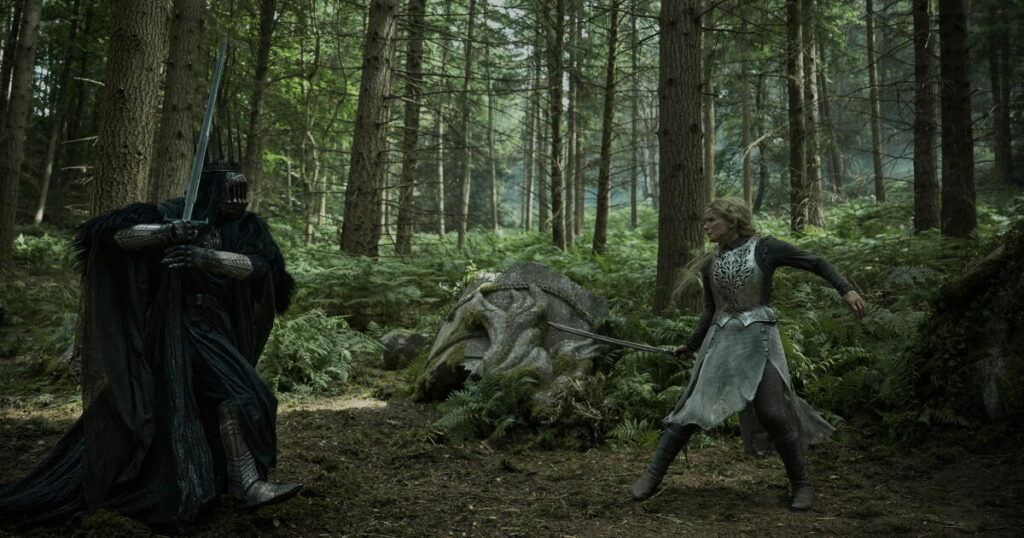
Today’s battle features a tired group of elven warriors led by Morfydd Clark’s Galadriel and Ismael Cruz Córdova’s Arondir as they face Sauron’s increasing supporters. After a bloody skirmish with the orcs and wild men, an imposing figure arrives on horseback, grabbing one of the warriors and hurling him at Galadriel’s approaching horse. The horse stumbles, trapping Galadriel underneath as the figure, a ring-wearing nazgnagôl, strides toward her. The scene is the result of two weeks of filming at Tilsey Farm with director Charlotte Brändström and stunt unit director Vic Armstrong at the helm.
“When you’re doing a huge cinematic sequence like that, it’s a constant Jenga tower of schedules and moving back and forth between units,” McKay says. “But we wanted to start our season with a bang and then show how the elves, after a five-year time jump, are losing. There’s a new force on the battlefield.”
“When we last left Sauron, he had just gotten the nine rings for men and now you discover that he’s already given some of them out,” Payne adds.
Clark describes Galadriel’s life in Season 3 as being “completely altered.” Some of the clear-eyed naivete she had previously is gone.
“It’s good to know yourself more, but also there is a tragedy to being so aware of who you are and where you stand,” Clark says. “They’re not frolicking anymore. She’s being faced with something that she couldn’t previously comprehend because she doesn’t have that darkness within her.”
The new season brings many of the disparate storylines from past seasons together. There are fewer characters and more focus on Sauron (Charlie Vickers), who is amassing power across Middle-earth.
“All roads lead to Sauron,” Payne says. “For the first few seasons we’ve been lighting fuses and now the bombs are going off. We’re now at the height of the war.”
“We never want to repeat ourselves,” McKay adds. “We wanted, moment to moment, for the audience to feel the dramatic interpersonal stakes of these world-shaking, epic events. That necessitates a leaner focus and a darker tone, so that each individual story has enough space to shine.”
“The Rings of Power” is adapted from Tolkien’s writing and set during his fictional Second Age. Some of the storylines are imagined based on the author’s works, including this opening battle sequence.
“We took two different parts of the [Tolkien’s] legendarium in terms of the war and braided them into one narrative,” Payne says. “The Battle of the Gwathló is the inspiration for some things you see earlier in the season. The events you see toward the end of the season come from a part of the legendarium you find in the appendices. We’ve compressed some events.”
Brändström, who has directed on the series since Season 1, describes the new episodes as a “more dramatic season.” “There is something constantly at stake,” she says. “Sauron is much more present. He’s trying to forge the one ring. It all leads into a very exciting cliffhanger ending.”
This time, Brändström directed the first two episodes and the season finale. For a sequence like today’s fight, she works closely with Armstrong and stunt coordinator Roy Taylor on the action scenes, often storyboarding them in advance. Armstrong and Taylor also rehearse with the actors and the stunt performances ahead of filming. While the action is important, there also has to be a meaningful resonance.
“The most important thing is that the scene works emotionally,” Brändström says. “The actors need some drama moments, not just action moments. This scene has high stakes. It’s a bit like David against Goliath for the elves because they are trying to fight an impossible battle.”
Being on location and doing as many practical effects versus special effects is important to the directors. There are 12 horses on set today, although some share roles — Galadriel’s horse is played by five different horses, including the one who laid on top of the actor for their stunt.
“Everything is movie scale,” Armstrong says. “We’re lucky enough to be allowed to attempt to do the things for real and still get the magical feeling across. The hardest stunt you can do is being original. I think we’ve been able to do stuff in the woods [for this scene] that’s really original and it all looks real.”
“The Rings of Power” shot at 14 locations for Season 3, primarily on private estates and in Windsor Great Park. The only existing building used is Neath Abbey, a 10th century monastery in South Wales. Production designer Kristian Milsted also built an expansive outdoor set for Numinor, as well as numerous new interior sets. These include the hidden elven valley of Rivendell, which was created on a stage using real plants and trees. Although CGI is used to expand the mythical scope of Middle-earth, as much is done practically as possible.
“We don’t want to do lots of blue-screen environments,” Milsted says. “It’s great for the actors to be able to act in a place that feels real. What’s really important for this season, and all seasons of ‘The Rings of Power,’ is that it’s grounded and the design doesn’t look too high fantasy.”
For Córdova, who does a lot of his own stunt work, the locations and practical effects help to make his performance richer.
“You truly feel like a kid and you’ve imagined yourself more grown up battling in some fantastical place,” the actor says. “The Rivendell set has a microclimate because they built this forest and suddenly there were little insects in it. It became a living set. That level of work is what the story deserves, but furthermore what the audience deserves.”
The tactile quality of “The Rings of Power” extends to all of the creative departments. Costume designer Libby Dempster works with a variety of artisans, including a weaver, the armory department, the jewelry department, pattern cutters, a textiles team and a breakdown team, who make the clothes look worn in.
“So many historical things are being kept alive through a fantasy series,” says Clark, who has a new armor for Galadriel this season. “We’ve got all this amazing costuming that’s using medieval-type of stitching and real craftsmanship. One of the greatest experiences in my whole career is being able to wear these people’s art.”
Set decorator Tina Jones has used various artisans from a glassblower to a potter to a stone mason to augment the sets. Jones and the props team went into Season 3 with a stock of 100,000 props, including more than 200 rings. She is also responsible for designing the horses’ armor and costumes, including the striking black look on the nazgnagôl’s horse.
“Our first port of call was concept artist John Howe, who did a lot of work on Peter Jackson’s films and on our first two seasons,” Jones says. “This was his interpretation. But Charlotte also knew she would be shooting the horse in slow motion and she wanted a lot of movement, which armor would not have given her. So we bought and dyed Indian silk to get it slowly flowing.”
Today’s battle features 16 stunt performers and 10 special action extras playing orcs, as well as eight stunt performers and 42 special action extras playing wild men and women. Hair and makeup designer Flora Moody estimates her team applied orc makeup to 1,070 performers over the season’s eight episodes — a huge feat for her team of 65 makeup artists. In addition, Moody’s team made 37 wigs and 25 beards for the main cast, and approximately 720 elf ears. On the biggest day, for a scene in Numinor, the makeup department applied makeup, wigs and prosthetics to 324 performers.
For Moody, the goal is to seamlessly integrate her designs into the show. “You don’t want your look to be ‘ta-da,’” she says. “You want it to work well within the world.”
She also wants the characters’ looks to feel unique while retaining some familiarity. “We’re not following someone else’s interpretation of Tolkien,” she says. “It’s important not to jar the viewer with a massive change in the look of a world, but you can start pushing in your own nuances into those characters.”
It’s up to McKay and Payne to make each department’s vision cohesive. “Your challenge as a showrunner is to bring together a very diverse group of people with a very diverse group of skills and to make sure that they’re all playing the same song,” Payne says. “Making it all one thing with these brilliant people is a constant joy and a constant challenge.”
“That is the managerial challenge,” McKay adds. “The artistic challenge is: If you’ve succeeded at that, how does it come together in every frame and does it feel true?”
For the actors, it does. “It feels like playing the most incredible imaginary game,” Clark says. “The stuff we can do with rigs and green screens is amazing, but when you’re in a forest surrounded by orcs it feels like, ‘Oh my God, how did I get this golden ticket?’ It still feels amazing to me.”
The post Dozens of orcs and wild men, 12 horses and one ring: How ‘Rings of Power’ created Season 3’s battles appeared first on Los Angeles Times.