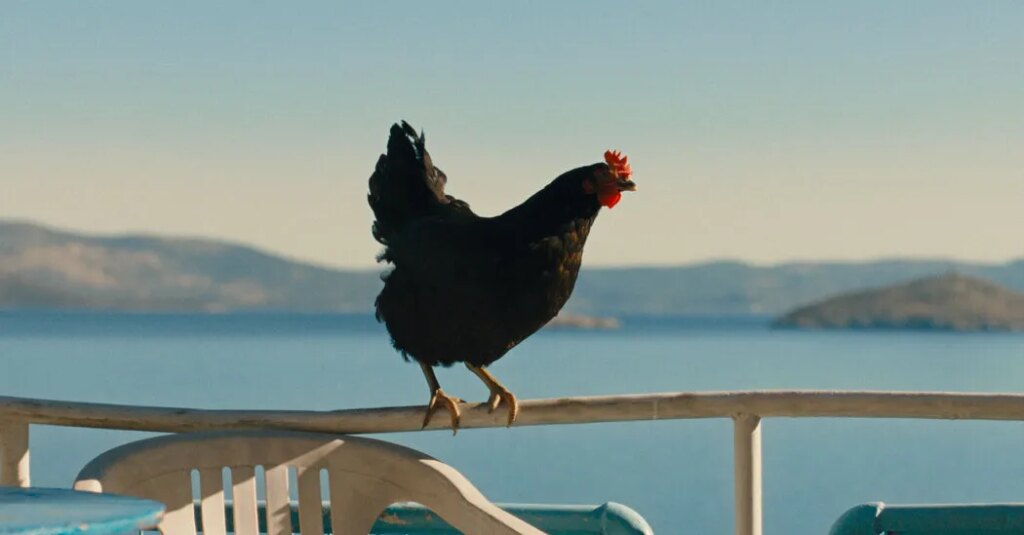
The opening shot of “Hen,” from the Hungarian filmmaker Gyorgi Palfi, is of an egg squeezing out of a chicken’s cloaca. The startling image sets the mood for this peculiar poultry character study, whose opening sequence culminates in the egg hatching to release a chirping black fuzzball — our heroine.
Over the next 96 minutes, the camera clings to the chicken’s perspective as she escapes the butcher’s knife, crosses traffic, flees predators and eventually ends up inside the pen of a kindly taverna owner. For a while, our protagonist reveals little emotional life beyond the will to survive. But once she starts laying eggs, a new desire awakens. She yearns to become a mother hen.
In recent years, films centering on farm animals have become a subgenre of their own: “Gunda” follows a pig; “EO” is about a donkey; and “Cow” is set at a dairy farm. Designed to build interspecies empathy, these films make a case for cinema as a metamorphosis machine. By watching, audiences walk a mile on their hooves.
Unlike those predecessors, “Hen” introduces a human drama: Nearby the chicken coop, a brutal criminal enterprise quietly operates. Observing this violence from the sidelines can feel uneasy, and as the gulf between the storylines widens, their division often diminishes the emotion of each.
“Hen” is still a worthy and even urgent film, and not only for its attention to an overlooked creature. In making the film, Palfi eschewed CGI and instead cast and trained eight indistinguishable hens to portray his heroine. If his ingenuity doesn’t fill you with hope for the future of cinema, I don’t know what would.
Hen Not rated. In Greek, English and Italian, with subtitles. Running time: 1 hour 36 minutes. In theaters.
The post ‘Hen’ Review: A Bird’s-Eye View appeared first on New York Times.