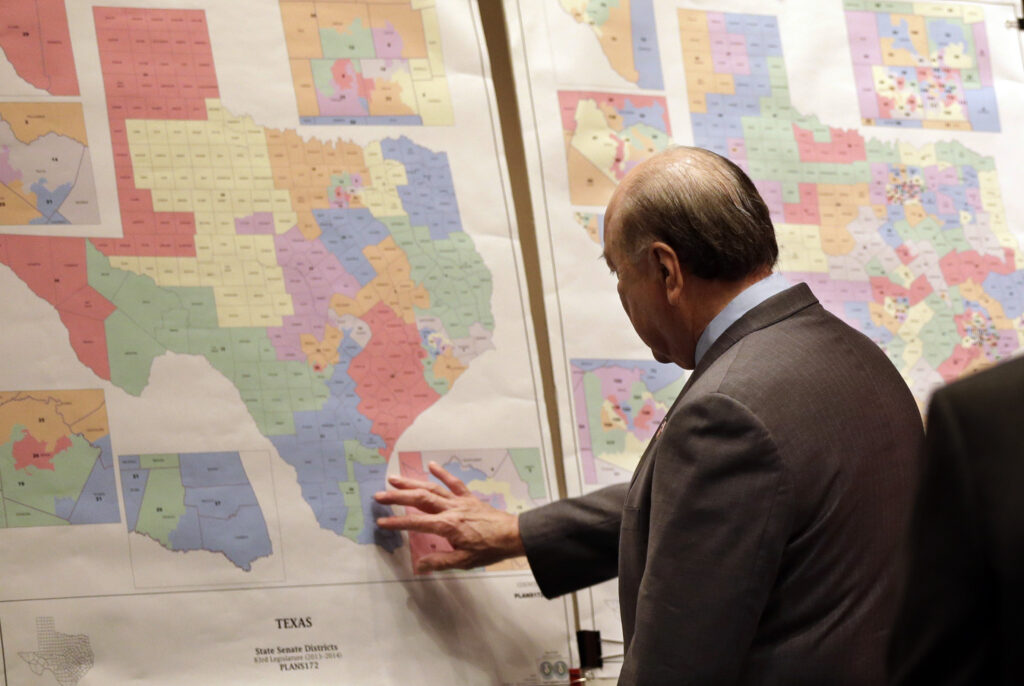
In the aftermath of their failure to flip House districts they redrew this year to favor themselves, Republicans mounted a defense of their controversial project, arguing that without it, their losses would have been even worse.
“Redistricting saved Republicans seats in Texas that otherwise would have been lost in this wave,” Adam Kincaid of the National Republican Redistricting Trust said in an interview. “We were building that Texas map for a scenario like 2018, but not a 1974.”
In a memo obtained by The Washington Post, Kincaid argued that Democrats’ retaliatory gerrymander in California backfired by packing more Republicans into two districts they would have lost under the previous map.
Separately, Florida Gov. Ron DeSantis (R) argued that his redistricting earlier this year saved two Republican seats that would not have survived under the old map, even as the GOP lost in all four districts the map was designed to flip.
Democrats dismissed the arguments as a contorted attempt to justify the expensive and controversial gerrymandering offensive that did not accomplish what it set out to do. Not only did all of their targeted incumbents survive, they were headed toward multiple surprise upsets in gerrymandered states including Ohio and North Carolina. A Democrat also beat Rep. Scott DesJarlais (R-Tennessee) in a district viewed as solidly red, offsetting a different seat that the GOP eliminated in the Memphis area.
“Republicans lost the redistricting wars they started, and their lame attempt to use Rube Goldberg logic to defend their failed strategy is somewhere between moronic and embarrassing,” Democratic Congressional Campaign Committee spokesperson Viet Shelton said. “Anyone who has taken a fifth-grade math class knows that Republican attempts to rig the midterms backfired.”
The dispute has immediate repercussions for what the parties do next. The White House pushed Texas and other states to redistrict not just in hopes of gaining an advantage in this year’s midterms. They also aimed to accustom lawmakers to redrawing maps every cycle so that Republicans would be prepared to take advantage of the Supreme Court’s decision weakening the Voting Rights Act’s protection for majority-Black districts in the South. The ruling opened the door for Republicans to eliminate more Democratic seats in Alabama, Florida, Louisiana and Tennessee.
Democrats are urging Republicans to abandon their gerrymandering ambitions. They also contended that the gerrymandering fueled the mobilization of Black voters, helping save Democratic Rep. Shomari Figures of Alabama. And with Tuesday’s state-level victories, they warned, they could redraw maps to eliminate Republicans in states including Maryland, Wisconsin and Minnesota.
“Republicans might start this redistricting and gerrymandering battle. Democrats were going to finish it,” House Democratic Leader Hakeem Jeffries of New York said on Wednesday. “Last night, that’s exactly what happened.”
With gubernatorial victories in Georgia and Texas on Tuesday, Democrats also won the power to block further Republican gerrymanders in those states. Outgoing Georgia Gov. Brian Kemp (R) ruled out calling a special session to rush through new maps before Democrat Keisha Lance Bottoms succeeds him in January.
Within hours of Democrats gaining full control of Wisconsin’s legislature for the first time in 16 years, leaders were discussing drawing a new House map in their favor.
“We have gerrymandered maps, and they favor Republicans to a significant degree, and we know that other states will consider redistricting efforts in the months ahead that will further attempt to entrench Republican power,” said state Rep. Greta Neubauer, the leader of the Democrats in the State Assembly. “And so we will be considering a congressional redistricting effort in Wisconsin.”
For years, Democrats have held just two of Wisconsin’s eight House seats. They won four in Tuesday’s election, and they could shore those up with a new map to insulate themselves in future elections.
The Wisconsin Supreme Court, which is controlled by liberals, is separately considering legal challenges to the GOP-friendly map, giving Democrats another path to securing better districts for themselves.
Redistricting hawks in both parties worried that the 2026 results would sap the appetite for future battles. Some Republicans portrayed Kemp’s announcement as an olive branch. John Bisognano, president of the National Democratic Redistricting Committee, said his party would take the win if Republicans stand down, but he’s not counting on it.
“I would want to believe that Republicans would look at a mirror at large and say, ‘This was clearly insane … we shouldn’t do this again,’” he said. “I think it’s more likely that they end up with a significant loss in the House and they turn to gerrymandering in the South, specifically Black districts, to try and take seats back because that’s what they will feel is their only option to try and get back into the driver’s seat.”
Sen. Cory Booker (D-New Jersey) said the GOP redistricting contributed to a surge of Black turnout. He argued for Congress to ban partisan gerrymandering.
“This is not complicated to me,” he said. “We should have a nation that does not allow politicians to scheme and plot to slice and dice an electorate for their own advantage.”
Jack Herrera contributed to this report.
The post GOP’s defense of its gerrymandering: The rout could have been even worse appeared first on Washington Post.