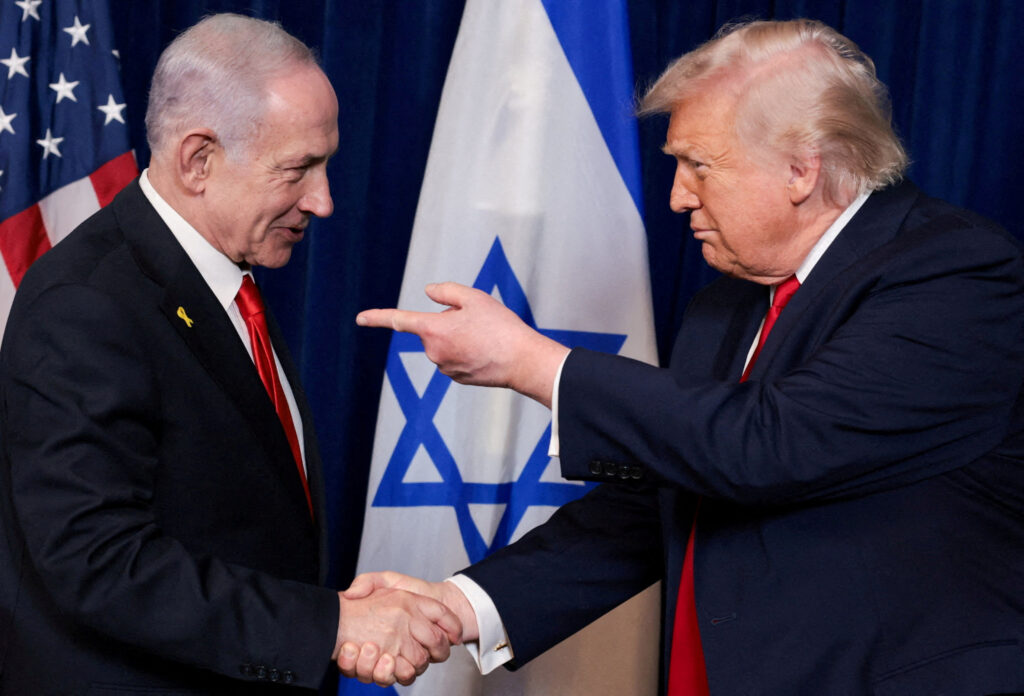
Democrats and Republicans might be deeply split after the midterms, but a growing number agree on one big idea: The era of unquestioned U.S. support for Israel needs to end.
It is the rare proposal that unites Vice President JD Vance and the leftist senator-elect from Michigan, Abdul El-Sayed. In both parties, some strategists note that voters have delivered two drubbings, in 2024 and 2026, to leaders — former vice president Kamala Harris and now President Donald Trump — who hewed too closely to Israeli Prime Minister Benjamin Netanyahu and his policies.
The growing sentiment for change comes at a moment of political transition on the U.S. and Israel, and presages a potentially dramatic change in the relationship between the two countries.
Vance on Wednesday offered criticism of Israel that was sharper than anything heard from a top Republican since at least 1991, before a three-decade stretch in which unblinking backing for Israel was all but a requirement for mainstream U.S. politicians of both parties.
Trump voters want Republicans to “change our relationship to Israel,” the vice president wrote on X Wednesday, in a long post in which he effectively broke with the president’s handling of the Iran war and Israel.
“Our voters showed up,” Vance wrote — but he said that “many of them voted for Democrats” because they wanted to end the Israeli-backed war with Iran and rethink ties to Israel.
The president’s son, Don Trump Jr., agreed.
“Every word of this is 100 100 100,” he wrote atop Vance’s post.
The president himself told reporters Wednesday that he thought Vance’s comments were “fine” and “good.” As voting got underway Tuesday, Trump made an unusual announcement, declaring in an interview with Fox News that he planned to halt $4 billion in military assistance for Israel by the end of the year, saying explicitly that he wanted to deprive El-Sayed of a talking point.
El-Sayed embraced Trump’s move.
Some of the other Democratic upset winners Tuesday night — including James Talarico of Texas and Troy Jackson in Maine — won Senate seats in part by condemning Netanyahu’s wars and promising to withhold arms sales to Israel.
Some in the pro-Trump camp have been quick to point fingers at his Israel policy as a reason for his flagging fortunes.
“The miscalculation on the Iran War led to total disaster. Predictable result of trusting neocons,” wrote pro-Trump podcaster Benny Johnson, atop an older post in which he asked “did Israel LIE to Trump to get the U.S. into the war with Iran? The White House is reportedly FURIOUS.”
The ingredients are in place for the biggest break with Israel since the era of President Dwight D. Eisenhower, said Aaron David Miller, who worked on U.S.-Israel diplomacy across multiple administrations and now is a senior fellow at the Carnegie Endowment for International Peace.
In 1956, Eisenhower forced Israel to withdraw from the Sinai Peninsula after it launched a surprise attack on Egypt without informing Washington.
Since then, “never has the U.S.-Israel relationship in its various components been under as much stress as it is now,” Miller said.
“You have fracturing within each party on the Israel issue,” he said, with a growing number of voices in each party advocating a break even if many still advocate a relatively friendly approach to the country.
For now, he said, even as the politics of the U.S.-Israel alliance have changed, the policy has not. The Trump administration still backs Israel inside the United Nations Security Council; it hasn’t enforced conditions on military aid that Congress has demanded; and it continues a robust policy of intelligence sharing — all indicators of whether an administration is willing to break from decades of close ties, Miller said.
“The question to me is this: When does all of the stress and all of the fracture actually lead to fundamental changes in the essence and substance of our relationship with Israel?” he said.
The U.S. midterm results have come at a potential moment of transition in Israeli politics, as well. Elections last week could lead to Netanyahu losing power just as Washington reevaluates its ties. Many of Netanyahu’s critics in Israel fault him for alienating the country’s most important ally.
One question facing Israelis is whether swapping out Netanyahu for a new prime minister can solve their problems. Netanyahu’s main opponent, Gadi Eisenkot, who appears on track to have the first shot at forming a ruling coalition, issued a carefully worded statement Wednesday that tried to create distance between the Israeli state and the long-serving prime minister.
“The bond between Israel and the United States is more than an alliance between governments. It is a partnership between peoples, built over generations,” Eisenkot posted on X. “I look forward to working closely and constructively with President Trump and his administration, whose friendship and commitment to Israel we deeply value.”
Shira Efron, who heads Israel policy at Rand, said Israel should be doubly concerned: After Harris’s loss in 2024, some Democrats blamed frustration over President Joe Biden’s refusal to restrain Netanyahu during the Gaza war for turning off a key segment of their voters. Now, Republicans are blaming the Israeli premier for another war, this time in Iran, as a key factor that scuttled their midterm prospects, she said.
“In these two elections, both parties took a hit for reasons partly to do with Israel and its perceived role,” Efron said.
“Netanyahu and the policies of this government have become toxic” across the political spectrum in the United States, she added.
As they digested the U.S. midterm results Wednesday, Israeli political leaders immediately blamed Netanyahu for turning Israel into a political albatross in the eyes of its American partners. The results even began to shape discussions around the formation of the next Israeli government.
After last week’s Israeli elections ended with neither Netanyahu nor Eisenkot amassing enough parliamentary seats to form a government outright, many in Israel mulled the possibility of the two blocs merging to rule as a unity government, a prospect that Netanyahu favors. The tone is now changing.
“I swear, I wanted unity, and I even believed it was possible,” Asaf Zamir, a former Israeli minister of tourism and consul general to New York said on X. “But the last 24 hours make it clear that Netanyahu must be removed from power and a national emergency government must be established. Now.”
Yair Golan, a member of the opposition bloc led by Eisenkot, warned on X that Netanyahu remaining in power “could lead Israel down a path of international sanctions, international isolation, and a clash with the U.S., our friend and most important ally.”
Yaakov Katz, a fellow at the Jewish People Policy Institute, a think tank in Jerusalem, said the midterms showed that Israel’s image had plummeted. But simply swapping out Netanyahu as its face would not repair it, he said.
“There are a lot of serious issues for Israel: the perception that it was Israel that dragged the United States into this Iran war, more talk of another round of war, a lack of enforcement on settler violence, greater settlement expansion — even with a different prime minister, it’s not going to change anything without a substantive change in policy,” Katz said.
The post Rare bipartisan idea gains ground: U.S.-Israel tie needs a break appeared first on Washington Post.