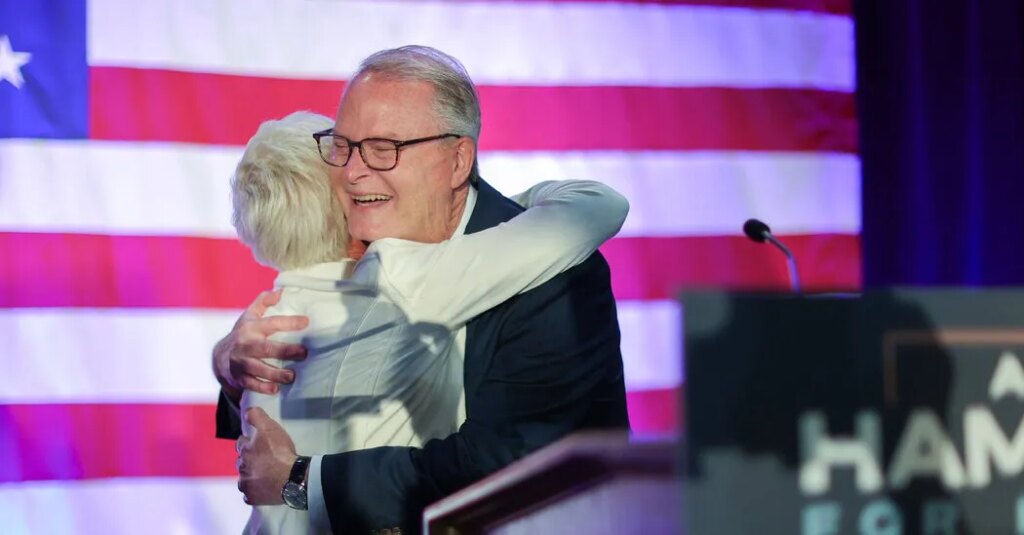
On an Election Day with historic Democratic victories across several conservative states, one of the most momentous happened in Kansas, where Adam Hamilton became the first Democrat to win a U.S. Senate election in nearly a century.
But Kansas Democrats have been slowly rising from political oblivion for years, laying the groundwork for Tuesday, when a strong candidate, a beatable incumbent and an auspicious national environment converged.
Despite its ruby-red reputation, cemented in the 2004 book “What’s the Matter With Kansas?”, the state has a two-term Democratic governor, a Democratic congresswoman and an electorate that backed abortion rights in a statewide vote. In addition to Mr. Hamilton’s victory, Democrats held narrow leads on Wednesday in elections for governor and attorney general in races that have not been called.
“This wasn’t an overnight success or an overnight accident,” said Representative Sharice Davids, a Democrat who flipped a congressional seat in Kansas in 2018 and who won re-election on Tuesday by more than 20 percentage points. “This was the culmination of literally almost a full decade of us working hard.”
Entering this year, Kansas was at the center of the Senate map only in the geographic sense. Few expected Senator Roger Marshall, the Republican incumbent, to lose his seat.
But Mr. Hamilton, a moderate Democrat, changed the political landscape when he entered the race. He had strong name recognition in the Kansas City suburbs, where the United Methodist congregation that he started has grown into a megachurch. And he proved to be a skilled messenger and fund-raiser on the campaign trail.
Mr. Marshall, a doctor and first-term senator who aligned himself closely with President Trump, was the ideal opponent. He faced scrutiny for his frequent trips to Florida. And he struggled to respond to criticism after The New York Times reported that, as a doctor, he often sued his patients over medical debts, leading to dozens of them being arrested.
“You’re not always going to have the perfect environment, the perfect candidate, a weak opponent — all of the things align for you,” said Ashley All, a longtime Democratic strategist in Kansas. “But if you do the work and you prepare, and you invest in building those relationships with different voters and building back trust, then you have a chance.”
Kansas Republicans were still assessing their losses on Wednesday.
In addition to statewide races still in play, Democrats flipped several seats in the Kansas House of Representatives. Some heavily Hispanic counties with large meatpacking plants accounted for the largest shifts away from Republicans after a recent immigration enforcement campaign in those areas alarmed even some of the president’s usual allies.
But many of the same economic themes that resounded across the country, as Democrats won races in several bright-red states, were also driving the conversation in Kansas.
“National issues played a bigger part in Kansas politics in the outcome than ever before,” said Gov. Laura Kelly, a Democrat barred by term limits from running again.
State Senator Mike Thompson, a Republican from the Kansas City suburbs, said voters were “sending messages to us that we want this economy straightened up, and I think that’s lesson learned.” High diesel prices and tariffs were areas of voter concern, he said.
State Representative Pat Proctor, a Republican, said that he thought “Kansas just got caught in the national winds.”
He said the effort “to turn out very, very angry and disgruntled Democrats and left-leaning independents was just so overwhelming that it shifted the entire electorate.”
Not all was lost for Republicans. Mr. Proctor, his party’s nominee for secretary of state, was leading in a narrow race on Wednesday. Republicans will also retain a supermajority in the Kansas Senate, where most seats were not up for election.
Still, Kansas Republicans are not used to losing in such spectacular fashion.
No Democratic presidential candidate has carried the state since Lyndon B. Johnson in the 1960s. And while past U.S. Senate races — including in 2014 and 2020 — had generated hopes of breaking Republicans’ 94-year winning streak in that chamber, liberals ended up disappointed.
The seeds of Tuesday’s results were planted in Kansas in 2018, during the first Trump midterm, when Ms. Kelly flipped the governorship and Ms. Davids flipped her House seat. Both candidates benefited from stronger-than-usual performances in Johnson County, just outside Kansas City, a former Republican stronghold that has since become the engine of Democrats’ statewide relevance.
Mr. Hamilton and State Senator Cindy Holscher, the Democratic nominee for governor, are both from Johnson County, the state’s most populous county, and both were leading there by more than 20 percentage points.
“We have built an infrastructure in Johnson County,” said State Representative Mari-Lynn Poskin, a Democrat who flipped a legislative seat in the county in 2020 and described years of work to staff a party office, fill precinct-level roles and step up door-knocking efforts. It was not that many years ago, she and the governor said, that there was not even a permanent Democratic Party office there.
Ms. Kelly, who expressed confidence that the close races for governor and attorney general would ultimately be called for Democrats, said she was “on cloud nine” on Wednesday. She said having Mr. Hamilton in Washington will give Kansans a senator who will “stand for them and their real values.”
Like other Democratic officials, she expressed hope that Tuesday was not a fleeting high-water mark for her party, but rather a sign of a durable political shift — a counterpoint to anyone who had written her state off as permanently Republican.
“You know the book, ‘What’s the Matter With Kansas?’” Governor Kelly said on Wednesday. “We rewrote it.”
The post How Kansas Democrats Laid the Groundwork for a Historic Senate Upset appeared first on New York Times.