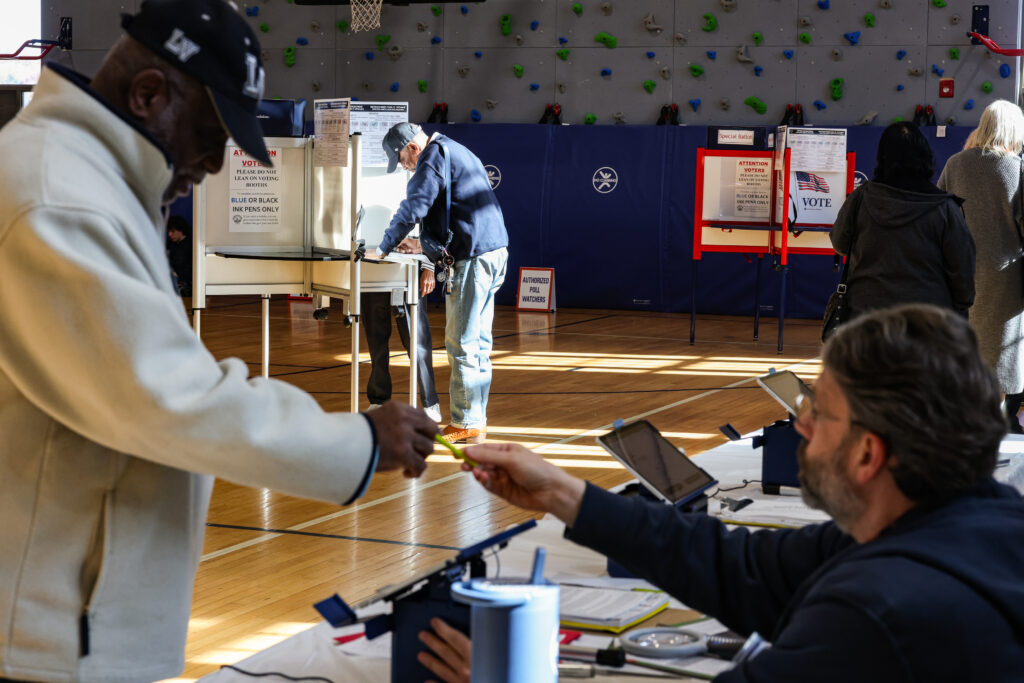
The wave of Democratic victories in Tuesday’s elections were fueled by broad frustration with the economy and the direction of the country, according to a survey of more than 90,000 midterm voters by the research firm NORC in partnership with The Washington Post and other sponsors. The survey found Democrats made significant gains across a wide range of demographic groups since 2024, including Hispanic voters and young voters. And President Donald Trump’s high disapproval ratings — including in many states he won comfortably in 2024 — helped Democrats flip several key Senate seats on their way to taking control of the chamber.
Below are 10 key findings from the poll:
1. Trump’s unpopularity drags down GOP House, Senate candidates
Trump’s approval rating, which in pre-election polls was at a low point, proved to be a major factor in Tuesday’s results, acting as a drag on Republican House and Senate candidates across the country.
The poll of voters found his approval at 39 percent positive and 61 percent negative, with 50 percent saying they strongly disapproved. While slightly higher than in some pre-election polls, it was lower than his 44 percent standing in 2018, when Democrats made major gains, and lower than Biden’s 42 percent rating four years ago. Most of the competitive House races were in Republican areas; Trump’s approval rating was almost identical in those battlegrounds as in the nation as a whole.
Voters who approved of his job performance overwhelmingly chose Republicans, as did a small majority of those who said they somewhat disapproved of the job he’s done. Among the near majority who said they strongly disapproved of his handling of the presidency, more than 9 in 10 backed Democrats for the House. Trump’s approval rating was net negative even in red states he had won handily two years ago but which elected Democrats to the Senate on Tuesday.
2. Democrats flip the script, reverse the GOP’s advantage on the economy
The economy was the dominant issue for voters — and that proved to be a major asset for Democrats in the midterms. More than half of voters cited the economy and jobs among the top three issues facing the country, more than those who named health care, the war in Iran or immigration. Among those who cited the economy and jobs, Democrats had a 15-point advantage. Democrats held a much wider lead on health care — over 30 points — which ranked second among 12 issues included in the NORC voter survey. And among the more than one-third of voters who cited the war in Iran as a top national issue, over 6 in 10 backed Democrats in the House, compared with about a third who supported Republicans.
Republicans were widely favored by voters who were focused on immigration and crime, two traditional GOP strengths, but fewer voters prioritized those issues than the economy or health care. Underscoring how much ground the Republicans have lost on the economy, voters who cited the economy and jobs as a top national issue two years ago favored Trump over former vice president Kamala Harris by more than 20 points.
Democrats will be under pressure to address voters’ concerns about affordability when they take control of Congress next year. Nearly 3 in 10 want action on grocery prices, while nearly as many expressed concern about the cost of health care and gasoline.
3. Financially squeezed voters turn to Democrats
Americans’ sour views of the nation’s economy — and their own financial struggles — had a major impact on midterm voting. Nearly three times as many voters rated the economy as somewhat or very poor as those who said it was in good shape. Those unhappy with the state of the economy — about 6 in 10 of all voters — supported House Democratic candidates by more than 2 to 1. Republicans were overwhelmingly favored by voters who feel good about the economy, but that comprised only about 2 in 10 of them.
The pattern is similar in voters’ assessments of their own financial situations. Most voters said their family’s finances are holding steady, while about 3 in 10 said they are falling behind; only about 1 in 10 feel like they actually are getting ahead. Republicans dominated among that small group who say they are moving ahead.
Voters who reported that they are struggling financially favored Democratic candidates by more about 30 points.
This is a striking change from the 2024 presidential election, when voters who felt that way supported Trump over Harris by 30 points.
4. Political independents shift blue
Not surprisingly, Republicans and Democrats overwhelmingly favored their party’s candidates in the midterms. But the roughly one-in-five voters who do not identify with either party favored Democratic candidates by more than 20 points, a much larger margin than those who favored Harris over Trump.
Independents were also key to Democratic Senate victories, particularly in states Trump won by hefty margins in 2024. In Kansas, nearly 7 in 10 independents supported Democrat Adam Hamilton, while Texas Democrat James Talarico won nearly two-thirds of independent voters.
5. Democrats make modest inroads among Trump voters, win nonvoters from 2024
As noted, party loyalty remained a powerful force in the midterms. Still, slightly more Harris voters backed Democratic candidates Tuesday compared with Trump voters who voted for GOP candidates. In four states where Democrats flipped Senate seats — Iowa, Kansas, North Carolina and Texas — about 1 in 10 Trump voters supported the Democratic candidate for Senate. Those who did not vote in the presidential election — about 15 percent of this year’s voters — favored Democratic candidates by roughly 20 points.
6. Hispanic and White voters swing to Democrats
Democrats won more than 6 in 10 Hispanic votes in the House election nationwide, reversing gains Trump had made in 2024. The Democratic advantage was similar to their win among Hispanics in the 2018 midterm race during Trump’s first term.
A more surprising change may be the Republican weakening among the much larger White voter group. Whites split nearly evenly between the parties, a shift from Republicans’ 10-point advantage from two years ago and smaller than prior midterms. The decline was in both White men and women. White men voted 52 percent to 45 percent for Republicans. White women gave Democrats a narrow win, removing a 10-point advantage Republicans previously won.
Black voters maintained their historically strong Democratic support, voting 83 percent to 13 percent for the party, a small increase from two years ago but not as large as Democratic margins from 2018.
7. Young voters swung furthest to Democrats but the party even won senior voters
Younger voters who had swung toward Trump two years ago moved strongly back to Democrats in the House election, by more than 20 percentage points. The strongest support was among the youngest voters aged 18 to 24, who voted about 2 to 1 for Democrats. The party won a slightly smaller share of voters aged 25 to 29, taking about 60 percent. Voters in their 30s favored Democrats by 57 percent to 38 percent. Voters in their 40s split evenly two years ago, but voted 53 percent to 43 percent in Democratic favor this year. Voters aged 65 and older gave Trump a four-point win two years ago but swung to favor Democrats by six points this year.
8. Democrats draw even with working class voters
Democrats wiped out Republican advantages among voters without college degrees, narrowly winning the group by roughly 49 percent to 47 percent, according to the preliminary poll results. Trump won that group by more than a dozen percentage points two years ago, but they narrowly favored Democrats this year. Republicans still won White voters without degrees 55 percent to 42 percent, but that win was less than half the size of Trump’s victory with that group in 2024.
9. Democrats won male voters
The biggest gain for Democrats was among men, who have long favored Republicans. Men favored Trump by 55 percent to 43 percent two years ago, but they voted slightly in favor of Democrats this year, 50 percent to 47 percent. Meanwhile, women voted 56 percent to 41 percent for Democrats, increasing their Democratic backing by four percentage points.
10. Voters in a grim mood, support sweeping changes
Voters’ frustrations went far beyond their deep unhappiness with the economy. More than 6 in 10 voters are dissatisfied with the way things are going in the country and slightly more than half say America’s best days are behind it. This has fueled a powerful desire for sweeping change. Only about 1 in 5 voters signaled acceptance with the status quo: About half want “substantial” change,” while more than a quarter said the country needs a “complete and total upheaval.”
Voters who demand change generally supported Democrats. For example, among those who want a total upheaval, voters backed Democrats over Republicans by a whopping 56 points.
These are preliminary results from the NORC Civic Health & Elections Project survey sponsored by The Washington Post and other partners. Results are based on interviews of more than 90,000 U.S. registered voters sampled from three different sources: state-level files of registered voters from Catalist LLC, NORC’s probability-based AmeriSpeak panel and six opt-in online panels. The survey was conducted online and by phone, with voters invited to participate by postcard, live-caller phone, text message or email. Results shown are based on early voters and those identified as likely voters and have been weighted to match the latest estimates of national and state vote tallies. Additional details about the survey methods are available from NORC’s website.
The post Ten key factors behind Americans’ midterm votes appeared first on Washington Post.