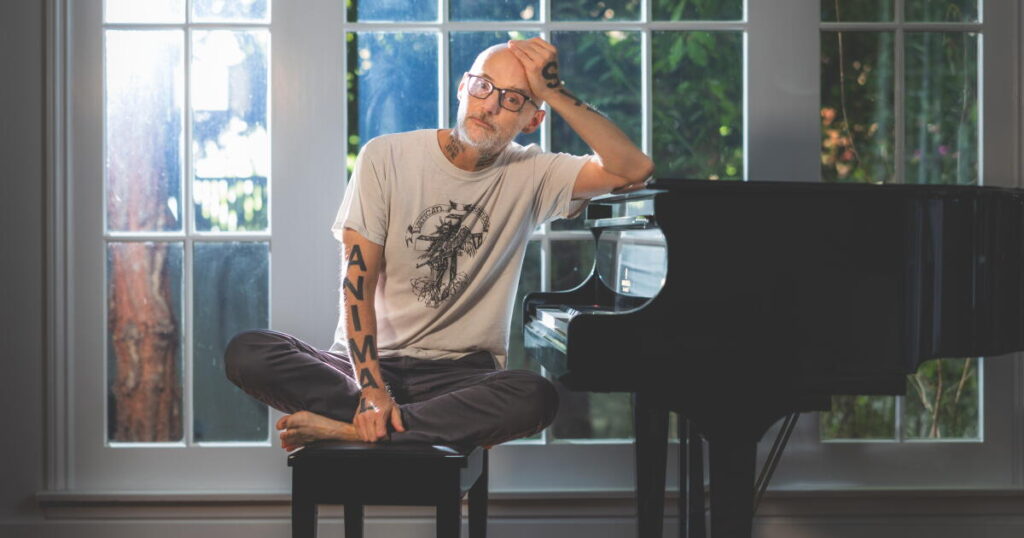
Moby is headlining a large-scale show, joined by Underworld, Fcukers, Nia Archives (DJ set) and DJ Holographic, at Brookside at the Rose Bowl on Saturday.
For Moby, who will also play in San Francisco two nights earlier, being able to headline a venue and show of this scale solidifies the fact that, following his very memorable Coachella 2026 set, highlighted by “Natural Blues,” with vocals from Jacob Lusk, he is, once again, on the upward side of fame.
However, as he talked with The Times, now older and sober, he is so much better equipped to handle fame and all its trappings. As always, a conversation with Moby is a fascinating journey, from lessons on fame to tales of hanging with David Bowie and Lou Reed.
We did a Times interview for Area One in 2001, and this particular show brings me back to those tours.
Oh yeah, very much so the eclecticism. Also, I realized roughly around that time was the first time I ever played with Underworld. It was at the very first Coachella in ’99, so I guess for better or worse, everything is full circle.
Do you feel like being older you’re in a place now where you can appreciate the magic of these moments more?
It’s a sort of hopefully expanded version of that. One, you can appreciate it more, but also the public figure stuff becomes less of a pillar. Meaning when I was in my late 30s or I was enjoying the success of the album “Play,” a lot of my self-worth and self-perception had to do with the opinions of strangers. It was basically public figure style accolades. And now it’s nice, I guess, if people respond well to what I do, but that’s not the foundation of my life. Back then, public figure stuff was the rule. And now it’s the minor exception. For example, last spring, I played at Coachella and it became this crazy viral moment, which was fun. It was nice. But basically, my daily life is going to Gelson’s, going hiking, cleaning my house and being very happy with that. So, when the public figure stuff happens, it’s pleasant, but it’s a very minor part of self-perception.
Do you think that’s just because you’ve experienced it and you’re also just older and wiser?
As I’ve gotten older, especially in sobriety, I think you and I have spoken about this, but to me, the cornerstone of sobriety, and we’ll call it some degree of spiritual well-being, is the willingness to look at actual evidence and not engage in dangerous magical thinking. Before I got sober, I thought I could have 20 drinks a night and do cocaine every day and somehow be a responsible, healthy person. And all the evidence clearly said, “No, you cannot be a healthy person doing drugs and drinking 20 drinks a night.” Those two things are inconsistent. And fame is interesting because a lot of people, especially when you’re chasing the dragon of fame, are unwilling to look at the evidence of like, “Does it improve people’s character? Does it improve their moral fiber? Does it make them humbler? Does it make them of service? Does it make them smarter? Does it make them more interesting?” And the answer is usually no. We get older, we age, we become less relevant in that sort of public figure capacity, or at least in a youth and beauty fame. Accepting it seems healthier, more sustainable than trying to rail against it. Cause if you rail against it, suddenly you become a plastic surgery disaster, trying desperately to hold on to relevance as you hit your 50s and 60s or 70s.
What have been some of your favorite moments that fame has afforded you?
One time, David Bowie and I sat in my living room, just the two of us, and drank coffee and played “Heroes” on acoustic guitar. So as far as top of the list goes, that’s a pretty phenomenal one. I got to play “Walk on the Wild Side” with Lou Reed. I played “Me and Bobby McGee” with Kris Kristofferson. I got to spend time in David Lynch’s art studio, and we jammed together on weird instruments. It’s overwhelming these experiences, almost to the point where it makes me wonder, did they really happen or not? Like, is it actually more likely that I’m currently out of my mind on mescaline in the desert in 1986 and none of this has happened?
Being around these people you idolized, what lessons stand out to you the most?
One of the oddest parts of public figure status is becoming friends with your childhood heroes. At least that’s been the case for me, becoming friends with David Bowie, becoming friends with Lou Reed, friends with David Lynch. I think the main lesson I learned, especially from David Bowie and David Lynch, is to be sustained by the love and enthusiasm for what you’re doing. David Bowie and David Lynch both had their insecurities. They had their anxieties. But I know from spending time with them, every day they woke up excited to make something. And even till the end of their lives, they brought this childlike enthusiasm to everything they were doing. And cultivating that “ars longa, vita brevis” approach of focus on the art, focus on the joy, the mystery and the joy and the fascination that you have for the creative process and for making art, music, writing. If you can then do that and also somehow have the goal to, through your work, try to make the world a better place, to try and be of service. To me, that seems like a much healthier approach towards existing in this fame-driven world than self-involvement and self-aggrandizement.
You were off touring for years. What changed your mind to do occasional shows?
I just finished doing a long tour of Europe and we played to 50,000 to 100,000 people a night, which is great. But again, reminding yourself you’re meeting the emotional needs of people in the audience who sometimes have saved up a lot of money for a ticket and really trying to put on stage what I would want to see if I was in the audience. You’re not playing new obscure songs that no one cares about; you want to give people a rich emotional experience. And because especially now, the world is in such a weird place. If you can create this utopian microcosm that gives people the ability to have some semblance of a transcendent emotional experience, at the very least, all I can do is try to facilitate that.
Do you see your shows as an escape?
One of my great shortcomings is I’m not good at writing political music, which I wish I was because I love Neil Young and Joe Strummer and Chuck D and Billie Holiday. There have been so many remarkable political songs. I don’t know how to write them. I wish I did. So instead, what I do is talk about politics endlessly in public and with my friends and make music that is more emotional rather than political. But certainly, I saw the James Hetfield quote recently about his band just wanting to entertain. I don’t think this is the right time for a band to just entertain. The world demands political engagement from all of us. And I will do everything I can in my power to move the needle away from the status quo as it currently is.
You are being joined by Underworld. And I would choose “Born Slippy” as greatest electronic song. How much joy does it bring you to bring this lineup to people?
I would say “I Feel Love” [Donna Summer] is the greatest electronic music song of all time but in any case, you cannot go wrong with that one either. Doing these live shows, it’s funny because the early days of the rave scene, I fell in love with that euphoric music and I didn’t think about it very much. But as time has passed, and especially, I don’t know if you saw it, but Frank Marshall made a documentary about the Bee Gees. And it includes the “Disco Sucks” riot in Comiskey Park. I watched it around the same time as I watched a documentary about Woodstock ’99. There’s an old religion called Manichaeism, which had this idea of basically light versus the dark. I started thinking of all these expressions of darkness, of malignant patriarchy, of violence, of even cynicism and bitterness and thinking about how, it’s a weird thing for a cisgendered white guy to say, but like how the divine feminine is the opposite of those things, like the strength of beauty, the strength of vulnerability, the strength of emotion and how this culture we live in of men, especially who are so shut down and so emotionally broken that they can’t be vulnerable. They can’t embrace beauty, they can’t experience that transcendence of both joy and despair, and music can do that and so my hope in the live show that I do is that somehow, I can help people to access that vulnerability and beauty.
The post Moby is ready for this round of fame appeared first on Los Angeles Times.