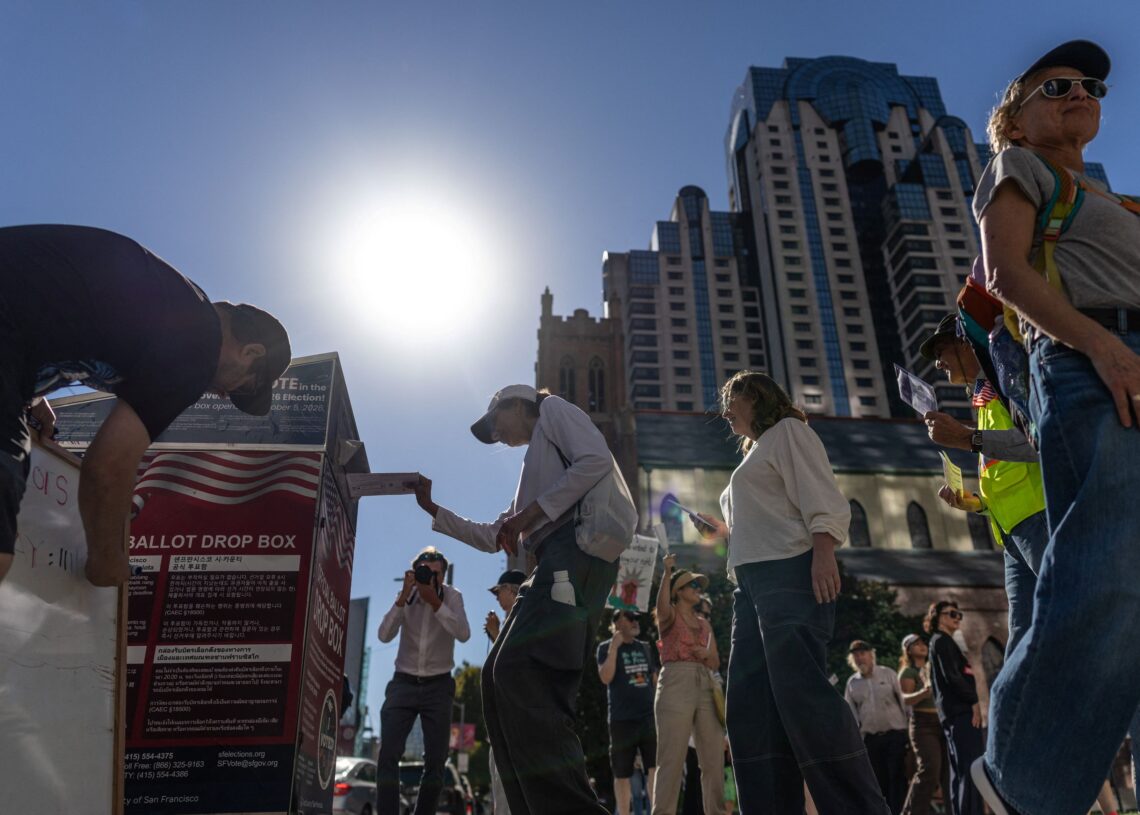
Election Day is finally here, and there will be no shortage of hard analysis as results pour in. But what is actually bringing voters to the polls? Five Post Opinions writers share which issues are motivating them to cast a ballot.
Government debt
The only thing that gets me excited about voting is saying no to bond issues. Fairfax County wants me to approve $180 million in debt for public parks and $75 million in debt for community health and human services facilities. I don’t know the specifics of what they want to spend it on, but the specifics don’t matter, and I’m voting no.
The fallacy of bond issues is that they are presented as an up-or-down vote on parks or health or schools or libraries. I like those things and want them to be nice in my community, just like everyone else. But bond issues are actually questions of how government should finance itself. Should government live within its means or not?
State and local governments face binding budget constraints because they can’t print money. That should force elected officials to make trade-offs. Bond issues short-circuit that deliberative process. They’re the same as raising taxes in the long run, as the government will require more revenue in the future to pay back the debt, plus interest. But bond issues allow politicians to avoid difficult fiscal decisions in the present and push the costs onto people in the future — when they’ll probably no longer be in office.
Is it really impossible for Fairfax County to cut spending somewhere else in its nearly $6 billion annual budget to fund its plans for parks and health services? I doubt it. But if cuts are impossible, officials should be honest and raise taxes to pay for these projects. If voters won’t go for that, then that’s the democratic signal that the projects aren’t worth pursuing right now. It’s cheating to ask today’s voters if they want to benefit from spending that tomorrow’s taxpayers will finance.
— Dominic Pino, editorial writer
The value of each vote
I vote because every ballot could be decisive.
In my adopted state of Virginia, control of the 100-member House of Delegates came down to a tied race in 2017. A random draw from a bowl awarded the seat, and the chamber, to Republicans.
In my home state of Minnesota, Al Franken won the 2008 Senate race after a recount by 312 votes out of nearly 3 million cast. That briefly gave Democrats a 60-seat supermajority.
Minnesota consistently ranks at or near the top for highest voter turnout in America. This reflects a Scandinavian culture that celebrates civic participation, as well as rules that make it easy to vote. My teachers in Apple Valley taught me that ballots, not bullets, settle ideological disagreements, and that citizenship comes with rights and responsibilities. Voting is both.
In this politically polarized era, so many contests come down to minuscule margins. In 2023, Damion Green ran for city council in Rainier, Washington. He didn’t vote for himself because, he said later, it didn’t feel right. He lost 247-246. Green’s opponent had voted for himself.
Since I will never run for office, I’ll never get to vote for someone I agree with on every issue. I might also never cast a deciding vote, but there’s no way of knowing beforehand. Most people hate politicians. I respect anyone willing to put themselves out there, and I sympathize with the candidates who lost by a single vote. That’s why I’m going to the polls on Tuesday.
— James Hohmann, deputy opinion editor
The Iran war disaster
I live and breathe foreign policy, and I live in D.C., where I get by without meaningful representation in Congress. Those two facts mean that I’m largely disengaged from midterm elections: On the thing I care about most, my vote counts the least.
Local politics do matter, of course. I’m not a fan of “socialist” governance — even if that doesn’t quite amount to Titoism in the American context — so I’ll vote accordingly. Apart from that, though, I’m watching the election-night pageantry with keen interest as to the people’s verdict on the last two years — and will probably overinterpret the result as comeuppance for President Donald Trump’s disastrous foreign policy.
Voters are rightly furious about high fuel costs. And while some old guard conservative commentators are pointing their fingers at Trump’s foolish tariff policy as the main source of voter dissatisfaction, it’s hard to imagine that the Iran war did anything but exacerbate a bad situation, not only by punishing voters at the pump but by driving prices up more broadly.
Even if people are unhappy with Trump’s “little excursion” for transactional reasons — affordability — they ought to be angry about more than that. It certainly feels like the American mastodon is finding itself trapped in the Middle East’s tar pits yet again. Moreover, unlike in the early 2000s, the United States seems to have shown the limits of its power. Interceptor stocks are low, and while the military appears to have been able to restore shipping through the Strait of Hormuz to some degree, it’s been doing so at an eye-watering cost.
What makes me most angry is that this was a war of choice that exposed those limits. It makes me think of the old saying: “Better to remain silent and be thought a fool than to speak and remove all doubt.”
— Damir Marusic, assignment editor
Protecting higher education
Higher education is essential to the prosperity of my home state, North Carolina, and I’m voting to protect it. As a recent graduate, I’ve seen how public higher education uplifted North Carolina students and, in turn, the entire state. Across the country, public universities have the potential to create productive and engaged democratic citizens. State legislatures, not federal officials, make that a reality.
Universities help attract billions of investment from businesses into local economies. But at many institutions, administrator ranks have ballooned and costs have risen. Fiscal responsibility is essential to keeping costs low and education accessible to all students, and that requires prudent decision-making by state legislatures.
But most of all, civic health is essential to a well-rounded education. North Carolina and Florida have opened new civic schools and curtailed divisive critical-theory-based course requirements. They are adding new classes that constructively teach about American institutions and the founding. That should help cool down the country’s highly polarized climate.
A healthy democracy needs healthy citizens, and that starts with universities. Higher education isn’t a topic that often appears on the campaign trail, but elected officials’ commitment to fiscal and civic responsibility will shape how the country’s universities are run.
— Ashley Dowdney, fellow
Hyperlocal politics
For D.C. voters, Election Day can feel anticlimactic. The mayoral race was decided in a contentious Democratic primary in June. Control of the U.S. House and Senate will be decided elsewhere. It would be understandable if races for nonvoting delegate or shadow senator didn’t motivate you to get up early and wait in line at a local library or gym.
But I’ll make my way to my polling location on Tuesday morning regardless. There are always reasons to cast a ballot, even if your vote won’t tip the balance of power on Capitol Hill.
If you’re a parent with children in the D.C. education system, there are contested races for seats on the D.C. State Board of Education. If you’re motivated by a hatred for (or a love of) foie gras, you won’t want to duck Initiative 86. There are also hyperlocal races for advisory neighborhood commissioners. The stakes might seem like small potatoes compared with control of the legislative branch, but Advisory Neighborhood Commissions hold sway over issues that matter to quality of life in neighborhoods, such as liquor licenses, zoning and trash collection. All politics should be more local, and participating in the ritual of democracy is a privilege to take seriously.
— James Desio, researcher
The post ‘Rightly furious’: Five writers reveal why they’re voting in this election appeared first on Washington Post.