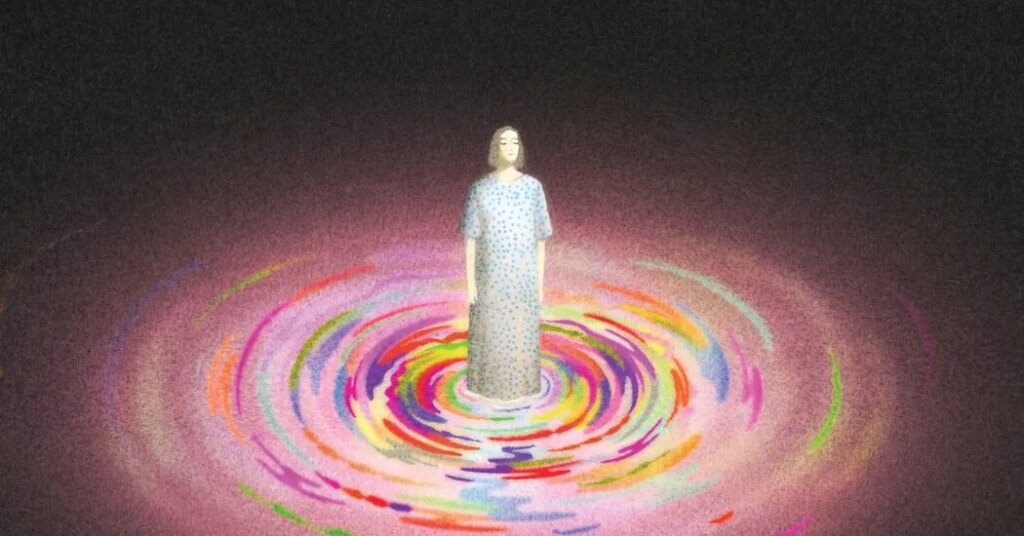
My patient sat bolt upright, her eyes wide. She looked terrified. The cancer had eaten through her bones, and she was dying. It was difficult to witness her suffering. I cannot imagine what it was like to be inside her body.
We gave her meds to calm her, meds so she would sleep, anything to bring her — and perhaps us — relief. Slowly, they kicked in. Her eyes closed. She appeared more peaceful. But I wondered whether we could have done something more for her than to blunt her consciousness.
A growing body of research suggests that psychedelics — psilocybin in particular — can ease the existential terror and despair that so often accompany dying. Psilocybin, the active compound in “magic” mushrooms, acts on the brain’s serotonin receptors to produce a few hours of altered perception and, in some people, profound shifts in how they understand themselves and their lives. Researchers believe the drug briefly makes the brain more flexible, making patients more receptive to the therapy that comes along with it. This summer, the Food and Drug Administration finalized its guidance on how psychedelic drugs should be studied, and in September it held a public hearing on how they might one day be delivered: who should be trained to give them, how patients should be screened and monitored, how they will be paid for. The F.D.A. could decide whether to approve psilocybin for treatment-resistant depression as soon as early next year.
But this research has not made its way to my patients — not into the I.C.U., and barely into the hospital at all. I don’t think that’s only because our sickest patients are too sick or unstable to safely take part, nor is it because research on psychedelics requires a hefty infrastructure that many hospitals don’t have. I think there is something else at play here. Medicine has developed many tools for suppressing suffering, but fewer for cultivating meaning or peace.
Since 2016, when researchers gave psilocybin to patients with life-threatening cancer as part of early landmark studies, a small but consistent body of trials has found that psilocybin gives patients something clinicians rarely get to offer: improvements in patients’ reported sense of meaning, spiritual well-being and ability to face what’s coming. The patients in these and other psychedelic studies receive therapy sessions before and after taking the drug and are accompanied by trained mental health facilitators who can provide support during a four- to six-hour “trip,” when the patients are experiencing altered consciousness. Scientists are still working out exactly how psilocybin works. One hypothesis is that it temporarily disrupts some of the brain networks that tend to reinforce habitual patterns of thought, potentially making those patterns less rigid.
Some medical researchers have cautioned that the early enthusiasm for these drugs may be getting ahead of the science. The hardest problem for testing their efficacy is that psychedelic trials are almost impossible to blind: If you’ve taken psilocybin, you know it. Patients who know they’ve received something they’ve read could change their lives may feel better partly for that reason, or because of the dedicated therapy that comes with it — regardless of the drug. There have also been accounts of harm, such as persistent anxiety following psychedelic experiences, especially when the drugs are used outside of research settings.
But for a dying patient, the outcome we’re after — less terror, more meaning — is subjective. If some of the benefit comes from the attention, the sense that someone is trying to help, those are important data. We owe these patients rigorous studies rather than hopeful anecdotes.
Psychedelic trials tend to enroll patients who are medically stable and can participate in hours of preparatory therapy, the supervised psychedelic trip and weeks of follow-up. But what about patients like mine, who spend weeks or months in the hospital, waiting for an improvement in their condition that may never come? As regulators and health officials begin to shape how these treatments will be delivered, they should consider whether and how they could be offered to hospitalized patients, too. A dying patient may be too ill to travel to a clinic — and too distressed to wait for a treatment model designed for someone else.
For now, what’s available to us in the hospital is ketamine, which is pharmacologically different than classic psychedelics but has similar properties; we can already use it for sedation and pain control. Unlike psilocybin, ketamine doesn’t require a guided, hourslong session to administer, and its effect is often fast. In one case report, a 78-year-old woman with advanced cancer who had lost her wish to keep living received a single ketamine infusion. Her desire to hasten death disappeared within days and stayed gone for nearly a week. One case doesn’t prove this drug would be effective for everyone, and the more rigorous trials of ketamine have had mixed results. But if there are other patients in the I.C.U. who might have a similar benefit, even a few days of relief may be worth studying.
Dr. Zachary Sager, a palliative care doctor and psychiatrist at Dana-Farber Cancer Institute, has used ketamine in the I.C.U. to try to provide this relief to patients, accompanied by therapy. For some patients — particularly those who were stuck in a cycle of fear and distress — he saw a benefit. “While this of course needs more research, some individuals experienced increased peace and comfort,” he told me.
Medicine is extraordinarily good at taking things away: pain, anxiety, appetite, consciousness. Those of us in the profession are less practiced at asking what we might give back, especially if the experience might be described as pleasurable or meaningful. I have long yearned for some way to offer my patients something more at the ends of their lives. I offer milkshakes, a favorite food, even alcohol — all the things we deprived them of when we were offering life-prolonging care. Most often, people say no. They are too sick. There is a part of me that is looking to the research on psychedelics in much the same fashion, as a way to offer something beyond what we have in these four walls. I cannot offer religion. I cannot offer a cure. I cannot make death not be death. But if there is some way that I can help people believe that there is more than this, that life is not just short and absurd, then maybe I can do that for myself, too.
Daniela J. Lamas, a contributing Opinion writer, is a pulmonary and critical care physician at Brigham and Women’s Hospital in Boston.
The Times is committed to publishing a diversity of letters to the editor. We’d like to hear what you think about this or any of our articles. Here are some tips. And here’s our email: [email protected].
Follow the New York Times Opinion section on Facebook, Instagram, TikTok, Bluesky, WhatsApp and Threads.
The post Could My Patients Benefit From Psychedelics? appeared first on New York Times.