BUENOS AIRES — Cristina Fernández de Kirchner, Argentina’s former president, opened the tall, arched doors and stepped onto the balcony.
The crowd below, fresh from a demonstration to protest education cuts by libertarian President Javier Milei, had stopped outside her apartment to chant her name.
“Cristina for president!” supporters shouted, undeterred by the fact that she is serving a six-year sentence house arrest for corruption and banned for life from holding public office. “Cristina for president!”
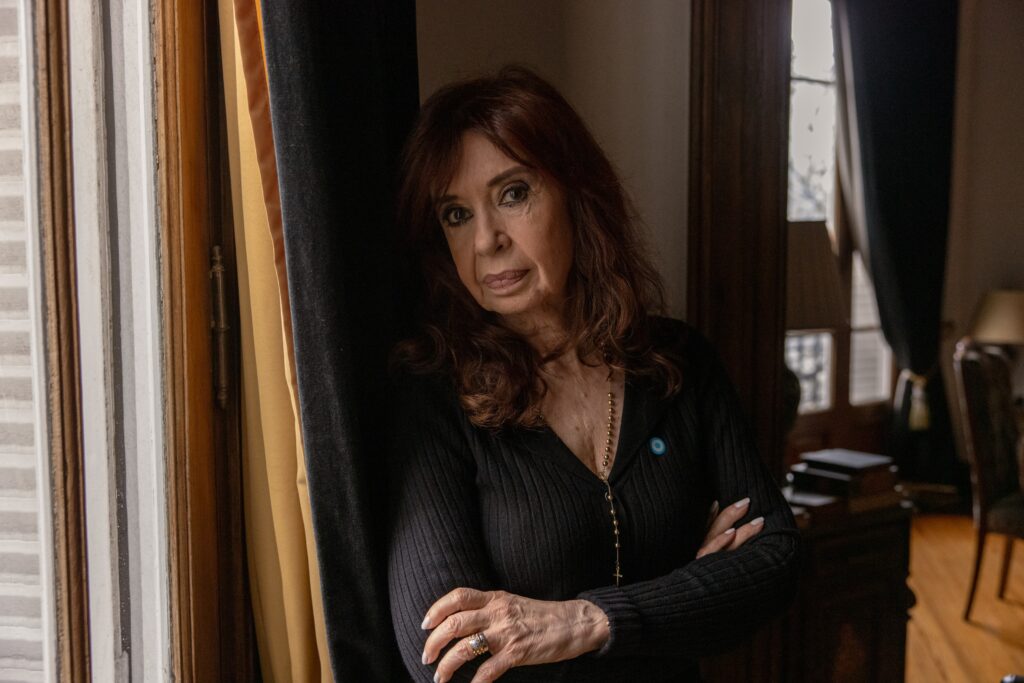
Kirchner, wearing jeans, a black top and a gold rosary, waved, said thank you, held a hand to her heart and blew kisses.
The encounter on a recent Thursday lasted just seconds. Argentina’s courts have left her little room for anything more.
She returned from the balcony, drew a deep breath, sank into a brown leather sofa and resumed an interview with The Washington Post, her first with an international outlet since her sentencing last year.
Kirchner has also has been barred from entering the United States, but she sees the possibilities of a comeback for herself and for the left-wing political movement that carried her to the presidency.
“History is not written in straight lines,” she said. “There are advances and setbacks. But the people always come back.”
The clearest example, she said, would be the losses she predicts for President Donald Trump and the Republicans Tuesday in the U.S. midterms.
“Paradoxically, the man who has done everything to help right-wing governments win in Latin America will lose the elections in his own country,” Kirchner said. She is hoping U.S. voters will launch a progressive wave.
Kirchner, a former member of congress, senator, first lady, vice president and president, is one of Argentina’s most polarizing figures, and she is not quite 18 months through her prison term.
But at 73, she remains an icon of Peronism, the populist movement that has shaped the country’s politics for generations.
She’s still president of Argentina’s left-wing Justicialist Party, founded 80 years ago by Juan Perón and his wife, Eva, and co-leader of the Homeland Front, the largest opposition bloc in the National Congress. Recent polling has shown her approval ratings to be slightly higher than Milei’s, though both are in the 30s.
Still, she was heartened by the young demonstrators outside her window. “Many of them are students,” she said.
For now, Kirchner’s world is limited to her 2,150-square-foot apartment. She has established a routine, eating healthy, exercising four to five times a week on a treadmill, a step platform and weights, and studying English and Chinese “to keep my neurons from aging.”
She spends her afternoons reading and following political developments around the world on television.
The hardest part, she said, is not being able to share her thoughts with friends and allies. She is allowed four hours of visits a week, spread across two days, with no more than three people at a time. She can use a cellphone, but she fears her communications are monitored.
Longtime friend Luiz Inácio Lula da Silva, who was reelected president of Brazil last week, visited her last year. Lula spent 580 days in prison on corruption charges before he was released in 2019 and his convictions were annulled.
“He told me, ‘Exercise, and don’t get depressed,’” she said. “But I don’t have the right to get depressed or torment myself in the face of others’ suffering. I know why I’m here: because of what I represent, the government we built and my refusal to submit to established powers.”
Kirchner, a lawyer, was first lady of Argentina when her husband, Néstor Kirchner, was president from 2003 to 2007. She then succeeded him as president from 2007 to 2015. (Néstor Kirchner died in 2010.)
Later, she served as vice president to the presidential candidate she chose, Alberto Fernández, from 2019 to 2023, when she was seen as too polarizing to head the ticket.
Amid an economic crisis, Fernández and Kirchner declined to run for reelection in 2023. That year, Milei, a close Trump ally, tapped into public anger at inflation, disillusionment with the political establishment and frustration with corruption.
Kirchner acknowledges that the Peronistas contributed to their own defeat. Under Fernández and Kirchner, annual inflation reached 211 percent, and the poverty rate climbed to 40 percent, eroding wages and leaving some workers unable to afford basic necessities.
“There was a breakdown in the culture of work,” she said. “People saw that those who worked eight-hour days, endured bosses and long commutes were earning the same or less than neighbors who received government benefits.”
Kirchner was convicted in 2022 in a public works contracting scheme in the province of Santa Cruz during her presidency that prosecutors said benefited a business ally. She was found not guilty of heading an organization that engineered bribes and overpricing tied to roadwork projects in Patagonia.
Kirchner denies wrongdoing and describes her prosecution as politically motivated.
“Tell me where I put the money,” she said. “Because honestly, if I had stolen it, I wouldn’t be in prison. I’d be free, because I would have been able to buy the Argentine judicial system, because they are corrupt.”
Kirchner and her lawyer, Rafael Valim, have asked the U.N. Human Rights Committee to review her case on the grounds she was denied due process and fundamental rights. That’s the path Lula took; Valim was an adviser in his case.
Kirchner and Valim say she was unfairly held responsible for the actions of her chief of staff and other ministers, and her defense was denied access to key evidence.
The priority, Valim said, is to restore Kirchner’s political rights and overturn her ban from public office.
The U.N. committee may rule on whether a defendant’s rights were violated. It doesn’t have the authority to overrule national courts. But as a signatory to the International Covenant on Civil and Political Rights, Argentina is obligated to uphold its standards.
“The decision must be submitted to the Argentine judiciary,” Valim said. “But given Argentina’s human rights tradition and the openness of its legal system to international human rights decisions, I see a much greater possibility of compliance, even in Cristina’s case, despite the fact that this is a system that wants to persecute her.”
Argentina has historically been committed to multilateralism and international law, said Flávia Piovesan, a former vice president of the Inter-American Commission on Human Rights. She said right-wing governments such as Milei’s often portray foreign oversight as interference, but said a favorable ruling could be potent.
“In the eyes of the international community, she will have been vindicated,” said Piovesan, a law professor at Pontifical Catholic University of São Paulo. “That creates a powerful narrative that could have an impact on the domestic political arena.”
That’s what Kirchner and Valim are counting on. “If Argentina fails to comply,” Valim said, “I foresee an irresistible social mobilization by the Argentine people.”
Kirchner sat at a red table in her dining room, surrounded by books and a large television that alternated among mostly international channels. She would consider running for president again in 2027, she said, when Milei is expected to seek reelection. The opposition has not rallied behind one candidate.
“When I recover my political rights, why not?” she said.
When Milei and other right-wing leaders around the world fail to deliver on their promises, she argues, the antiestablishment anger that has propelled them will turn against them.
Kirchner acknowledges that voters have lost faith in democracy and traditional politics. They have been willing to back leaders who promise to tear down existing systems.
“But now many Argentines are frustrated because their lives have not improved, their money doesn’t last until the end of the month, and they see a government that not only does nothing for the poor but actively attacks them.”
Argentina’s economic picture is mixed. Milei has succeeded in driving inflation down from the heights he inherited. But poverty rose this year as household incomes struggled to keep pace with the rising cost of living. Unemployment has also climbed.
Milei won praise from financial markets for slashing spending and lifting currency controls as part of his effort to overhaul Argentina’s long-troubled economy. But the social costs of his austerity drive are weighing on his political standing. His approval ratings have fallen to their lowest levels since he took office.
The challenge now for progressives, Kirchner said, is not simply to regain power, but to understand the anger that has driven voters toward leaders promising to upend the system and to offer a credible alternative. What’s needed, she said, are proposals people believe can actually be implemented, particularly to address everyday economic concerns and debt.
“Is it possible to rationally govern a society in which 50 percent think the other 50 percent must disappear?” she asked.
Her Chinese lessons, she said, have given her a new way to think about the question. In the West, she said, politics has long been shaped by the expectation that one side must defeat the other. In Chinese philosophy, the opposing forces of yin and yang coexist rather than seek to eliminate each other.
Outside, more sound rose from the sidewalk. “Here comes the drumming!” Kirchner smiled.
Among her supporters, one woman held a sign that read “Free Cristina!”
“It’s crowded today because of the protests,” said Christina Rivera, who stood among the demonstrators. “It’s not always like this. But I come every week, so up there she knows she’s not alone.”
The post Argentina’s Kirchner is betting on Trump’s defeat — and her own comeback appeared first on Washington Post.