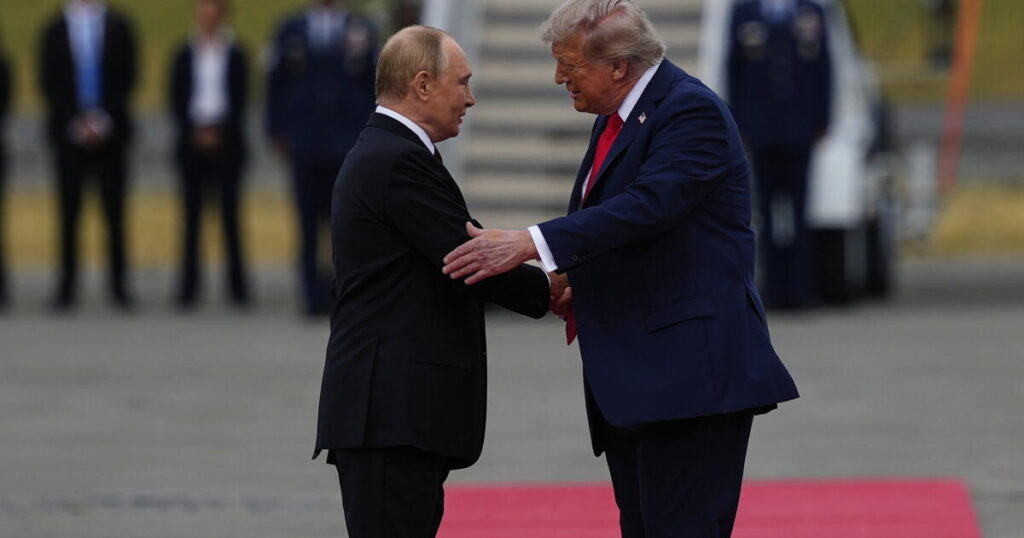
Sensitive, as he should be, to Americans’ resentment of higher prices on staples in the run-up to the midterm elections, President Trump on Oct. 9 unveiled what he called “a great announcement on Russian energy,” namely a deal to import nearly 5 million tons of Russian diesel fuel “within a short period of time.”
Consequently, he posted on his social media platform, diesel prices in the U.S. and across the world would be “COMING DOWN, IN RECORD NUMBERS, AND FAST!” (Capital letters in the original.)
How has that worked out? For anyone whose daily commute takes them past local gas stations with placards stating their prices, the answer will be no surprise. The week before his announcement, the average diesel price in the U.S. was $6.20 per gallon. At the beginning of last week, the average was $6.35.
No one disputes that higher diesel prices are a drag on the economy. Diesel is a crucial input to manufacturing, agriculture and transportation, though its direct impact on consumers is obscure compared with the effect of auto fuel. “Cars run on gas, the economy runs on diesel,” Mark Zandi, the chief economist at Moody’s, told CNBC early in October, citing a familiar energy business chestnut.
Nor is there much doubt about what has caused the spike in diesel prices. Trump has blamed Ukraine, which has wreaked havoc on Russian refineries since the Russian incursion into Ukraine. But the spike really dates from the start of Trump’s Iran war, which has strangled crude shipments through the Middle Eastern Strait of Hormuz.
Since just prior to the Feb. 28 launch of the war and through Oct. 26, average diesel prices have risen by nearly 67%, according to the U.S. Energy Information Administration. That handily outstrips the rise in regular gas prices, which are higher by about 41% over the same period.
So it’s perhaps unsurprising that the sharp rise in diesel prices caught Trump’s attention. His prescription, however, was fated to fall wide of the mark.
Trump’s focus on diesel is part and parcel of his bizarre obsession with the energy market in almost all its forms. This has been manifested in his efforts to revive the moribund coal mining industry — “We’re ending Joe Biden’s war on beautiful, clean coal,” he declared April 8.
Also in his “completely weird war on wind power,” to quote energy expert Steven Cohen of Columbia University, who pointed out that most wind power is generated today in red states such as Texas, Oklahoma, Iowa and Kansas.
Then there’s his mysterious deal for Venezuelan oil, which appears to have been crafted to shield the details from public scrutiny.
What all these adventures have in common is that the White House has promoted them as means to bring energy prices down — and that none of them has had that effect. The coal industry is not coming back from its inexorable slide toward irrelevance, not to mention its catastrophic effect on the environment.
Then there’s Trump’s payment of more than $2 billion in taxpayer funds to kill commercial wind power projects, many of which were already under construction; his hostility is largely based on myths, such as the assertion that it’s a particularly expensive source of energy (in fact it’s cheaper than natural gas, coal and nuclear generation), and that wind turbines are responsible for mass killings of whales and birds (there’s no known link to whale deaths, and turbine threats to birds are manageable through design).
As for the Venezuela deal, that country’s oil industry is in such a shambles that bringing it back to its peak output will take years and billions of investment dollars.
Energy experts have been nearly unanimous in casting doubt on Trump’s assertion that his deal for Russian diesel will have an appreciable, or even a noticeable, effect on U.S. diesel prices. Basic mathematics validate their skepticism.
As Portland, Ore.-based energy consultant Robert McCullough observed in a recent note, “4.8 million tonnes of diesel sounds large and would impress a naive audience.” (A tonne, or metric ton, is 2,204.6 conventional pounds, or about 10% larger than conventional tons, which are 2,000 pounds.)
The world market for diesel is about 1.4 billion tonnes a year, meaning that the Russian deal would cover about 30 hours of global consumption. The U.S. itself consumes about 2.94 million barrels of diesel a day, so the entirety of the Russian deal would provide the U.S. with perhaps 12 days of diesel supply.
In any case, the U.S. is the world’s net exporter of diesel, sending an average of about 200,000 metric tons of diesel abroad every day. “Thus, the concept of shipping diesel to the U.S. recalls the old phrase ‘carrying coals to Newcastle,’” McCullough wrote.
According to Trump’s description of the deal, Russia would provide more than 300,000 tons of diesel immediately, another 500,000 tons through the end of November, an additional million tons “immediately thereafter” and a further 3 million tons “within a short period of time.” Other than the projected deliveries through November the timing of deliveries is murky.
But Trump has suspended U.S. sanctions on Russian diesel deliveries until early April 2027, which appears to be the endpoint of the deal. According to an estimate by Goldman Sachs, the first shipments of Russian diesel might pare diesel prices in the U.S. by no more than two to five cents per gallon at the pump. That would be barely noticeable by customers who have seen diesel prices rise by more than $2.65 per gallon over the last year.
Some experts have questioned whether Russia can meet the schedule for diesel deliveries, in part because of the complexities of transporting the oil within Russia to its ports and thence to its destination. Another factor is the degradation of Russia’s refinery infrastructure, which has sustained considerable damage from Ukrainian attacks.
What’s evident is that the person laughing all the way to the bank in this transaction is Vladimir Putin, though his glee could be muted. The diesel sales and lifting of sanctions could provide Russia with tens of millions of dollars per month, estimates Sergey Vakulenko of the Carnegie Russia Eurasia Center, who calls it “small fry for Russia.” But it could relieve some of the stress on the Russian economy from its Ukraine invasion and international sanctions.
The deal also represents a wedge into what formerly was a unified wall of anti-Russian sanctions consisting of the U.S. and European Union. In effect, it abrogates the Lindsey O. Graham Sanctioning Russia and Iran Act of 2026, which Trump signed into law on Sept. 18 and was to go into effect just as Trump waived its provisions.
“The diesel deal was a major shock for the Ukrainians, for European governments, for members of Congress who thought they were slowly moving Trump toward new sanctions on Russia,” Stephen Sestanovich, a senior fellow for Russian and Eurasian studies at the Council on Foreign Relations, said recently. “It showed the U.S. was willing to start dismantling sanctions unilaterally, even when doing so violated its own laws.”
Trump’s lifting of the Russian sanctions appears to have violated other laws governing a ban on Russian oil deliveries, which has been in place since 2022. Lifting the ban requires that the U.S. certify that a ceasefire is in place between Russia and Ukraine and that Russia has withdrawn its troops from Ukrainian territory, according to Mary Kate Godfrey of the CFR. Neither has happened.
The diesel deal also has elicited a bipartisan backlash in Congress. The deal “only provides Putin with more fuel to finance his war machine and enables Russia to continue its brutal attacks on Ukrainian civilians,” six Republican and six Democratic senators wrote to Trump on Oct. 13. “This deal is a gift to our adversary and a betrayal of our Allies; it should be rescinded.”
The post Trump’s diesel deal with Putin benefits no one except Putin appeared first on Los Angeles Times.