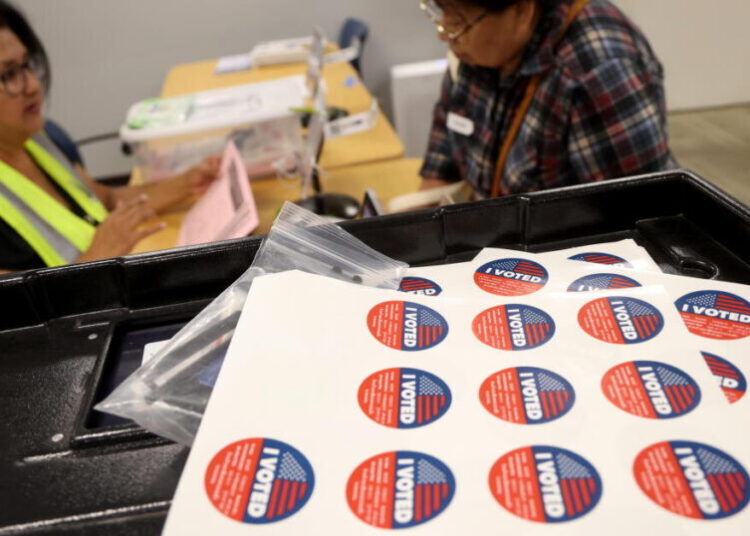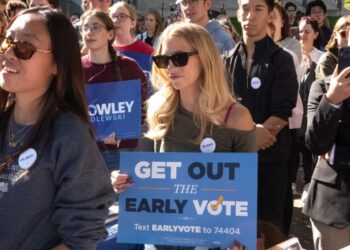
Republicans’ hopes of avoiding a wipeout in the midterms comes down to how many of their voters show up Tuesday.
Unlike two years ago, when the party invested in encouraging supporters to vote early and by mail and headed into Election Day meeting or beating its targets, GOP operatives said their fate this year hinges on whether voters turn out on Election Day or not at all. The concern extends beyond Trump supporters who don’t consistently vote when he isn’t on the ballot; Republicans said usually reliable base voters are considering sitting this election out or crossing over to support Democrats.
Multiple groups are running field operations aimed at turning out different segments of the Republican coalition, including Elon Musk’s America PAC, Charlie Kirk’s Turning Point USA, and Charles Koch’s Americans for Prosperity Action (AFP Action). But operatives caution that even the best get-out-the-vote programs can only make a difference of about 1 percentage point — crucial in a tight race, but not enough to overcome an overwhelmingly hostile environment.
“Depending on which eye you close you can try to make out what you want” from early voting data, said Drew Klein, a regional vice president of the Iowa chapter of the AFP. “If there really is a turnout problem, it’s impossible to interpret that as anything other than voters punishing the party in control.”
AFP sounded the alarm this summer that as many as one in five reliable Republican voters were at risk of voting Democratic or staying home. The group said it has since halved that share, to about one in 10, by targeting those voters with messages portraying Democrats as socialists in contrast to Republicans with concrete plans.
“Right now, canvassers across the Senate battlegrounds are making the same closing argument about the generational harm socialism would cause,” AFP spokesman Bill Riggs said. “These races are razor tight, and that’s where the ground game can make all the difference.”
Polls show Democrats are more motivated to vote this year: 75 percent said they were certain to vote or already had in October’s Washington Post-ABC-Ipsos poll, compared with 67 percent of Republicans. One in four Republicans said they “probably will vote” or that the “chances are 50-50.”
President Donald Trump disputed such results based on the energy at his rallies.
“We’re the ones with the spirit,” he said in Lubbock, Texas, last week. On Friday in Daytona Beach, Florida, he said: “There’s never been such excitement for a midterm.” He then heard a protester interrupt, and shouted “Shut up!”
Pollsters have cautioned that Republicans have been much harder to reach in surveys this year. That could be a sign that surveys are not accurately capturing their views. It’s also possible that their lack of enthusiasm for answering polls points to a lack of enthusiasm to vote.
Republicans are telling their supporters not to believe the polls.
“We are going to turn out on Tuesday, and we are going to win and shock the world on Tuesday night, I believe it,” House Speaker Mike Johnson, R-Louisiana, said Sunday at a rally with Trump in Dubuque, Iowa.
Kathryn Stuczynski, a 38-year-old child protective services officer in Dunkirk, New York, thought that when Trump first came on the scene in 2016 there was finally a politician fighting for people like her. Now she doesn’t see any politicians fighting for the working class, just leaders looking out for themselves — including Trump.
“I know I should, but I’m not sure that I will,” she said of voting in this election. “If it’s inconvenient for me, I won’t.”
The job of reaching GOP voters is now divided between the Republican National Committee and a coalition of outside groups, which are targeting different voters or parts of the country. In 2024, the Federal Election Commission decided that parties and campaigns could coordinate with super PACs on paid canvassing.
The RNC is running an operation similar in size to 2022 and slightly smaller than in 2024, but this time its target races are spread across 22 states. The RNC says it’s doing better in early and mail voting than at the same point in 2022, but still needs to mobilize voters who don’t usually vote in midterms or may not even know there’s an election going on. The 2022 election was the height of Trump telling his supporters to vote only on Election Day.
“That’s the name of the game for us, whether or not they’re going to turn out on Election Day,” an RNC official said on the condition of anonymity because the official wasn’t authorized to speak publicly. “You will get your answer on Wednesday morning.”
America PAC is running a similar program to 2024, with direct mail, texting, digital ads and paid door-knockers. Musk has given the outfit more than $200 million this cycle. The extent of its spending is not yet apparent in federal campaign finance disclosures because super PACs are not required to report paid canvassing in real time.
Trump’s own political operation is investing heavily in digital advertising to get out the vote, becoming the largest political spender on Facebook. More than 2,000 variations of ads encourage voters to find their polling locations in states including Texas, Michigan, Ohio and Iowa, totaling almost $10 million in October, according to Meta’s online disclosures.
“We will win if Republicans are motivated and not apathetic,” Texas Attorney General Ken Paxton (R), who is trailing Democratic state Rep. James Talarico in polls for the Senate race, said in a podcast interview on Friday. “Everybody needs to talk to their family, talk to their friends — I mean, literally text them, call them, just harass them until they go vote.”
Alesha Verhaeghe voted straight-ticket Democrat on Sunday at City Hall in Racine, Wisconsin, home to the toss-up race between Rep. Bryan Steil (R-Wisconsin) and challenger Mitchell Berman. She said she was optimistic that Democrats would rally because her mom, who is very religious, usually voted Republican in every election and was sitting this one out.
“She opened her eyes a little bit to seeing what Donald Trump is doing and how he’s not a Christian and really doesn’t like anybody else except for the uber wealthy,” Verhaeghe, 42, said. “So she’s not even showing up to vote.”
In Pinellas Park, Florida, a 77-year-old former Republican named Ernest Verni happened into a rally for Democrat Leela Gray, who is running against local Rep. Anna Paulina Luna (R).
“I ripped up my Republican card in May, and I sent a letter to the lunatic,” he said in an interview, referring to the incumbent congresswoman. “I believe the Republican Party left me. I didn’t leave the Republican Party.”
Dan Simmons contributed reporting from Wisconsin. Laura Beveridge reported from Florida.
The post Republicans count on Election Day turnout despite enthusiasm gap appeared first on Washington Post.