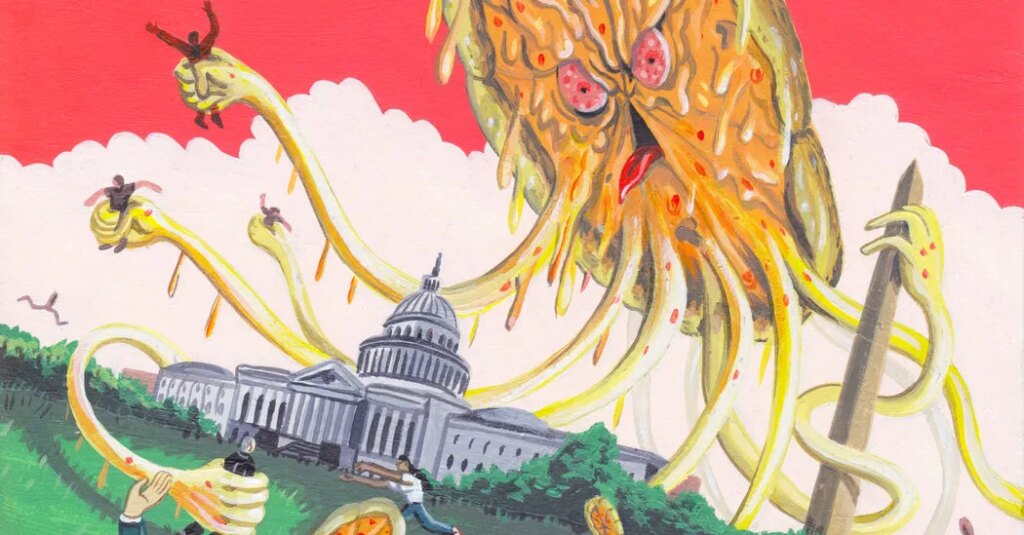
About two months into President Trump’s first term in office, I attended a rally near the White House, one of the first in-person events for a nascent community that was coalescing around a conspiracy theory known as Pizzagate. I had spent hours reading thousands of posts on message boards, Facebook and Twitter in support of the burgeoning movement. At the rally, it was as if those message boards had come to life. “I strongly suggest that you beg for forgiveness!” roared the rally organizer, Neil Wolfe, speaking to the pedophiles he believed would soon be forced to release their child captives. He received ecstatic applause.
The mood was an odd mix of rage and celebration. The attendees seemed sincerely concerned about child abuse and the impunity often granted to offenders in high places but believed the man who would expose these evildoers was finally in power. “This is why Trump has emerged as someone people trust,” one of the women I spoke to that day told me. “He calls things out as he sees them.”
I’ve been covering Pizzagate — and the broader world of conspiracy theories it helped catalyze — since the first social media posts about it went viral 10 years ago. The theory, which claimed that powerful Democratic Party operatives were running a sex ring out of the basement of a Washington, D.C., pizzeria called Comet Ping Pong, arrived at a time when social media platforms were primed to spread paranoia and encourage the self-investigation that has come to define so many conspiracists today. Pizzagate, as the rally made clear, was also becoming a source of meaning and community for its believers, who saw themselves as heroic crusaders against a force that many believed was literally Satan working on Earth.
Like all good conspiracy theories, Pizzagate was an accretion of highly charged, lurid and politically valuable distortions arranged around a pearl of truth: Sexual predators, especially powerful ones, are too rarely held accountable. That truth is why the theory broke into and has remained in the mainstream, minted a class of pundits and politicians and indelibly changed the rules of public discourse.
There were no children in the basement of Comet that Mr. Trump could have freed. But in the years since Pizzagate began, we have seen irrefutable evidence of a conspiracy to prey on vulnerable women and children, one that went to the highest levels of power and whose leader once moved in the same circles as Mr. Trump and was a longtime friend of his. Until the Trump administration — or the larger political establishment — holds Jeffrey Epstein and his associates to account, Pizzagate can never really die.
The Pizzagate theory was born in October 2016, 10 days before the presidential election. In a Facebook post, a person using the name Carmen Katz claimed that a huge child trafficking ring was about to be exposed. According to an “N.Y.P.D. source,” the poster wrote, incriminating emails on the disgraced politician Anthony Weiner’s laptop would prove that he and Bill and Hillary Clinton had taken Mr. Epstein’s plane. (Flight logs have never shown either Mr. Weiner or Mrs. Clinton to be on Mr. Epstein’s jet, nor did the two have any documented contact with him.) “We’re talking an international child enslavement and sex ring,” the person wrote.
The post proliferated across social media, and its idea quickly gained fuel with the WikiLeaks dumps of Mrs. Clinton’s emails. The leaks provided a novel degree of sleuthing for anybody with access to the internet: People drawn to the conspiracy theory could read her and her campaign chairman’s emails, mine social media for clues, then unite on sites like 4chan and Twitter to discuss the new objects of their suspicion. Pizzagate soon acquired its own paranoid glossary: Seemingly innocuous references to “pizza” and “pasta” in the leaked emails were understood as coded stand-ins for child pornography and abuse. Discussions about campaign meals and dinner parties became “proof” of wrongdoing, and the basement of a pizza parlor became the site of it.
Less than five weeks after that first Facebook post and after a swarm of online posters threatened and harassed Comet staff members, Edgar Maddison Welch entered Comet with an AR-15 and a revolver, stalking through the restaurant looking for trafficked children in a basement that didn’t exist. He fired the rifle multiple times at a locked door and soon surrendered to police without injuring anyone.
Mr. Welch was sentenced to a four-year prison term for the shooting. (In January 2025, after his release, he was shot and killed by police after pulling out a gun during a traffic stop.) While reporting on Welch’s sentencing, I watched exhausted Comet staff members give victim impact statements about the months of abuse they suffered.
In retrospect, this moment was only the beginning of the wave of suspicion and paranoia that would spend the next decade escaping the bounds of the internet and turning into real-world violence. In 2019 someone attempted to set a fire at Comet while it was full of diners and staff members — an act celebrated in Pizzagate-linked Facebook groups. In the years that followed, adherents of Pizzagate and QAnon, its successor movement, were arrested in connection with bizarre and dangerous behavior — blocking bridges, allegedly plotting attacks, even killing their own family members.
Conspiracy thinking has led to devastating personal consequences for the people who go down the rabbit hole. Like false theories about the Sandy Hook mass shooting before it, Pizzagate seemed to galvanize people to a special degree of action, convincing them it would be morally reprehensible not to intervene on behalf of children who needed saving. I spoke to people who had become obsessed with this pursuit and increasingly distressed when the wider world wasn’t joining in.
In the still highly active QAnon Casualties subreddit, people continue to post, lamenting losing contact with family members and loved ones who fell into the grip of the conspiracy theory. The page is a testament to the ways these theories have strained and severed relationships and led to irretrievably bad personal, medical and financial decisions. More than anything, the posts speak to the devastating inability of believers to return to consensus reality.
And meanwhile, the Pizzagate theory has not gone away. It recirculated on TikTok in 2020 among younger creators who looked back on it as a prescient piece of internet lore. Among far-right influencers, the phrase “Pizzagate is real” has recently become shorthand to indicate that you understand the depths of corruption and abuse among elites, that your eyes are all the way open. The theory has thrummed beneath the surface of American life, like a radio tuned just too low to make out the words.
That is because reality has continued to give Pizzagate more material. The #MeToo movement came less than a year after the shooting at Comet, and soon stories of the elite and powerful engaging in unchecked sexual abuse were seemingly everywhere. No one exemplified this culture of impunity better than Mr. Epstein. In 2008 he pleaded guilty to state charges of soliciting a minor for prostitution in a sweetheart deal that helped him avoid federal prosecution. He spent the next decade cavorting with top businessmen, academics, entertainers and politicians who shamelessly pursued his money and social clout while evidence and allegations of his sexual abuse grew.
The flight logs for Mr. Epstein’s private jet — Mr. Clinton, Robert F. Kennedy Jr., then-Prince Andrew, Kevin Spacey, Mr. Trump — seemed to confirm the “deep state” that conspiracists saw everywhere. Bill Gates flew on another of his private jets and had conversations with him from 2011 to 2014, well after Mr. Epstein’s conviction. The social associations between Mr. Epstein and people in the upper echelons of power were confirmation of one piece of the Pizzagate worldview: that the elite know and protect one another.
By the time I covered the rally in Washington, many supporters had begun calling the purported conspiracy Pedogate, broadening their concerns beyond a pizza parlor and theorizing a high-level web of sexual abuse spanning the globe. More cases supported the idea: They spoke of Jimmy Savile, the British TV presenter who was exposed as a serial predator of monstrous proportions after his death. If that is real, Pizzagate theorists reasoned, why couldn’t their theories be true, too?
But the way these cases reaffirm the ideas behind Pizzagate reflects our tendency to condemn only the most lurid, extreme and public examples of sexual abuse. In my conversations with Pizzagate believers, they rarely mention the more pervasive kind of sexual abuse that happens in churches, schools and homes, the kind that hundreds of thousands of children and adults experience every year.
As the list of examples from reality grew, conspiracy-minded politics became the order of the day rather than a side note. Pizzagate was never a singular event; it became the blueprint for a way of thinking about power, secrecy, abuse and impunity that has stamped itself onto our national psyche. So many of the conspiracy theories that followed — about the cause of Covid-19, vaccines, stolen election claims — blame the same “deep state” oft cited by Mr. Trump and his allies. Being outside the “deep state” guarantees one’s place as the underdog, as the hero fighting a group of shadowy villains in pursuit of justice against just about the worst kinds of crimes imaginable.
That intoxicating worldview gave rise to many a conspiracy theory peddler. MAGA personalities like the conspiracy theorist and now former Representative Marjorie Taylor Greene built a political following through QAnon. Far-right commentators like Tucker Carlson expanded their viewerships with their willingness to traffic in these ideas. Mr. Trump’s cabinet is also riddled with people who have promoted conspiracy theories professionally, like the F.B.I. director, Kash Patel, who praised QAnon on several conspiracy-theory-themed podcasts before his appointment. Before becoming a deputy F.B.I. director under Mr. Patel, Dan Bongino devoted several of his podcast episodes to Mr. Epstein, theorizing that he’d been murdered to cover up what he knew. (Once in office, Mr. Bongino said he’d come to believe Mr. Epstein died by suicide.)
The worldview was politically expedient to Mr. Trump and his allies, too, who spent the lead-up to the 2024 presidential election presenting their candidate as the only person brave enough to expose the truth. “If Trump wins, the Epstein client list is going to become public,” Elon Musk told Mr. Carlson in October 2024. Mr. Trump’s statements on the matter were more circumspect. Before that election, Fox News asked him if he would declassify the Epstein files if he became president. “Yeah, I would. I guess I would,” he replied. “I think that, less so, because you don’t want to affect people’s lives if it’s phony stuff in there, because it’s a lot of phony stuff with that whole world. But I think I would.”
But once Mr. Trump was back in office, his administration bungled its handling of the case in a way that makes it difficult for even his most devoted followers to condone. The Pizzagate community — which did not turn on him for his well-documented friendship with Mr. Epstein — instead saw his handling of the Epstein files as the ultimate betrayal. In February 2025 the administration’s showy release of the files, hyped as the final day of reckoning for the abuser’s supporters, instead incited immediate backlash. The attorney general at the time, Pam Bondi, handed conservative influencers binders of printed documents — virtually all of which were already public. The loyal Trump backer and far-right provocateur Laura Loomer excoriated Ms. Bondi, writing on X: “I can’t trust anything in the binder. Neither should you.”
Ultimately, the tranches of documents released under the Trump administration proved embarrassing for some of the high-profile people who corresponded warmly with Mr. Epstein over the years, but in the United States, very little has been done to identify or bring other sexual abusers in his circles to justice. That stands in stark contrast to Europe, where the release prompted a wave of investigations and arrests. His former girlfriend and pimp Ghislaine Maxwell, the only other person to be criminally charged besides him in the case, is now serving a 20-year prison sentence for sexually exploiting underage girls. She was recently moved to a lower-security prison after an interview with Todd Blanche, the deputy attorney general at the time and now No. 1 at the Justice Department, who was once a personal lawyer for Mr. Trump.
Mr. Trump’s anger, flippancy and impatience with the public outrage over Mr. Epstein haven’t appeased those who thought he’d deliver justice. “We have a PERFECT Administration, THE TALK OF THE WORLD,” he wrote on Truth Social in July 2025. “And ‘selfish people’ are trying to hurt it, all over a guy who never dies, Jeffrey Epstein.” Today Mr. Trump and those in his orbit seem to stay very far away from anything that looks or smells like Mr. Epstein. On an episode of Joe Rogan’s podcast this summer JD Vance admitted that the administration had “absolutely screwed up the comms of the Epstein files.” But gone are the thundering promises that Mr. Trump will expose the pedophiles and imprison and execute the evildoers.
Absent any real path toward holding Mr. Epstein’s enablers and fellow abusers to account, Pizzagate remains as original, as alluring and just as false as ever. The conspiracy theory and its handmaiden theories have become a set of distorted mirrors, showing us an exaggerated but concerning picture of how this country works, what it cares about and what drives us to action and even violence. Ten years after it all began, no one in a position of power seems especially motivated to show us a clearer view.
Anna Merlan is a senior reporter at Mother Jones and the author of the 2019 book “Republic of Lies: American Conspiracy Theorists and Their Surprising Rise to Power.”
The Times is committed to publishing a diversity of letters to the editor. We’d like to hear what you think about this or any of our articles. Here are some tips. And here’s our email: [email protected].
Follow the New York Times Opinion section on Facebook, Instagram, TikTok, Bluesky, WhatsApp and Threads.
The post Why the Pizzagate Lie Won’t Die appeared first on New York Times.