SOUND TRACKS: An Archaeological Journey Through Our Musical Past, by Graeme Lawson
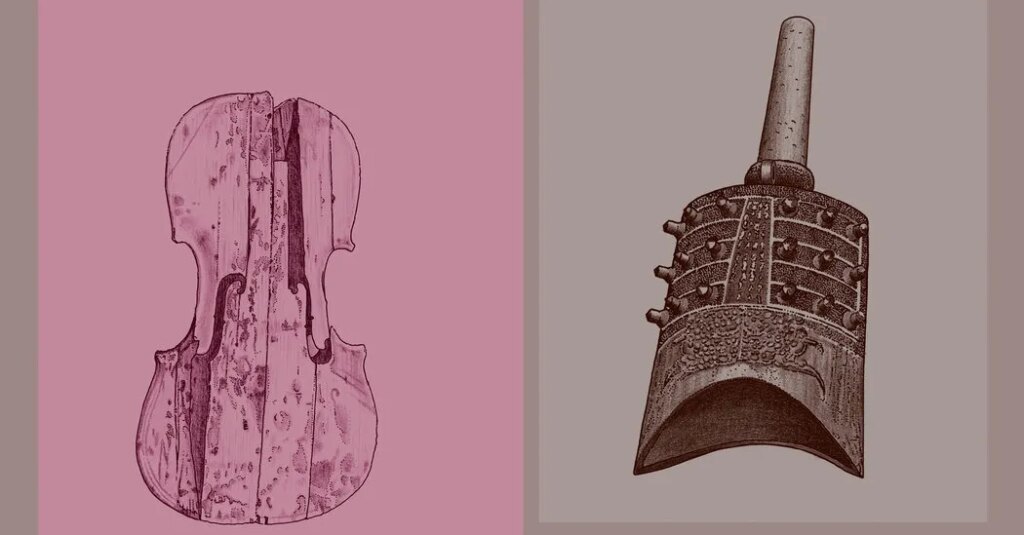
One of the jewels of the Metropolitan Museum of Art’s collection is a violin made by Andrea Amati in Cremona, Italy, in the middle of the 16th century. A Latin inscription wraps around the sides and painted decorations cover the back: fleurs-de-lis, flowers and, around the middle, some bits of what might have been a coat of arms.
Better preserved on another Amati, this one in Paris, and it’s easier to identify the coat of arms as that of King Philip II. This has led to speculation that these instruments, now separated by an ocean, were created as part of the festivities surrounding Philip’s 1559 marriage to Elisabeth of Valois.
Opera lovers will instantly recognize those two as the central characters in Giuseppe Verdi’s masterpiece “Don Carlos.” When I look at the Amati violin at the Met today, I can’t help imagining it as it might have sounded some 450 years ago at the Spanish court, and then reverberating three centuries later onstage.
I’ve allowed myself this fantasy — of hearing a silent violin playing, of listening to the distant past, of jumping through time — because it’s so similar to what Graeme Lawson does so artfully throughout his book “Sound Tracks.” An archaeologist who is also a musician, Lawson has based much of his career on analyzing instruments preserved in water, mud, ice and more, with the notion that even the tiniest fragments of wood and bone can, to an attentive and creative mind, conjure the sounds of long (long, long, long) ago.
His book is structured like a dig, starting at the top and working its way downward, layer by layer. So while we’re used to histories that progress forward chronologically, “Sound Tracks” begins, intriguingly, in the present day and wends backward — anecdote by anecdote, object by object — all the way to sketchy visions of the footfalls of our ancestors four million years ago.
In between, this friendly, curious and informative journey takes in flutes snapped as part of human sacrifice ceremonies in 14th-century Mexico; silver whistles that sank with a ship off the English coast in 1545; pots that were, for some reason, embedded in the walls of a medieval church in a small German town; ancient Celtic trumpets; and several dozen more examples of finds that have broadened our sense of where, when, how, why and by whom music was made.
Lawson is a self-effacing guide, inclined toward underplaying his talents. But over the course of “Sound Tracks,” the impression builds of him as a kind of unflappable Hercule Poirot, moving from shipwreck to shipwreck, museum to museum, meticulously sifting through and weighing the evidence.
“This is how, like crime detection, music’s archaeology works at its best,” he writes, “by the slow, patient assembling of clues, many of them negligible in themselves perhaps, but together slowly and steadily building a case.”
He describes an excavation in Oxford, England, in which wire, tuning pegs and more gave “the strong impression of organized craft activity.” In other words, this was most probably the site of a 15th-century instrument repair shop, and especially significant because its remains “place musical industry for the first time in an urban landscape.”
Archaeology, Lawson writes, is “nosy, it’s never satisfied and it’s messy.” He lets us glean insider information about the profession, not all of it sunny: At least two of his colleagues, he reports, have taken ill after being exposed to the poisonous dust made by working with the wood of the yew tree.
While movingly demonstrating how much research has been able to uncover and understand, Lawson is just as careful to note how much we don’t know. (Maybe those Amati violins were part of a royal wedding gift, but maybe that’s just poetic license.)
One of the cases he investigates involves the Celtic trumpet, known as a carnyx, which is thin and about six feet long, with flared ends capped by scary, seemingly screaming animal heads. Several were found in 2004 in a village in France, but it’s unclear why these examples are missing crucial parts. Lawson muses on whether these were used in battle, damaged and recovered, or whether they were broken as part of a ceremony. Even more puzzling, a set of long, curved bronze horns found in Denmark have metal walls so thin that we can’t fully replicate how they were made.
“To this day,” Lawson writes, “their creation remains a mystery.”
That kind of mystery comes up again and again in “Sound Tracks.” Why was a prehistoric pipe painstakingly hollowed out of solid mammoth ivory when naturally hollow bird bones were available? It’s unclear. How did a brass trumpet end up buried in the River Thames? Was it tossed off a boat? “Maybe the crew were drunk and it was deliberately thrown into the river in a moment of high spirits or mischief,” Lawson supposes. “We’ll never know.”
Yet his informed guesses can be haunting. He tells about the discovery, in the late 1970s, of a set of 65 massive bronze bells that were buried in a Chinese tomb even more lavish than King Tut’s. (After 2,500 years, the bells were, remarkably, still in tune.) In addition to the ruler for whom they were made, the tomb contained the coffins of 21 women. How did they die? Was it murder? And who were they?
“Given that musical instruments form the great bulk of the assembled objects,” Lawson writes, “it seems reasonable to assume that some if not all of them must be the court and household musicians.”
Plain-spoken and spine-tingling at once, it’s a sentence that speaks for “Sound Tracks” as a whole: It lets the ghosts of faraway music be heard, faintly yet unforgettably.
SOUND TRACKS: An Archaeological Journey Through Our Musical Past | By Graeme Lawson | Knopf | 241 pp. | $35
The post A Beguiling, Artful Dance Through the Music of Time appeared first on New York Times.