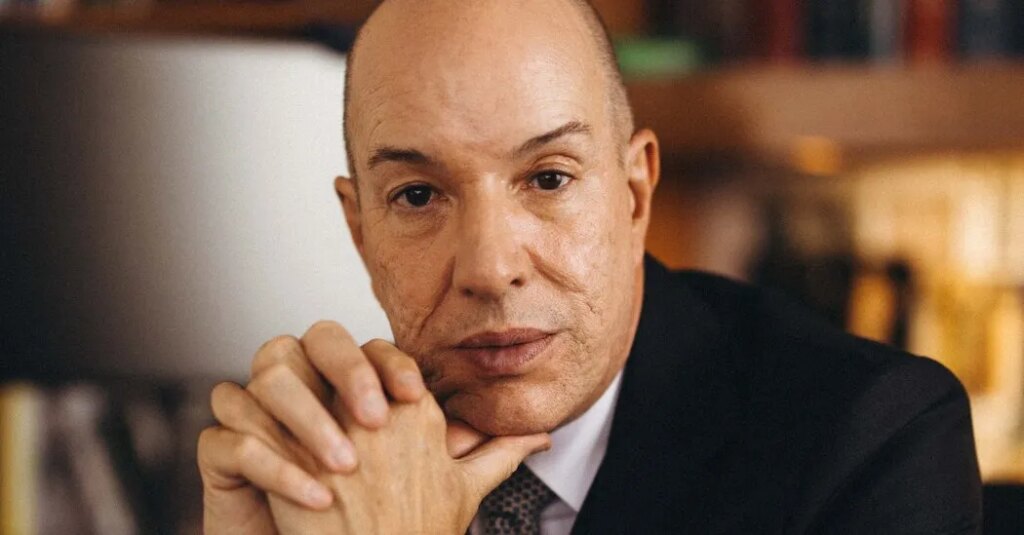
Anthony Romero, the longtime leader of the American Civil Liberties Union, isn’t afraid to speak out against government policies that he sees as harmful. He wishes other chief executives would do the same.
Business leaders have appeared reluctant to air their views during President Trump’s second term. During that time, tariffs have disrupted supply chains and immigration raids have upended labor markets. Law firms and media companies cut deals and settled lawsuits that many experts said were winnable. Mr. Trump has regularly cast doubt on the integrity of elections and pre-emptively challenged the results of a midterm race in Alaska and thousands of ballots in California.
Mr. Romero, 61, who has run the organization for the past 25 years, recognizes that his role is not akin to that of a chief executive who answers to shareholders. But he believes that corporate executives also have a role to play in defending democratic institutions. He has taken notice of the tech billionaires who donated to the A.C.L.U. during Mr. Trump’s first term but have not written checks this time around.
During the 2016 presidential campaign and first few months of the first Trump administration, the A.C.L.U.’s revenue more than doubled from the previous fiscal year. It waned during the Biden years and jumped again in the lead-up to Mr. Trump’s return to the White House, but half as fast as before.
Mr. Romero, who directs some 2,100 employees and more than $550 million in contributions, says that the A.C.L.U. still must be judicious about the cases it pursues.
“This is not a church,” he said at his office with a view of the Statue of Liberty in New York Harbor. “Prayer is not enough. You have to have a plan.”
This interview has been edited and condensed.
What do you want to see from corporate C.E.O.s during the Trump administration?
I’ve been frustrated with the lack of engagement. Many of them are ducking the hard issues, whether it’s freedom of speech, the integrity of our voting systems, the mass deportation of hundreds of thousands of immigrants, the undercutting of the freedom of the press or the assault on rule of law and the courts.
They don’t have to agree with me on immigration or trans rights, but they should think that the functioning of our electoral system is critical, regardless of who you vote for.
Do you think executives should speak out on that publicly?
They need to tie it back to their business. For some businesses that rely upon immigrant labor, it’s a core issue.
Assaults on the rule of law in America have massive implications for business because if the judiciary’s independence is questioned or threatened by the administration, it hurts the prospects of business.
But I don’t want corporate C.E.O.s to try to do my job. Because when they tried to do it, they did it poorly.
Are you talking about 2020?
Yes, exactly. In the aftermath of the murder of George Floyd, you had so many who wanted to rush to make statements about the police. They weren’t really committed, as you can see now with their backtracking. No one wants halfhearted measures. If you don’t really believe it, don’t do it.
What do executives tell you in private?
They tell me it’s hard and I say, “I understand.”
If the president, for instance, pulls out all the stops and tries to subvert the outcome of this election, then that’s a moment when profiles in courage will be noted. The leadership of the private sector should stand up.
I understand the worry about the government targeting companies. They have a fiduciary responsibility to their shareholders.
What I find more perplexing is in their private lives. I can list — although I won’t, I don’t kiss and tell — six Silicon Valley billionaires who wrote large checks to the A.C.L.U. in Trump 1.0 and not one of them is engaged with us today.
Some have changed their mind, and they have every right. Some of them are making pragmatic decisions and some are just afraid.
The point of being powerful and sometimes wealthy is that it gives you independence to do what you want, to speak your mind. For the very wealthy and the very powerful to feel afraid and to hide, I think is very troubling.
One criticism that the A.C.L.U. receives is that it acts as a wing of the Democratic Party. So is there anything that the Trump administration is doing that the A.C.L.U. would defend?
I can applaud them for not doing things as aggressively as they might.
Where does the A.C.L.U. stand on how A.I. might affect civil liberties?
We are taking our time to study it. I want to be sure we get it right.
There have already been a number of suits that we’ve done that challenged the racial discrimination in algorithms. We’ve got to make sure the civil rights laws are applied in that context.
I’m especially concerned with the rights of immigrants. You have almost $240 billion appropriated for immigration enforcement. How could A.I. be used as a tool to help further identify, track, detain and deport immigrants?
And Republicans and Democrats alike are criticizing the ubiquitous nature of Flock cameras. All of this is leading us to think about the implications of A.I. in our work.
I’ve heard you say that Americans have fewer rights now than when you became executive director in 2001. How does that make you think about your legacy at the A.C.L.U.?
We’re going through a hard time, and the institutions that constrain power seem to be either breaking or struggling.
There will not be a quick fix. The institutions that constrain government power have been so weakened or dismantled that it will take a generation to rebuild them. You can’t just go back and reassemble the same Justice Department you had before Donald Trump.
At the same time, there have been successes that continue. I never imagined that gay people like me would be able to marry their loved one.
Do you worry about what will happen to the institution when the next person sits in your seat?
This is not the Anthony Civil Liberties Union, it is the American Civil Liberties Union.
We can lose Silicon Valley donors and still have the rank-and-file folks who are writing an average gift of $112 a year. The power of the organization is rooted in the card-carrying members and because of that, I don’t worry about the leadership.
Tell me about your upbringing.
The first nine years of life in the Bronx and in the Castle Hill housing project. Then, the second nine years in Passaic County, N.J.
There was so much love in my family that I never knew we were humble until years later.
Were you the first in your family to go to college?
I’m the first to finish high school. My father finished the fourth grade. My mother finished the 10th grade. They didn’t know anything about college.
When you were growing up, your father, who worked in a Manhattan hotel, filed a legal grievance with his union when he was passed over for a job. How did that impact you?
When we wanted to leave the Bronx, my father applied to be a banquet waiter at the hotel. He was turned down initially. They said his English wasn’t good enough. He filed the grievance, and he became the first Latino to be a banquet waiter.
It was that filing and that promotion that changed the trajectory of our entire family, where we could just live very differently and better.
How much does your upbringing impact your work at the A.C.L.U.?
I was a beneficiary of every government program and institution meant to level the playing field. For me, it worked. I got a scholarship, I got aid, I lived in public housing, I got student loans. I’m a proud affirmative action baby. You don’t go from where I started to Princeton, Stanford and where I am now without affirmative action ripping open the doors.
I earned my grades, my successes and my failures, but all of these programs give us an equal opportunity to compete. That is the animating force of my work at the A.C.L.U. — let every person fully actualize who they want to be.
It’s time for the lightning round. Favorite Supreme Court justice?
Sonia Sotomayor.
Why?
Her opinions, her dissents, her integrity. I’ve known her a very long time.
What’s something you’ve learned from one of your youngest employees?
Speak your truth. Don’t be afraid of it.
In hindsight, what’s a decision you would have done differently?
Early on, I would have consulted my board more regularly. I was coming in as a chief executive and sometimes made decisions without the benefit of other people’s thoughts.
Do you think C.E.O.s should admit mistakes more often?
The only mistake you shouldn’t admit is the one you haven’t yet recognized.
What is your most contrarian take?
Divisiveness is not necessarily bad. I’d rather that people are engaging, even when they vehemently disagree, than silence.
What’s the last question you asked A.I.?
[Laughs]
Why are you laughing?
Oh god, I should have asked another question.
[Shows me the screen on his iPad]
“Any final words of advice for the Jordyn Holman interview?”
The answer: “Don’t try to win every question.”
The post The Head of the A.C.L.U. Thinks C.E.O.s Are ‘Ducking the Hard Issues’ appeared first on New York Times.