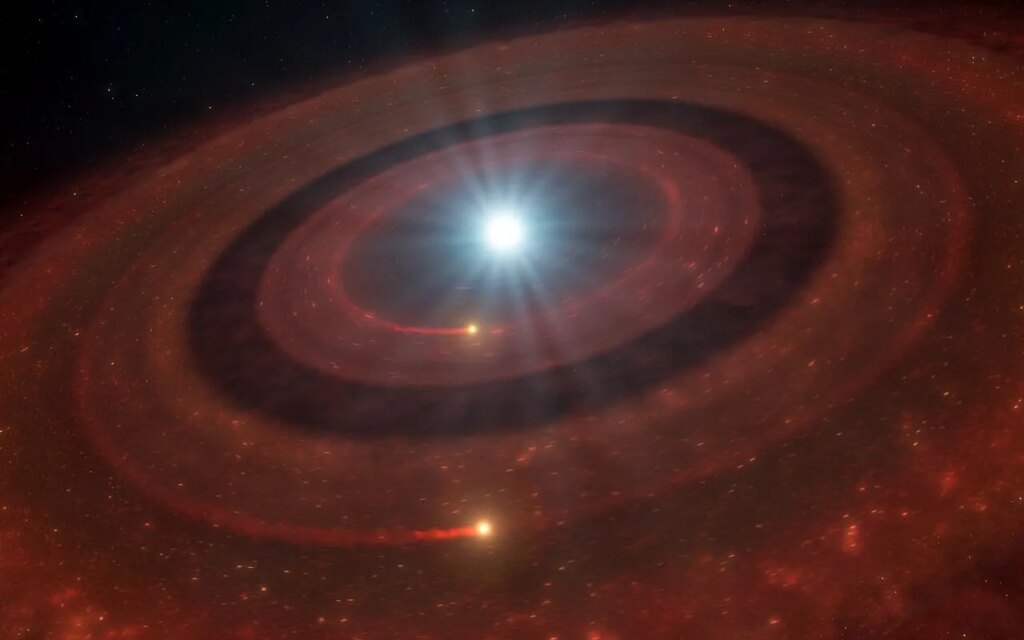
Astronomers at the European Southern Observatory (ESO) have discovered a debris disk around a white dwarf, consisting of the remnants of the solar system that once orbited it. For researchers, these structures could offer a clue as to what the end of our solar system will look like once the sun runs out of fuel.
The white dwarf J1328−1450 is located about 1,600 light-years from Earth. Astronomers were already aware of it thanks to star-mapping catalogs, but new observations taken with ESO’s Very Large Telescope (yes, that’s its real name) revealed that it is surrounded by a disk of debris with an unusual structure: Two distinct rings of gas separated by a gap.
According to the observatory, this disk of material is likely the remnant of the planetary system that once orbited J1328−1450. As it passed through a red giant phase and subsequently became a white dwarf, the star may have destroyed some of its planets and left other rocky bodies exposed to an extreme environment. Some of the released material ended up forming a disk of gas and dust around the dead star.
The process that shaped this system could repeat itself in our own. In about 5 billion years, the sun will exhaust its fuel and expand into a red giant. During this phase, it could engulf nearby bodies, like the closest planets. It will then shed its outer layers, leaving behind a white dwarf. Any rocky bodies that survive this transformation could break apart and form a debris disk around the dead star, like the one astronomers are now observing in J1328−1450.
But the white dwarf’s two debris rings hint at another possibility. Their structure appears to be shaped by bodies that astronomers have not yet been able to identify directly. The data suggest that, following the star’s transformation, at least two planetary objects may have survived among the remnants of that system.
Researchers believe these two bodies could be very different in size. The one closest to the white dwarf would measure just a few kilometers in diameter, while the more distant one could be as large as Pluto or even the moon. Their interaction with the surrounding material would explain the formation of the two rings, although it has not yet been confirmed that they exist as separate objects. An alternative possibility is that the structure originates from different parts of a single planet-like body, such as its crust and core.
This story originally appeared on WIRED en Español and has been translated from Spanish.
The post A Newly Discovered Trail of Cosmic Debris Illustrates How the End of the Solar System Could Look appeared first on Wired.