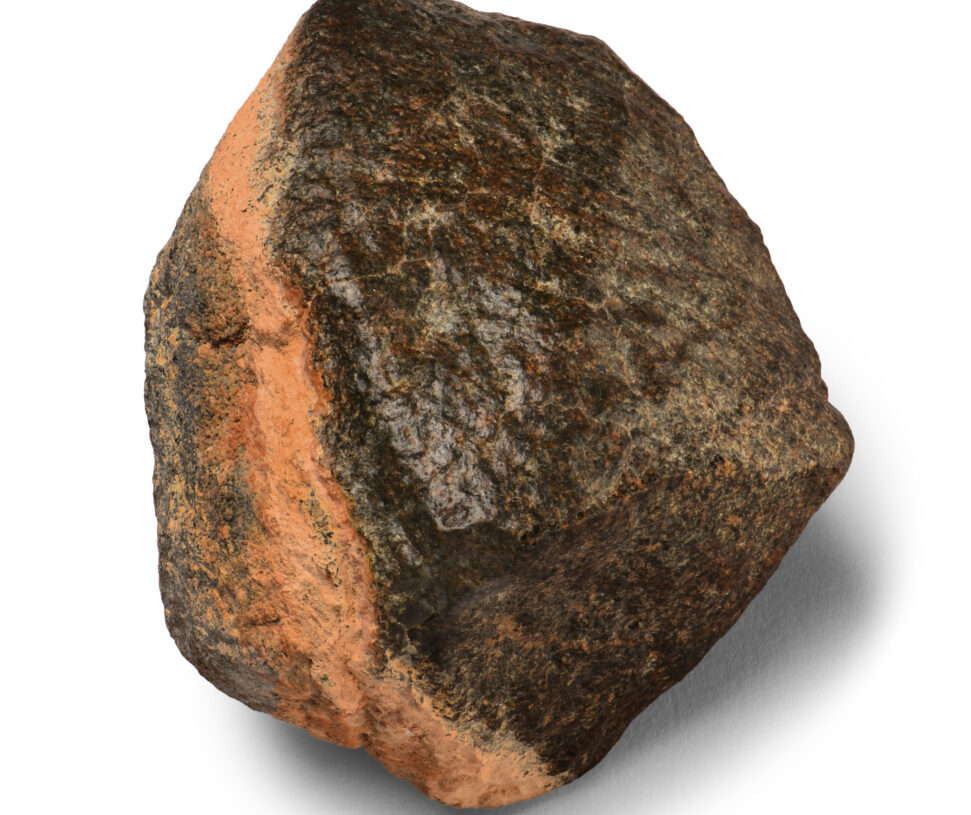
From the outside, it looks like an unassuming rock, polished and dark with a reddish stripe running through it. But cracking it open has revealed a planetary scientist’s dream: one of the oldest Mars meteorites on record, unlike anything scientists have studied, according to research published Thursday in Science.
“I didn’t think a rock like this existed on Earth,” said Willie Nicklas, a geologist at the Lunar and Planetary Institute in Texas who was not involved in the new research. “This one is very, very different and very, very exciting.”
The meteorite is dubbed Teghaza 001, and technically speaking it’s a collection of eight rock fragments, the largest of which is about the size of a fist. Nearly two pounds of the meteorite was discovered in the Sahara in Mali in 2022, and most is now held by a museum in Maine. Within two years, an initial examination determined the meteorite hailed from Mars; scientists are now finally digging deeper, with stunning results.
Yang Liu, a planetary scientist at NASA’s Jet Propulsion Laboratory in California, is one of those researchers. As soon as she started examining the meteorite, she knew there was something unusual about it, although the signs weren’t anything a non-geologist would recognize. As she and her colleagues got to work, they began painting a truly intriguing history for the meteorite.
“It’s a very complex rock to decipher,” Liu said.
The story begins 4.1 billion years ago, when crystals of a mineral called zircon probably solidified out of molten magma on Mars.
“That was a game changer,” Liu said, since scientists can date zircon very precisely, and it has been rare in other Mars meteorites. The date immediately put the Teghaza meteorite on special footing, alongside only two other Mars rocks known to have formed by 4 billion years ago. Most Martian meteorites are just a couple billion years old, which has long vexed scientists, given that spacecraft observations of the Red Planet suggest much of its surface is more than 3 billion years old.
And as the researchers investigated Teghaza ever more closely, they determined that its texture, mineral makeup and even basic elemental components didn’t match other meteorite samples from Mars. That makes the meteorite a new window into that planet, one that reveals history scientists haven’t been able to see in the scarce samples on Earth.
“We struggle because we want to say a lot about Mars, but if we only know one part of Mars, what do we really [know]?” Nicklas said.
Perhaps most intriguingly, the researchers also saw signs that the rock had been exposed to water during its evolution, a find detailed in work published this summer in Science Advances. That makes Teghaza an emissary from a wet, potentially habitable Mars.
Liu said there’s plenty more research she and other scientists can do on the existing samples, and Nicklas notes that there may well be more pieces of this rock or other equally surprising Mars meteorites still to find on Earth’s surface.
And, of course, it’s a tantalizing example of the analysis scientists hope one day to apply to samples delivered to Earth not by cosmic chance but by engineering. NASA’s Perseverance rover has been stockpiling the most intriguing rocks it’s found since landing on Mars in 2021, but the agency’s plans to fetch them is currently in limbo. Even just a tiny piece of that material would be a scientific treasure trove, Liu said the new work proves.
“We totally can do this if we have a Mars sample return,” she said.
The post Scientists have what they say is one of the oldest Mars meteorites appeared first on Washington Post.