This article is part of the Fine Arts & Exhibits special section on how the world of art and museums is pushing boundaries.
Many artists of color at the forefront of contemporary art today got crucial early support from Aljira — an artist-run, nonprofit space founded in Newark in 1983 and underrecognized for its role in seeding a more expansive and inclusive art world.
“Dreamtime in Newark: Aljira and the Making of Global Contemporary Art,” on view now at the Newark Museum of Art through June 20, makes visible the prescience and influence of this improbable gallery.
The exhibition includes 67 works by 46 artists that Aljira showcased across its 35-year tenure including Derrick Adams, El Anatsui, Firelei Báez, Amiri Baraka, Dawoud Bey, Frank Bowling, Jeffrey Gibson, Hew Locke, Jaune Quick-to-See Smith and Mickalene Thomas.
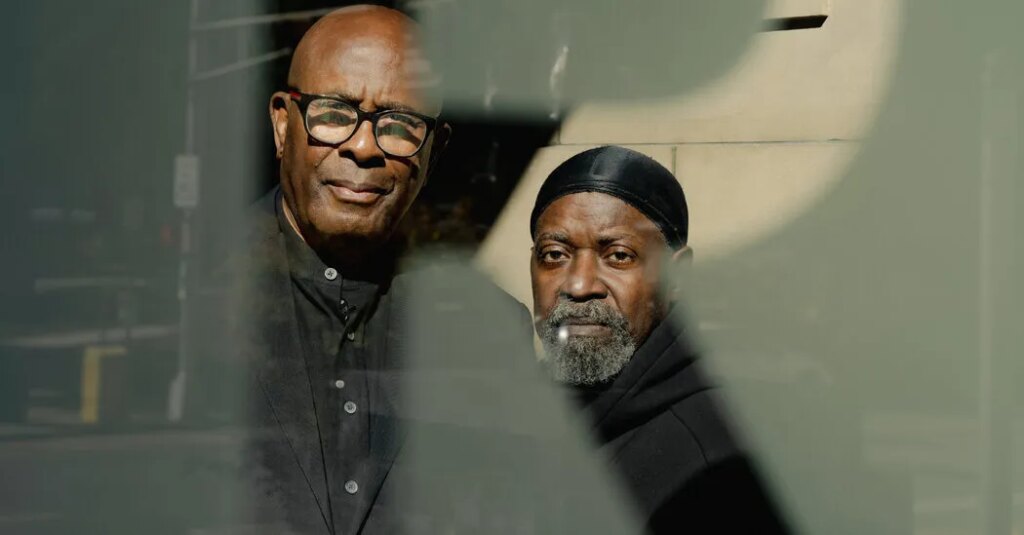
“The fact that we’re sitting in the Newark Museum at this moment is particularly significant for us because it means there’s a gap that somehow has been closed,” said Victor Davson, in an interview together with his Aljira co-founder Carl E. Hazlewood, both artists who immigrated from Guyana decades ago.
Lisa Funderburke, the Newark Museum’s director and chief executive, stressed the importance of honoring “the sweat equity Carl and Vic put into this work.”
“They saw a need and stayed very focused on what they were doing,” she said, “not knowing that all of these artists would be launched into global fame.”
In 1983, when Newark was still scarred by the 1967 riots over racial injustice, Davson and several recent graduates from art school rented a 5,000-square-foot walk-up studio space in a former bank building with huge windows and high ceilings.
Elizabeth Seaton, one of the cohort who had studied anthropology, signed the lease with the Australian Aboriginal word Aljira, meaning “dream time,” and the name stuck.
Hazlewood soon paid a studio visit to Davson and was impressed with the proportions of the space. Together they envisioned exhibiting there and giving opportunities to artists of all backgrounds who were being excluded from mainstream museums and galleries.
“Aljira became a space of possibilities for a lot of artists who came from everywhere,” said Hazlewood, who took on curatorial duties as artistic director while Davson began raising money as executive director. He started with a modest appeal to the local community to buy track lighting for the first exhibition in 1984 and later secured grants from organizations including the National Endowment for the Arts and the Andy Warhol Foundation for the Visual Arts.
“It just happened that we had the goods to pull it off,” Hazlewood added. “We walked through walls.”
In 1988, Aljira presented five interconnected and groundbreaking exhibitions on the art of the African diaspora rooted in scholarship, which anticipated by decades the future explosion of Black artists in the art market.
The 1989 show “Promise of Progress: Urban Narrative — Evil Empire,” guest curated by the artist Fred Wilson who included work by Mel Chin and Willie Cole, landed a review in The New York Times.
In 1995, Hazlewood invited his acquaintance Okwui Enwezor to co-organize “Modern Life” — an early curatorial foray by the Nigerian critic who went on to conceive sweeping global exhibitions over the next quarter century.
In 2003, Aljira began the “Bending the Grid” series of retrospectives devoted to neglected artists over 60, starting with Frank Bowling — a classmate of David Hockney’s at the Royal College of Art in London who had never had a survey. “It positioned Frank to be the first Black man to become a member of the Royal Academy of Arts,” in 2005, Davson said.
Aljira also supported artists at the start of their careers with the professional development program Emerge.
It introduced cohorts of artists to a cross-section of the art world and culminated in a group exhibition with a catalog. Gibson, who in 2024 was the first Indigenous artist to have a solo presentation in the U.S. Pavilion at the Venice Biennale, participated in Emerge in 2003.
“That was the beginning of everything,” he said. “It gave a foothold in an otherwise really overwhelming art world of New York City, and it gave me a community which has continued to this day.”
Firelei Báez, represented by the powerhouse gallery Hauser & Wirth (as is Gibson and Bowling), remembers commuting weekends from the Bronx to Newark in 2007 for Emerge and “the specialness of having this whole day dedicated kamikaze-style to making you a better artist,” she said. “Aljira helped you focus on how to keep a rigorous studio practice, but also know how to sustain a small business that was a pretty formative part of being an artist today.”
Ultimately, Aljira was not sustainable after its founders pulled back in 2016 (Davson left to be co-director of the arts facility Express Newark, and Hazlewood refocused on his own studio practice). In 2018, under financial and organizational stress, Aljira closed its doors on Broad Street.
“Once founders leave an organization that’s successful, it’s hard for someone else to take up the slack,” Davson said.
He and Cicely Cottingham, his wife and Aljira founding member, salvaged boxes of records from the abandoned space and now steward the Aljira Archive Project. It is producing the documentary “A Dream in Four Acts,” expected to be screened at the Newark Museum before the end of the show.
About a quarter of the works in the current exhibition are drawn from the collection of the Newark Museum, which consistently acquired works by artists in Aljira exhibitions.
“There is this incredible overlap between the artists that showed at Aljira and the artists in our collection, the ways Aljira took risks and the values of this institution,” said Tricia Laughlin Bloom, senior curator of American Art at the Newark Museum, which has nearly 6,500 works from global Africa in its permanent collection of more than 130,000 art objects.
Bloom collaborated on the show with a guest curator, Alliyah Allen, who wrote her master’s thesis at Columbia University on Aljira. Allen has organized the exhibition thematically across generations and media to underscore ideas such as Aljira being a shared studio space where “anyone could come in and experiment during a time when that was not marketable or wanted to the larger art world,” she said.
In the exhibition catalog, the artist Dawoud Bey framed Aljira among other alternative spaces that sprung up in a siloed art world to give foundational support to artists of color, including Cinque Gallery (founded in 1969), the Alternative Museum (founded in 1975) and Exit Art (founded in 1982).
Today, these institutions, Bey wrote, are often being “egregiously edited out” of the résumés printed in publications for these artists.
“This creates the misperception that larger institutions were the first to embrace these individuals,’’ he wrote, “and that their success is the result of being championed by the mainstream — a mainstream that we know in fact ignored them for decades.”
While proud to see how artists who Aljira supported have achieved broadly, “sometimes we disappear in the narrative,” Hazlewood said.
Davson concurred. “There’s that kind of cannibalization that goes on,” he said. “That’s what makes this show important.”
The post Recalling the Pathbreaking Role of a Newark Art Space appeared first on New York Times.