A dance can be about anything, but American Ballet Theater’s latest offerings raised a question. Should the sky really be the limit?
It was more disappointing than beguiling for the company to open its fall season at the David H. Koch Theater with a dance inspired by a flower. Throughout Helen Pickett’s “Petal,” the stage was awash in bright shades of lemon and apricot. (When she was creating the ballet, she saw a shop full of Gerber daisies, she said in a program interview.)
Eight dancers in yellow and blue dutifully echoed the rhythm of music by Philip Glass and Thomas Montgomery Newman in formations that sprinkled the stage with traveling lifts, supported turns and brisk, expressionless walking. But “Petal,” while busy, didn’t bloom with seamless exuberance. Often the dancers, exaggerating their shapes when time afforded, blurred transitions to keep up with the jutting angularity of the choreography. The effect, even with tacked-on smiles? More wilting than joy.
“Petal,” a dance created for Aspen Santa Fe Ballet in 2008, had pretty moments but was largely unremarkable beyond its cheerful lighting by Brandon Stirling Baker (originally by Todd Elmer). Why a major ballet company would take up valuable program space with “Petal,” especially in such a short season, was a mystery — and not the only one.
There was also “Flight” (2012), a company premiere by Jae Man Joo to Bach in which Herman Cornejo spread his arms like wings and thrashed like a bird (trite and terrible); and the premiere of “Trio Élégiaque,” set to Rachmaninoff, by Brady Farrar. A member of the corps de ballet, Farrar, 21, is the youngest person to choreograph a work for the main company. The strange takeaway, though, was that his ballet had a dusty, bygone air.
The theme was unrequited love. Farrar’s use of three couples led to a predictability of structure and choreographic design, which dwelled on lifts, turns and lifts while turning — the more whirl the better. Movement invention started to wear out by the second couple and was drained by the third.
The ballet began in front of a parted curtain with Devon Teuscher resting her head tenderly on Aran Bell’s chest before dipping backward into a passionate swoon. (The other pairings were Léa Fleytoux and Carlos Gonzalez, and SunMi Park with Thomas Forster.) Brad Fields’s lighting created a moody world in which the dancers entered and exited the stage in a series of encounters that alternated somewhere between the plea of “Let me go!” and the backpedaling of “Hold on, I’m coming back.”
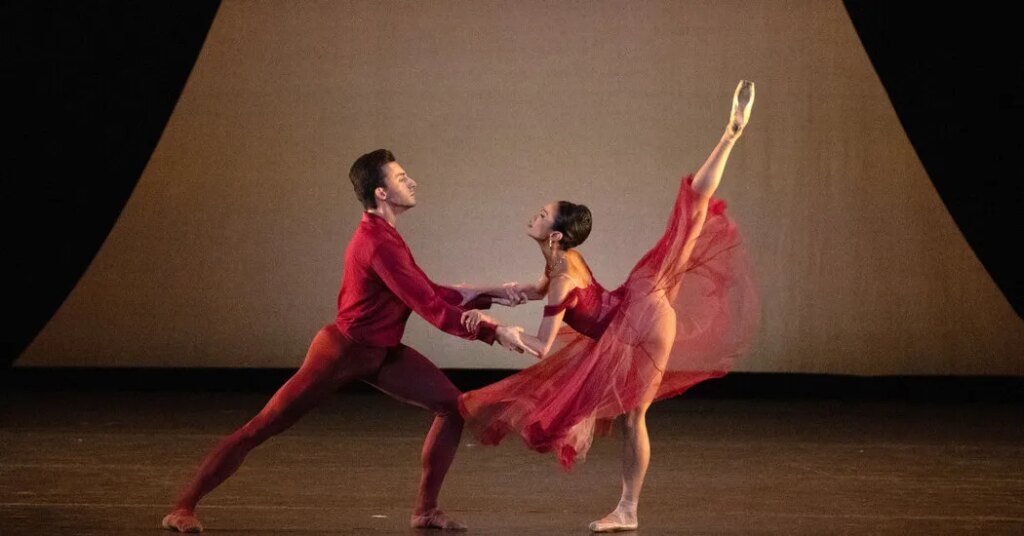
“Trio Élégiaque” had more than a whiff of Jerome Robbins’s “In the Night” (1970), which explores three couples at different stages of love. Robbins’s ballet is no masterpiece, but each relationship has a clear backstory. Farrar’s couples were less distinct, though the red costumes of Fleytoux and Gonzalez matched their sometimes fiery temperaments. (And yet red is so obvious.) Farrar can move bodies in space, but his ballet’s reason for being? That part was hazy.
Not all of the contemporary ballet offerings were tedious. Kyle Abraham’s dynamic “Mercurial Son” (2024) sends a small yet potent cast of seven ricocheting through space like shooting stars.
Abraham turns his dancers into stars, too. Breanne Granlund, a technical wizard, spun like the wind; Kayla Mak, a dancer to watch, was startlingly clear. And Melvin Lawovi, Calvin Royal III and Andrew Robare brought a feather-light conviction to their parts. “Mercurial Son” is a rare moment of cool for Ballet Theater, which seems most comfortable when leaning into the past. This Lincoln Center season included a couple of vintage gems by Frederick Ashton, including “Birthday Offering,” an odd charmer.
Created in London to highlight the talent of seven distinct ballerinas including Margot Fonteyn, the 1956 ballet has a specificity that persists even when the dancers struggled to fully inhabit their variations. “Birthday Offering” is a dance to showcase female talent, but the men — seven in all — have a vibrant mazurka to sink their feet into. Their most unusual and winning part happens early on when they retreat to the back of the stage with aristocratic bearing and stand like chess pieces while the women dance their variations. Ashton could do more than make steps sing; he was also awfully funny.
In her brilliant Titania debut, Catherine Hurlin led Ashton’s “The Dream” (1964) with sultry impertinence and power. Why was she cast so infrequently? It would have been illuminating to see her in George Balanchine’s majestic “Ballet Imperial” (1941), set to Tchaikovsky. Hurlin is fearless and nuanced; the life she weaves into all of her roles makes her Ballet Theater’s most complete and effervescent dancer.
In “Imperial,” the fiendishly difficult female lead was danced by Chloe Misseldine, who was strangely cold, executing the steps without the most important ingredient, musicality; and in a vivid debut, SunMi Park. She was wonderful.
Park’s understated demeanor lightened the ballet’s technical demands without dimming them — her sleek attitude turns were clear and calming — as she let the music carry her. This was not premeditated dancing, but instinctual. Park came to the stage simply as herself. In ballet, you hope to see the person behind the steps; that’s what can make even classical ballet contemporary.
But genuine openness is harder than it seems, and Park’s dancing in “Imperial” hinted at why other Ballet Theater performances can feel stale. This used to be a company of stars, but over the years Ballet Theater has become a company of dancers striving for the star quality of another time. This shows up in performance quality, too. It’s the difference between striking a pose and having poise, or balance, in the body and mind where harmony and spontaneity come together in vehement, joyful ways. Hurlin knows this freedom in her bones.
In “Imperial,” it wasn’t just Park who was dancing with abandon. Balanchine ballets show what good dancing looks like because of how natural his movement is on a dancer’s body. In Park, her naturalness met his. By the time the finale rolled around, all of the dancers were a united front, performing Balanchine better than they have in years — dancing with generosity, seeing one another and smiling as their feet raced toward the last notes. They were dancing the truth of ballet, with no airs, and it was something to behold.
The post New Ballets Fade in the Shining Light of Ashton and Balanchine appeared first on New York Times.