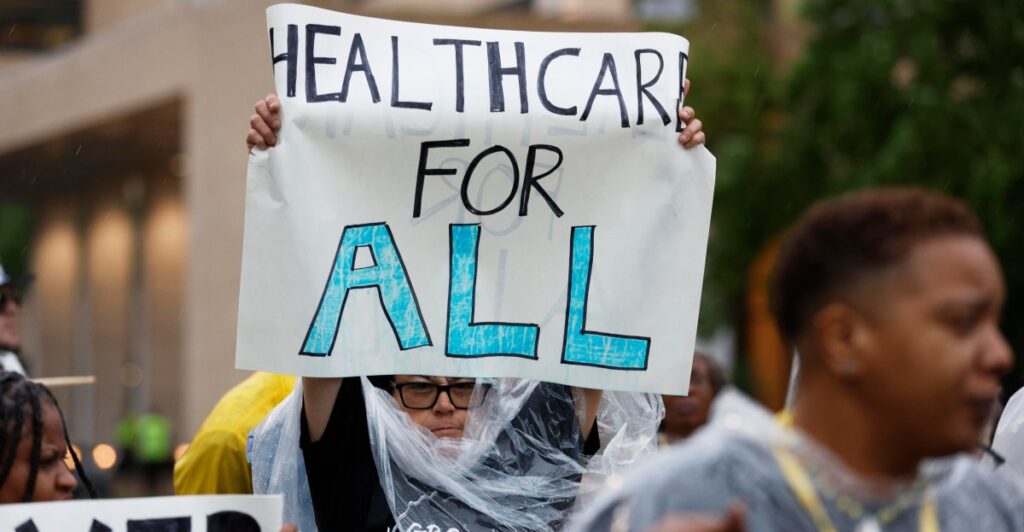
Americans want changes to their healthcare, and the candidates in this year’s midterms are making bold promises about how they are going to improve it: Medicare-for-all, or a public health insurance option, or free primary care for everyone. If Democrats win big this year, they could build up momentum to control Congress and the White House in 2029, which could leave them well-positioned to take on the thorny problem of how to fix the US health system.
History suggests that this won’t be easy. For every Affordable Care Act, you have the failed attempt to repeal it or the calamity of the Clinton-era healthcare initiative. Americans want change — but they fear it, too. I’ve spent years reading healthcare polls, talking to voters, attending focus groups. The public’s opinion of the healthcare industry has grown more and more sour, and distrust of the medical establishment is at an all-time high. People are sick of having a broken health system, but they worry that big changes could end up being bad for them.
Even though a meaningful attempt at reform is still years away and universal health care in any form might seem like a progressive pipe dream, the industry is not sitting idly by.
As Democrats have started to roll out policy proposals in anticipation of winning back Congress, the industry has been there to start making its case. In some campaigns, that means backing Republicans, but it also means lobbying Democratic Party leaders to hold the line against their more progressive members who want to push for far-reaching changes.
The question now is: Will their old playbook work? Can the industry convince Democrats to scale back their policy ambitions, or is their grip on Congress loosening?
“The next two years are actually quite pivotal, for doing the groundwork and all the necessary socializing, consensus-building,” said Kim Monk, a former congressional healthcare staffer who co-founded the private-sector research firm Capital Alpha Partners. “That’s the work that gets you to a point where either party decides, okay, this will be on our platform — or not.”
That will be the tug-of-war of the next two years: a PR battle waged between health companies with hundreds of millions of dollars at their disposal on one side and progressive lawmakers, activists, and patient advocates on the other that will ultimately determine what’s possible in the next phase of American healthcare.
The healthcare industry doesn’t want Democrats to win too big
In the short term, the industry is hedging its bets in the face of a Democratic wave.
Private enterprise has historically backed the Republican Party, but that’s starting to shift. What the healthcare industry values above all else is balance. Democrats operating without any constraints are more likely to impose government regulations on medical companies. But full GOP control comes with its own risks, like the $1 trillion in Medicaid cuts passed as part of the One Big Beautiful Bill Act, which has already led to clinics and hospitals laying off staff or even closing facilities altogether.
Sign up for the Good Medicine newsletter
Our political wellness landscape has shifted: new leaders, shady science, contradictory advice, broken trust, and overwhelming systems. How is anyone supposed to make sense of it all? Vox’s senior correspondent Dylan Scott has been on the health beat for a long time, and every week, he’ll wade into sticky debates, answer fair questions, and contextualize what’s happening in American health care policy. Sign up here.
“At least for the short term, I imagine the healthcare industry would welcome control of Congress by Democrats, creating more predictability, forestalling more cuts in Medicaid and the Affordable Care Act, and potentially reversing or delaying some of the cuts that have already been made,” said Larry Levitt, executive vice president for health policy at KFF. “The longer-term political calculus for the healthcare industry is more complicated. Many Democrats are pushing for a bigger role for government in health care.”
In other words, while healthcare companies might welcome a Democratic House as a check on President Donald Trump’s unpredictability, they aren’t necessarily hoping for a massive blue wave that could make significant reforms a serious possibility if Democrats were to win the White House in 2028.
The industry’s MO when it looks like a wave election is brewing is to balance the scales: I reported in 2016 how, in what was looking like a good year for Democrats, the drug industry poured money into the campaigns of Republican candidates by a 6-to-1 margin in competitive races, hoping to stifle the agenda of presumed President Hillary Clinton. (Of course they, like the rest of us, are still susceptible to being wrong.)
And that’s how the industry has been approaching the 2026 election: In many of the pivotal House and Senate races, they are backing the GOP.
As healthcare journalist Merrill Goozner reported last week, the American Hospital Association PAC and PhRMA, a drug industry trade group, have given a combined $14,500 to Republican incumbent Jon Husted and none to his Democratic challenger Sherrod Brown in the historically expensive Ohio Senate race. In Maine, Republican Sen. Susan Collins has received donations from all of the major healthcare trade groups — hospitals, pharma, insurers, and doctors — while her opponent, Democrat Troy Jackson, got none. (He also has sworn off corporate PAC money.) Even in an open race without an incumbent, like the Iowa Senate campaign, the Republican candidate has scored donations from hospitals and pharma, but the Democrat has not, Goozner reported.
If Democrats take the House but not the Senate, that would immediately put a damper on their healthcare reform plans — whereas winning a Senate majority would allow them to start drafting and debating bills in both chambers with an eye toward what could actually pass if they win in 2028 too.
“If there is actually a blue tsunami next week and Democrats get 51-plus [members] in the Senate, that’s a really big deal,” Monk said. “You can’t just say this doesn’t matter because Trump’s going to veto it, because I think it very much becomes a 2028 issue.”
And even as they work to push the next Congress more to their ideological liking, the healthcare industry is preparing for the fight that comes after.
The industry is prepping its counterattacks on ambitious healthcare proposals
After the midterms wrap up, the next two years in Congress and on the presidential campaign trail will be crucial. The industry is already working to set the terms of the debate and push back against big changes.
Each subset of the industry has its own versions of this argument: Pharma warns that price controls could stifle innovation, insurers warn that coverage mandates will increase premiums, hospitals warn that constraints on their funding could lead to closures and job losses. (There’s a well-known saying among DC insiders that every congressional district has a hospital, making every member potentially susceptible to the industry’s message that new healthcare legislation could result in their own constituents losing their jobs.)
They’ve started by trying to discredit the more sweeping health policy proposals before new members ever arrive in Washington, DC. In Texas, for instance, Republican groups have leaned on an industry-commissioned study to attack Democratic Senate candidate James Talarico for supporting Medicare-for-all, warning that it would lead to cuts for rural hospitals — at least according to an analysis produced by the Partnership for America’s Future, a coalition of industry groups that exists explicitly to oppose Medicare-for-all or a public option. They ran a similar ad against Democrat Janelle Stelson, who’s trying to topple incumbent Rep. Scott Perry in Pennsylvania.
The industry is trying to plant the idea in voters’ minds that these big, bold proposals may sound superficially appealing, but carry significant risks: You could lose your plan, you could lose your doctor, you could pay higher taxes. (And they often have their own studies to back those arguments, like the one cited in this year’s campaign, to counter the evidence offered by advocates in support of reform.) And it might work exactly like it has in the past. As John McDonough, a former congressional healthcare staffer and author of America’s Wrong Turn: US Health Care in the Neoliberal Era, put it to me, the history is clear: “Every comprehensive effort, defeat, and every incremental effort succeeds.” That is in part because of the healthcare industry’s influence and its success in framing the debate.
On top of trying to sway the competitive races, the industry is also trying to keep its most important allies within both parties happy ahead of the midterms. As the Center for Health and Democracy’s data shows, the health insurance industry PACs alone have given tens of thousands of dollars to Democratic and Republican leaders, as well as senior members of the healthcare-focused House and Senate committees.
It’s another hedge, an attempt to keep the members who will decide what’s on the agenda next year on their side. The industry supports reversing the GOP’s massive Medicaid cuts and increasing funding for the ACA marketplaces, two top-priority items for Democrats if they win Congress in the midterms. But they are hoping the party’s leaders will steer their members away from some of their more radical ideas for overhauling healthcare. Because while individual sectors within healthcare may squabble over smaller-scale reforms, the entire industry is united against plans to fundamentally change the US health system. (They are also increasingly owned by the same parent company, as consolidation in the medical sector becomes more and more common.)
“The healthcare industry is all for more people having coverage and stable government financing,” Levitt said, “but will circle the wagons to fight Medicare-for-all.”
Already, whenever Democrats start talking about their health policy ideas, the industry is ready with a response. Last month, as some Democrats announced support for a public insurance option, the Partnership for America’s Health Care Future argued it would reduce access. “A public option is not the answer to the affordability and access challenges patients and families are facing,” said the group’s executive director, Lauren Crawford Shaver.
Meanwhile, the health insurance lobbying group, AHIP, released a 40-page document in October on how to improve affordability and access, using it in part to argue against a public option because it would “stifle competition and threaten the coverage most Americans want to keep.” Centrist Democratic groups who receive industry support have said they are “preparing for war” against Medicare-for-all, according to the news outlet Sludge.
The industry is not omnipotent, however, and the debate could still change if Americans’ healthcare gets worse over the next few years. The US uninsured rate has been on the rise as pandemic protections expire and the costs of healthcare rise for millions. Unless Democrats succeed in stopping the Republican Medicaid and ACA cuts in the OBBBA, that problem is going to get worse — and that could also force Democrats to think bigger about how to fix it.
“I am not sure anyone has fully absorbed how damaging and disruptive that is going to be — including to hospitals and health systems,” Jonathan Oberlander, professor of social medicine at the University of North Carolina and the former editor of the Journal of Health Politics, Policy and Law, told me over email. “Large coverage losses will trigger great instability in health politics and perhaps open more of a window to bolder proposals.”
So, will the industry’s arguments still have juice? After the medical industry enjoyed a brief rebound in popularity during the pandemic, 50 percent of Americans say they have a negative view of it, while 37 percent have a positive view, per Gallup. And the appetite for reform is growing: 64 percent of Americans say it is the government’s responsibility to make sure that everyone has healthcare coverage — the highest share at any time, except for the late 2000s, shortly before the ACA became law.
Even the hospital industry, which has long enjoyed more public support than pharma or insurance companies, is seeing its popularity waver: A Families USA poll from August found that an overwhelming 81 percent of Americans thought hospital prices were unreasonable.
“Hospitals have done a great job of pleading poverty on Capitol Hill. ‘We’re probably the only provider who basically has to provide care to whoever shows up. We have no reason to be efficient. Just give us more money,’” Monk said. “I think that argument is wearing a little bit thin.”
The post Democrats have big healthcare plans. The industry is preparing for a fight. appeared first on Vox.