The moment is seared into Kristin Ingala’s memory: Her college professor in western Massachusetts was writing notes on a classroom whiteboard, and Ms. Ingala could barely see the words.
“I said, ‘Do you mind using a darker marker?’” — a DAH-kah MAH-kah, in her pronounced Boston accent. “Everyone in the class started laughing. I was so embarrassed.”
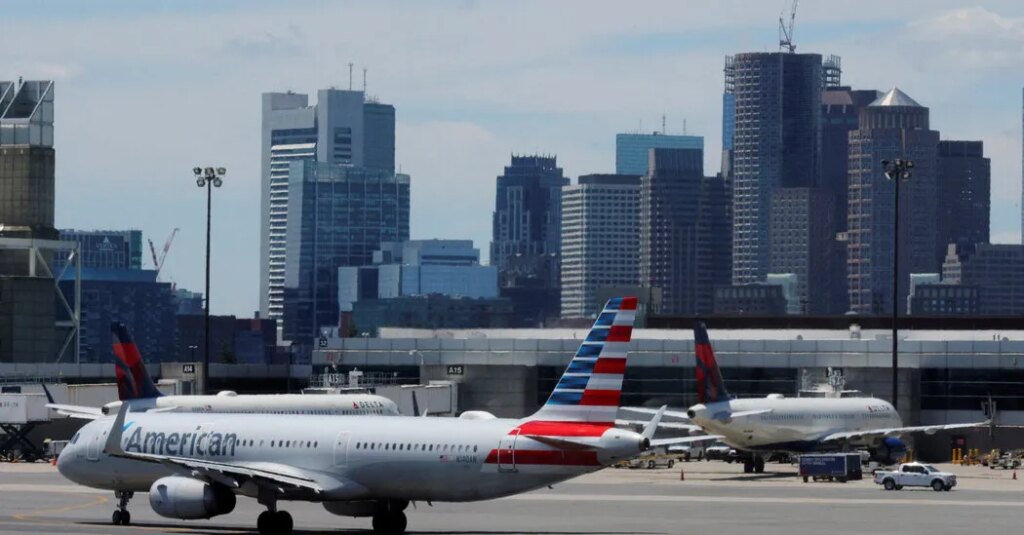
Years later, the accent that made her feel like a circus sideshow has made Ms. Ingala a local celebrity. She is one of eight finalists in a statewide search by Boston Logan International Airport for a quintessential local voice to welcome visitors.
The winner of the “Voice of Logan” contest will be announced next Thursday, after Massachusetts residents were invited to vote online this week. By Christmas, the chosen voice will echo through the airport in recorded greetings and announcements heard by more than 40 million travelers annually.
The contest drew more than 5,000 submissions from Massachusetts residents who recorded videos using a script studded with local clichés: “Whether you’re grabbing a lobster roll by the harbor, waiting in line for a cannoli in the North End, heading out to Gloucester for a little salt air, or paying your respects to the Green Monster like it’s a sacred landmark (because it is) — we’re wicked glad you’re here.”
When Jimmy Kimmel urged the Boston-bred actor Ben Affleck to stage a faux audition on his late-night show last month, Mr. Affleck played along, snapping into character as an abrasive “Masshole” and threatening to smack any visitor who calls the city Beantown.
But for some of the finalists, the airport’s embrace of their distinctive speech is not just something to have fun with. To Ms. Ingala and others, it feels weirdly therapeutic, a chance to move past experiences when their accents were not cause for celebration.
Max German, 29, a finalist from Worcester, Mass., remembers how confidently he responded when a professor called on him in a first-year class at Boston College Law School. When he heard other students cackling, he feared his case analysis had been flawed. Then he realized they were laughing at his accent.
“I’m very proud of it now, but I used to be more self-conscious,” Mr. German said. “People are pointing out that you’re different, or they’re repeating what you say, and you wonder if they’re even listening to you.”
The Boston accent originated with 17th-century settlers from southeast England, whose speech patterns shifted over time to follow the fashion in their native region. They started out pronouncing their Rs, but when dropped Rs became a marker of upper-class prestige in southeast England in the 1700s, the colonists latched onto the trend.
Centuries later, the Boston accent came to be associated with lower socioeconomic status, in a city transformed by immigrants and transplants from around the country. But fondness for the accent is widespread, said James Stanford, a Dartmouth College linguist who led an eight-year study of New England accents.
“People describe it as beloved,” he said, “even if they don’t speak that way themselves.”
Growing up in Everett, a working-class city north of Boston, Meagan Lewis-Michelson sounded a lot like everyone else. But when she arrived for her freshman year at Harvard — yes, she pronounces it as you’d expect — her scorching Boston accent instantly made her a curiosity.
“The only people on campus who sounded like me were the maintenance workers,” she said. “None of my friends had that blue-collar accent.”
Reassuring, in an age when colorful local accents seem to be fading, is the youth of the Logan contest finalists, most of whom appear to be in their 30s and 40s.
Ms. Ingala, 32, grew up in Wilmington, Mass., but has deep family roots in Medford, just outside Boston, and in Boston’s North End. An amateur boxer and two-time Golden Gloves champion who hopes to turn professional next year, Ms. Ingala is also a bartender at a popular restaurant on Cape Cod.
“In my older years, I’ve said, ‘Screw it, this is who I am, and it is what it is,’” Ms. Ingala said. “The accent is an energy, and people are looking for that when they travel here.”
Logan officials say they decided to seek an authentically Boston announcer after passengers complained in surveys about the airport’s generic, “Anywhere, USA” atmosphere.
Announcements there have typically been recorded by elected officials. The practice began with Mayor Tom Menino of Boston, a city native of Italian descent whose heavily accented, sometimes unintelligible speech won him the nickname Mayor Mumbles. More recently, the airport has featured the voices of the current Boston mayor, Michelle Wu, who grew up in Chicago, and Gov. Maura Healey, who was raised in southern New Hampshire.
The auditions were trickier than they might seem. Many Logan passengers are unfamiliar with the Boston accent or speak English as a second language. The winner, according to the contest guidelines, must achieve “effortless understanding” and “crystal clarity,” while also sounding “natural” and “friendly.”
Mr. German said he tried to follow those instructions by enunciating the word “airport” in his audition with two fully audible Rs. (Several other words in his recording — “HAH-bah,” “GLOSS-stah,” “MAHN-stah” — had no discernible Rs at all.)
“It’s a mix of things you’re trying to do,” he said. “I think part of why I got picked is because my accent is not the thickest ever.”
Trying to override her accent causes legitimate discomfort, Ms. Ingala said. She strained to pronounce the word “water” with the R sound in an interview, practically wincing with the effort.
“It hurts to say it like that, ‘wah-terrrr,’” she confessed.
For Ms. Lewis-Michelson, 37, who studied English at Harvard and now works as a singer, actor and voice teacher, accents have become a special skill — one she first began to master as she “Eliza Doolittled” her way through college classes, she said, taming her Boston accent to blend in.
She will soon manifest a Southern drawl in a production of “Steel Magnolias.” But to her mother — who is quick to call out Ms. Lewis-Michelson when her true accent disappears — her shot at airport stardom is the biggest thrill.
“She’s over the freakin’ moon,” Ms. Lewis-Michelson said about her mother. “She’s full of joy for me to be recognized for something that is just who I am.”
The post ‘Wicked Glad You’re Here’: Bostonians Vie to Be Their Airport’s Voice appeared first on New York Times.