The head of the Vietnam Veterans of America says he was misled before the group endorsed President Donald Trump’s planned triumphal arch and criticized three Vietnam War veterans who have sued to stop it.
Tom Burke, the president of the veterans group, told members on Thursday that he was given “inaccurate information” and that a pro-arch legal brief filed by his and several other veterans groups “went further than I anticipated or intended,” according to an email shared with The Washington Post.
The brief told a federal judge that Trump’s project should be built and said that veterans who have sued to stop it did not speak for the larger community of veterans. The White House encouraged the group to sign the brief, which was joined by several other veterans groups, according to three people familiar with their plans, who spoke on the condition of anonymity because they were not authorized to discuss it publicly.
“Let me be clear: National VVA has not adopted a position supporting or opposing construction of the proposed arch or its design,” Burke wrote in the email, acknowledging frustrations from members who oppose the project.
“This puts the organization squarely in the middle of a complex, sensitive situation, but our national commitment to neutrality remains firm.”
Burke and the Vietnam Veterans of America did not respond to questions Thursday about the organization’s stance on Trump’s project and the decision to join the legal brief. Earlier in the week, the association released a statement, joined by other veterans groups, saying that they were neutral on Trump’s project.
Lawyers for Consovoy McCarthy, a conservative law firm that handled the brief, and spokespeople for the White House did not respond to questions Thursday about the brief.
Vietnam Veterans of America leaders have been wary of jeopardizing their relationship with the administration by angering Trump and impeding one of his construction projects, according to two people who spoke on the condition of anonymity to discuss private conversations.
The association, which says it has more than 90,000 members, has been lobbying the administration over veterans’ benefits, mental health support and other priorities, according to publicly available lobbying documents.
James McCormick, the group’s top government affairs official, last month posted a letter from Trump and praised the administration’s engagement with his association. McCormick did not respond to questions Thursday about his conversations with the administration.
U.S. District Judge Tanya S. Chutkan on Friday will hear arguments over whether to let construction proceed on the planned 250-foot-tall arch, which Trump has identified as a priority to mark the nation’s 250th anniversary this year. The Trump administration is hoping to begin construction as soon as Nov. 5.
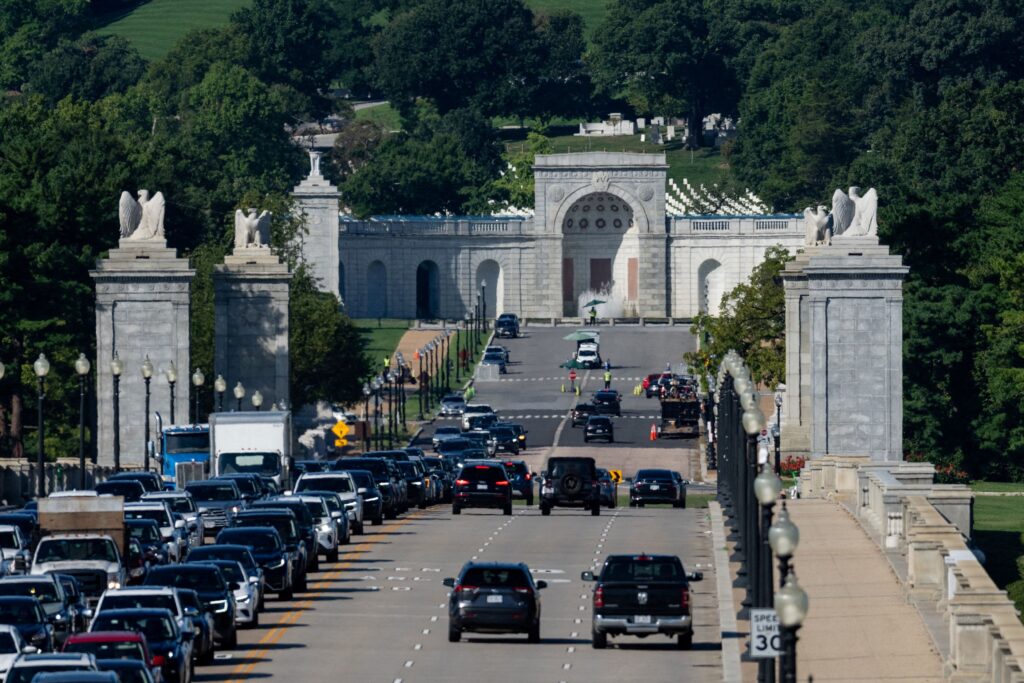
Administration officials have acknowledged that the towering arch will harm the views of nearby Arlington National Cemetery and dozens of other historic sites, create construction noise for several years and cause other disruptions. A Washington Post analysis found that the arch would also cast shadows on graves in the cemetery and on other monuments around the region.
The three Vietnam War veterans who have challenged the arch in court have said that they have legal grounds to sue because the arch would degrade their experience of visiting the military cemetery. Two of the men have said they hope to be interred in the cemetery when they die.
The White House has called on Chutkan to dismiss the three veterans’ complaint, invoking arguments similar to the ones the administration used to defeat an effort to halt construction on Trump’s White House ballroom.
A Justice Department filing on Wednesday does not identify any of the plaintiffs as military veterans and equates their criticism of the arch to a historic preservationist’s complaints that Trump’s ballroom would harm her enjoyment of the White House. The Supreme Court ruled in August that the preservationist likely could not prove that she would be harmed by the ballroom project. Administration lawyers hope that precedent will scuttle the challenge to the arch and other Trump construction projects.
The Vietnam veterans association was among six veterans’ groups — including the Korean War Veterans Association and the Military Order of the Purple Heart — that joined Wednesday’s brief arguing that the three veterans suing to stop the project did not speak for other veterans and that they should not have legal standing.
“The vast majority of [the groups’] feedback on the arch from their veteran members has been supportive,” the brief read, dismissing critics of the project. “Those who oppose it are isolated, often speak only for a small minority, and sadly seek to politicize something that should be supported regardless of political party.”
The White House encouraged the groups to join the brief, according to three people familiar with their plans. The White House did not respond to questions Thursday about the brief.
The brief caught some senior leaders at the veterans organizations by surprise.
Jay Kalner, president of the Vietnam Veterans of America’s Northern Virginia chapter, said that he and many of his fellow leaders and members opposed the arch. Kalner also said that he and other chapter and state leaders across the country had not been consulted before the national organization signed onto the legal brief.
David Pickett, who served as the president of the Korean War Veterans Association until June and remains on its board, said Thursday morning that he opposed his organization’s decision to endorse Trump’s arch because the topic hadn’t been discussed by his group’s leaders or members.
“It’s never come up in conversation,” Pickett said in a phone call. He initially said he did not see the “intrinsic value” of constructing the arch but in a later text message said he would support any effort to honor veterans.
Harold Trieber, the current president of the Korean War Veterans Association, subsequently told The Washington Post that he had made the decision for his group to endorse Trump’s arch.
“I represent the association, and I believe it should be built,” he said in a phone call, dismissing questions about whether his association’s members shared his views. “I don’t think it should be polled,” Trieber said.
John Weeks, a Vietnam War veteran whose brother also served and was killed in the conflict, said he was frustrated that the Vietnam Veterans of America had represented that there was consensus support from veterans for the arch when there was no consensus.
Weeks, who lives in Northern Virginia and frequently visits the military cemetery, said he was personally opposed to the arch and worried that it would disrupt the solemn experience of visiting the site.
“It should be enough to just simply say that we Vietnam and other war vets want no diminishment of ‘our hallowed ground.’ A giant Arch will do just that,” Weeks wrote in an email. “It in no way enhances our ground and it serves no purpose for us veterans.”
The post Head of Vietnam veterans group says he was misled before it endorsed Trump’s arch appeared first on Washington Post.