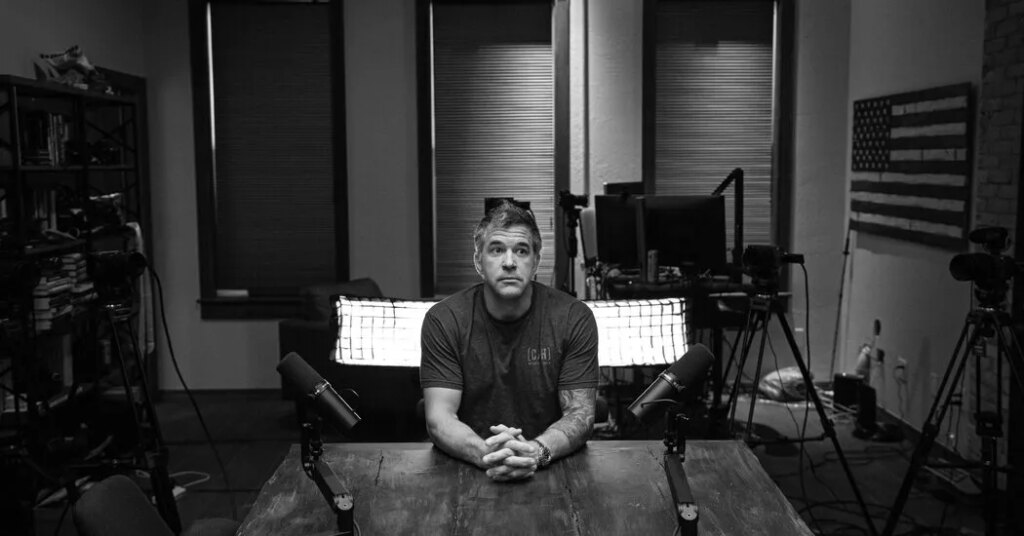
In July, nearly an hour into recording the 458th episode of his podcast, “Cleared Hot,” Andy Stumpf asked his guest, Matt Bissonnette, why he got out of the military.
Bissonnette, like many of Stumpf’s guests — and like Stumpf himself — is a former member of the U.S. Navy SEALs. In 2011, Bissonnette damaged his back when the helicopter he was in crash-landed during the mission to kill Osama bin Laden in Pakistan, and he left the service the following year, opting out of SEAL Team 6’s punishing pace of annual deployments. Even before the back injury, though, Bissonnette had been thinking about leaving, he said. On each deployment to Iraq and Afghanistan, new restrictions were being imposed on his unit — to his mind, putting him and his teammates in greater danger — and he had had enough of it.
“I saw the rules of engagement changing in Afghanistan,” Bissonnette explained. In the early years, he said, Team 6 had been left alone to do what it did best: sneaking into militants’ hide-outs undetected and killing whoever made any move to resist. But during President Barack Obama’s surge in Afghanistan, there was a shift to a “hearts and minds” counterinsurgency; senior officers began to emphasize capturing over killing, insisting that targeted commanders be given every chance to surrender.
“Why are you sending a very-high-end top-tier unit to go basically surround the mud hut and have an interpreter on a bullhorn say, ‘Hey, come out!’” Bissonnette complained. “Why are we putting ourselves in additional risk?”
Stumpf calls his podcast “Cleared Hot” after military lingo for authorizing pilots to open fire, and he tries to make his guests feel as if they’re cleared to talk about subjects they normally wouldn’t with a journalist. His is one of more than a dozen podcasts hosted by former “operators,” as modern commandos refer to themselves, who are retelling the story of America’s post-9/11 wars for a generation of men and boys too young to have fought in them. What written memoirs were to the post-Vietnam generation, these shows have become to the post-Afghanistan generation, holding sway over audiences who tune in religiously and who aspire to join the Special Operations forces themselves. The largest podcast in this space, “The Shawn Ryan Show,” sometimes comes in second only to “The Joe Rogan Experience” on the Spotify charts.
On these shows, the conversation might be about anything — CrossFit, mental health, testosterone — but a collective narrative about the fight against terrorism surfaces again and again. Some hosts and many guests argue that the United States was defeated in Afghanistan because our presidents and generals, more concerned with politics and optics than the realities of the battlefield, imposed crippling restrictions on Special Operations. Freed from constraints, they say, the lethal raiding machine that Team 6 was a part of — with its exquisite training, cutting-edge technology and overwhelming firepower — might have simply killed its way to victory.
That argument has become influential in the Trump administration, affecting how Defense Secretary Pete Hegseth has directed the military to operate in the Caribbean, Yemen and Iran. Hegseth, who stays plugged in with the most popular shows and was an occasional guest before taking charge of the Pentagon, has brought it out of the podcast world and into the national discourse. “We wonder why the war never ends and why it perpetuates itself,” Hegseth said on “Shawn Ryan” in 2024. “Because we’ve written rules that are impossible, that are written for us to lose. They’re written for our guys to be in handcuffs.”
Stumpf, a youthful-looking 49-year-old with salt-and-pepper hair and a cheerful interviewing style, is at pains not to endorse that message. He hopes to convey to listeners that the wars were futile and wore down the souls of those who fought them, but he did not push back when Bissonnette criticized the restrictions. Minutes later, Bissonnette made clear that he thought the war in Afghanistan had lost focus long before the surge, when the Bush administration decided to keep fighting against the homegrown Taliban after largely driving Al Qaeda out of Afghanistan. Neither man felt the two conflicts had accomplished much they could be proud of. “I wonder often about the long-term impact of the things that we broke, and the history books, and how they will judge us,” Stumpf said.
I had traveled to Kalispell, Mont., outside Glacier National Park, to sit in on Stumpf’s episode with Bissonnette. I’d been a guest on “Cleared Hot” five years earlier, when Stumpf invited me on to discuss a book I wrote about the war in Afghanistan. Since then, his operation had become more polished: He’d hired a producer, and his recording studio was furnished with military-themed décor, like replicas of M4 rifles and the emblem of SEAL Team 6’s Gold Squadron, the unit he fought with until 2005, when he took a bullet to the hip.
Stumpf had recently learned to fly helicopters, and he was planning to give Bissonnette a lift to the airport in Missoula, saving him a two-hour drive. Buckling into the little four-seat aircraft and taking off into the mountains, the three of us discussed the memories of Iraq and Afghanistan that helicopter flights evoked. Two decades ago in Baghdad, as a passenger, Stumpf relished such flights; he loved to sit in the open door of the Black Hawk ferrying him and other operators out on their night raids, his foot resting on the aircraft’s front wheel.
On the way back to Kalispell, over the cockpit intercom, I asked Stumpf which of the two narratives about Afghanistan he heard most often from his guests and other Special Ops veterans: that the war had been an exercise in futility, or that it might have been won if the United States had taken the gloves off.
“Unfortunately, the second,” he answered.
How veterans tell their stories about past wars has an inevitable influence on how their successors fight future ones. Many Special Ops veterans who enlisted in the decade before the Sept. 11 attacks were motivated to do so by Vietnam memoirs they read as adolescents — not the meditative antiwar ones by draftees and literary-minded officers but the exciting ones by that generation’s commandos. More than a dozen SEAL Vietnam memoirs were published in the 1990s. As a child in Alaska, Bissonnette tore through “Men in Green Faces,” a former SEAL’s fictionalized account of hunting Viet Cong in the Mekong Delta. “The world has changed and it’s a different medium, but the stories are the same,” Bissonette told me. “It’s access into a world you’ve heard about, read about, dreamed about.”
Stumpf was one of the pioneers of operator podcasting, starting “Cleared Hot” in 2017, four years after he left the Navy. He had been working for the chief executive of CrossFit and leaning into professional skydiving. He set a world record — gliding more than 18 miles in a flying-squirrel-like wingsuit — that landed him the first of several appearances on “Joe Rogan,” the emerging titan of the form. Podcastland seemed like “a weird world,” Stumpf remembered, but Rogan encouraged him to start his own show. Stumpf had all kinds of guests — a NASCAR driver, extreme athletes, a former-Scientologist-turned-activist against the cult — but war content proved the most popular.
Since then, operator podcasts have proliferated: “Combat Story” in 2020, “Frog Man Friday” in 2021, “Green Beret Chronicles” in 2022, “Tier-1” and “Lesser Known Operators” in 2025. Some, like “The Team House,” stick to stories of war and deployments, avoiding culture-war content, but many wander naturally into political and men’s lifestyle topics. “I’ve never seen you more lean,” Mike Glover, a retired Green Beret who served in Delta Force, told Stumpf near the beginning of his appearance on “Cleared Hot” in July, and asked what peptides he was using. (Sometimes a cocktail marketed as Wolverine, Stumpf answered, paired with kettlebell workouts and testosterone.)
Podcasts allow a parasocial dynamic that old war memoirs didn’t: For those who want personal advice from their heroes, the DM button on Instagram is right there. “Fanboys are a thing,” said Brent Tucker, a Delta Force veteran in Florida who hosts the “Tier-1” podcast. “I’ve met a few who I think know more about my career than I do.” Fans of the podcasts discuss different elite units and former operators as though they were their favorite sports teams and players. They pick apart what they see and hear in minute detail, cross-referencing missions described in different episodes and cataloging rifles, body armor, insignia and camouflage patterns. “What we got from the audience was, ‘Hey, man, it feels like I’m in the team room with you guys,’” said Glover, who originally focused on war stories on his show, “Mike Force,” before switching to wilderness survival and disaster preparedness content.
Much of this is frustrating to veterans from conventional military units — infantrymen, tankers, logisticians — who made up the majority of the United States’ troop presence and took the majority of casualties during the war’s first decade or so, up through the surge in Afghanistan. Special Ops stories tend to be about capturing or killing bad guys, not the slower, more patient work the infantry did patrolling neighborhoods day after day, trying to gain locals’ trust and locate I.E.D.s and ambushes. It’s the SWAT team’s story compared with the beat cop’s, and the operator podcasts can seem to erase the less glamorous side of the war altogether.
One 21-year-old fan, who asked to be identified by only his first name, Owen, told me that he stumbled onto the operator podcasts as a high schooler and that they turned his life around: He started to run and lift weights and took up mixed martial arts. “I’d be on the bus staring into the window listening to hours of podcasts, telling my friends information they didn’t care about Iraq,” he remembered. “I’d never felt so motivated about something.” Joining an elite unit like the SEALs or Rangers “felt like all I wanted to do.”
When Owen learned after graduating from high school that his vision was too poor to qualify for an elite unit even if corrected with laser surgery, he dropped the idea of enlisting altogether. “With the Special Operations guys on podcasts telling their side of GWOT,” he said, using the common Pentagon acronym for the global war on terrorism, “you would think there’s no conventional troops. I think I was a casualty of that. I definitely didn’t want to go into the conventional military.”
Even many Special Ops veterans disapprove of the podcast scene, maintaining that at least until everything is formally declassified in the coming decades, and maybe even after, “quiet professionals,” as special operators term themselves, should keep their war stories within the fraternity. Some Team 6 and Delta Force veterans who have gone on podcasts say others from their old units have pressured them to take down their episodes and declared them persona non grata, no longer welcome at official reunions and ceremonies. The ship has sailed, though: More than 70 Team 6 and Delta Force veterans of the post-9/11 era have talked about their service on podcasts. Stumpf sees no shame in that: The idea of all the secrecy is to protect current operations and tactics, not hide history. The phrase is not “silent professional,” he says.
Former commanders who oversaw operators like Stumpf, Bissonnette and Glover tended to react with exasperation when I asked them about the podcasts. Rich Clarke, who as a colonel commanded a task force of SEALs and Rangers in Afghanistan, told me that, as a Ranger commander, he’d insisted that new Ranger officers read books on Iraq and Afghanistan by journalists and academics. But in his final military job, as the general in charge of all Special Operations forces, he found that when he asked junior and midlevel officers what they were reading, he would often get blank stares; he got better results asking what podcasts they were tuning in to. He tells young listeners to “take them with a grain of salt,” he told me. “But senior guys like me who dismiss these podcasts do so at our own peril.”
By far the most popular of the operator podcasts is “The Shawn Ryan Show,” some episodes of which have cleared seven million views on YouTube alone. Ryan, whose real name is Sean Ryan Palmisano, was in the SEALs for four years (not long enough to try out for Team 6) and did two tours in Iraq and Afghanistan before joining the C.I.A. as a security contractor. After discussing his attempted suicide on another SEAL podcast, Ryan started his own in 2019. His aim was to give Special Ops veterans a venue to tell stories about the wars and their psychological toll. “All of our best friends are dead, most of them from suicide,” he told me.
His recording studio, on a sprawling compound outside Nashville, features deep purple backdrops, black leather armchairs and, although he no longer drinks, a wall of more than a hundred liquor bottles — everything from whiskeys and tequilas to Hpnotiq, the turquoise liqueur famous from hip-hop music videos.
Compared with the animated, jovial Stumpf, Ryan, a 44-year-old with broad features and a shaved head, is a minimally expressive interviewer. He often asks combat veterans who go on his show what it felt like the first time they killed someone. He does not generally press guests on whether the stories they tell are true, and his meteoric rise seems, in part, to stem from his willingness to dive into partisan politics and conspiracy theories: He’s into U.F.O.s and numerology and has claimed that the military mandated the coronavirus vaccine as part of a “woke agenda” to drive combat veterans out of the ranks. He publicly supported Donald Trump during the 2024 campaign.
Ryan now has around 20 employees, according to his chief of staff. He does brand collaborations with tactical gear and security companies, as well as with purveyors of wellness and workout supplements: Laird Superfood’s Shawn Ryan Bundle includes prebiotic greens and “performance mushrooms.” During some recent episodes, Ryan has given guests high-end assault rifles — gifts, he said, from the gun manufacturer Sig Sauer. In 2022, Ryan talked about his experience traveling to Tijuana, Mexico, for treatment with ibogaine, a psychedelic derived from the root of an African shrub, helping the drug go mainstream among veterans struggling with PTSD, brain injuries and alcoholism. “We shot that to the moon,” Ryan said. In April, Trump issued an executive order fast-tracking psychedelics like ibogaine for clinical trials.
He does the same thing for fellow veterans’ brands. When a former SEAL turned craft ice cream maker, Chris Fettes, went on the show last year, Fettes talked about his own brush with suicide after shooting two Afghan boys he thought were combatants and about how ibogaine helped him. But Ryan also coached him to say that he was looking for distribution for his ice cream. Less than a year later, Fettes is in talks with supermarket chains. Fettes’s flavors, with names like Cookie Commandough, “will be right next to Ben and Jerry’s,” Ryan said proudly.
Just before the 2024 presidential election, Hegseth went on “Shawn Ryan” and walked Ryan through what he called one of his proudest accomplishments. In 2018 and 2019, Hegseth used his platform at Fox News to defend a series of veterans who had been either accused or convicted of war crimes, including Mathew Golsteyn, a Green Beret whose team killed a captive suspected of being a Taliban bomb maker and covered up the death, and Eddie Gallagher, a SEAL member whose prosecution for allegedly killing a wounded ISIS prisoner and shooting at civilians the Navy had flubbed, resulting in acquittals on the major charges but a conviction on a lesser one.
Trump, Hegseth explained to Ryan, would reach out after watching Hegseth’s segments about the cases. “He’d call me and be like, you know, ‘They did some nasty, they did some tough things, these are rough guys,’” Hegseth said, mimicking the president’s voice. Because of Hegseth’s advocacy, Trump gave all of them presidential pardons or other forms of clemency. (Gallagher had been an early guest on Ryan’s show in 2020, and the host has made clear that he thinks the men were railroaded.)
“Rules of engagement are a huge problem,” Hegseth went on, invoking a popular rationalization for defeat in guerrilla wars that was also widespread after Vietnam. “Why have we spent the last 20 years fighting enemies that don’t abide by the rules at all? And these are rules written by, like, dudes in cloak rooms in Europe after World War I, because they thought that they could fight polite wars.”
Speaking to Tucker Carlson recently, Ryan claimed some credit for Trump picking Hegseth for defense secretary less than a week after the episode aired. At the Army-Navy football game the next month, Ryan recalled, he was in the V.I.P. box with the president- and vice president-elect when Hegseth mouthed, “Thank you,” pointing to him. “It inflated my ego,” Ryan told Carlson. “I’m like, Holy [expletive], this show has power.”
At the Pentagon, Hegseth has doubled down on the same rhetoric. Last fall, shortly after launching an air campaign of contested legality against suspected drug-smuggling boats in the Caribbean, Hegseth promised an assembly of hundreds of generals and admirals that he was working to “untie the hands of our war fighters.” In March, as he launched the bombing of Iran, he announced that this war would feature “no stupid rules of engagement.”
U.S. military rules of engagement are grounded in the internationally recognized laws of war, for which Hegseth has also expressed scorn; when he started referring to the Pentagon the “Department of War,” he called for “maximum lethality, not tepid legality.” Asked whether Hegseth considers the military bound by those laws, Sean Parnell, a Pentagon spokesman, said in a statement that the department “follows U.S. law in everything it does,” but in the next sentence, he reiterated the claim that “previous administrations handcuffed our warriors with bureaucratic caution and fear of overzealous lawyers.”
Soldiers, of course, don’t always abide by the laws of war, but for obvious reasons, violations tend to occur in secret and be kept secret. As the Afghanistan and Iraq wars recede further into history, though, Stumpf has found his guests more willing to speak openly about acts that once were only whispered about.
Last January, SEAL Team 6’s highest-profile veteran, Robert J. O’Neill, flew to Montana to go on “Cleared Hot” and address a years-old dispute that had escalated in the podcast world in recent months: Was he really, as he has long claimed, the one who killed Osama bin Laden, or was he stealing the credit from an unnamed teammate?
Two dozen members of Team 6’s Red Squadron had been on the Bin Laden raid, but only a handful entered the room where the fatal shots were fired. There is no public, official military account of the shooting, but O’Neill and Bissonnette described different versions in dueling memoirs: O’Neill’s 2017 book had him as the killer, while Bissonnette’s, in 2012, credited the point man — the first SEAL member up the stairs — who remains anonymous. Two years ago, Brent Tucker, the Delta Force veteran who hosts “Tier-1,” resurfaced the old controversy from the memoirs for the podcast generation; O’Neill is now suing Tucker for defamation.
As Stumpf probed his guest’s account of the raid, O’Neill claimed that the anonymous point man had taken the first shot at Bin Laden but missed; to spare him embarrassment, O’Neill said, he and the point man agreed, upon landing back in Afghanistan, to leave that detail out of the immediate postmission “debrief” to senior officers, which would form the basis for all subsequent internal military accounts of the mission.
Stumpf paused and let out a curse and a short sigh. “What this means is, in the official debrief, the truth wasn’t told,” he finally said. Lies of omission were still lies, he pointed out, and during his time in Gold Squadron, the idea of debriefs had been that you told the whole truth and nothing but the truth, so everyone could learn from any mistakes. “At the JSOC level, don’t you think we should be better than that?” Stumpf asked, referring to the Joint Special Operations Command, the parent organization of Team 6, Delta and the Rangers.
“I also don’t think we should have [expletive] tattletales at the JSOC level, which we do,” O’Neill shot back.
O’Neill then made a further admission: He and some of his teammates had routinely lied by omission in their reports about raids in Iraq and Afghanistan, agreeing on a “clean” version of what happened to recount to their commanders.
What else was O’Neill saying that he and other SEALs had been dishonest about, Stumpf asked. Well, O’Neill said, when they’d shot a bazooka-like recoilless rifle at a mosque, for example, “we kind of left that out of the debrief.”
Stumpf asked O’Neill about what operators derisively call the “catch and release” system. Many insurgents understood that U.S. policy set a relatively high evidentiary bar for placing them in long-term military detention; if it wasn’t met after two or three weeks, they either had to be released or handed over to Afghan and Iraqi judicial systems, whose officials were subject to intimidation and bribery. Had O’Neill seen militants released only for SEALs to have to risk their lives going after them again?
Animated, O’Neill said that he had. “I’ve had Al Qaeda just tell me that in English: ‘They’re going to send me to Abu Ghraib. I’ll be out in 30 days.’ That’s why you change a [expletive] debrief,” O’Neill said. “I’ll tell you that much, I don’t think he made it to Abu Ghraib.”
Stumpf paused. What O’Neill seemed to have described — the killing of a prisoner who had already surrendered — would constitute a war crime. He understood the temptation to cover certain things up, he said, but he didn’t condone it: “Rob, I’m going to tell you, man — I don’t know if there’s ever a good argument to change the debrief.”
“Guess what?” O’Neill said. “You don’t want to see how justice is served, but it is.”
Stumpf moved on with the interview, but he wasn’t blind to the significance of what O’Neill had said. “I was wondering whether or not he remembered this was going to go on the internet,” Stumpf told me later.
When I interviewed O’Neill recently, with his lawyer present, he seemed to have forgotten what he’d said in Stumpf’s studio in January. “That sounds pretty bad,” he acknowledged when I read his words back to him. But, O’Neill said, it never actually happened: “I love my children too much to murder somebody and go to jail.” He did vaguely remember a conversation with an English-speaking member of Al Qaeda, he told me, but he had never executed a prisoner, had never seen a teammate do so and wasn’t sure why he said that to Stumpf, other than that he might have been “trying to sound tough” to a fellow SEAL member. He later said firing the recoilless rifle at the mosque had been authorized.
The temptation to kill surrendering enemies is a persistent feature of war. By the time of the surge, that temptation had become acute for some Special Ops personnel in Afghanistan. Veterans of JSOC raids had described such killings to me, typically citing catch-and-release as the motive, but always on condition of anonymity; the British and Australian governments are currently investigating suspected prisoner executions by members of their own elite units, which worked closely with JSOC.
Stumpf told me he never witnessed or heard contemporaneously about such an illegal killing, perhaps because he’d left Team 6 for other SEAL units with different missions early in the war, before deep frustrations took hold. But based on private conversations with veterans of the units since starting his podcast, he told me, he believes that minorities within both Team 6 and Delta had taken to executing prisoners.
“We can sit here and pretend that these units didn’t figure out their own solution to the catch-and-release problem,” Stumpf said, but they did. And with a defense secretary at the Pentagon who both hero-worships Special Operations and is openly scornful of rules of engagement and the laws of war, the odds that anyone from the units will be retroactively investigated or prosecuted over it seem minuscule. O’Neill is far from the only Team 6 or Delta veteran to have complained about catch-and-release and the rules of engagement on podcasts, sometimes describing ways they broke, bent or bypassed various restrictions.
Some special ops veterans who felt handcuffed in Afghanistan have praised the Trump administration’s bellicosity, expressing hope that unrestrained bombing will quickly achieve the kind of victory in Iran they couldn’t in Afghanistan. Others have condemned the Iran operation, with one Team 6 veteran recently calling it “unjust” on Ryan’s show. Ryan himself has come out hard against it: “Everybody knows they’re fighting for Israel,” he told Tucker Carlson in July. “We’re not defending our country.”
Stumpf falls in the same camp. The idea that another level of violence could have brought the Taliban to its knees, or will force Iran to surrender, is a powerful one among his peers, he acknowledged. “Powerful doesn’t mean true, though,” he told me in July in his recording studio. “What’s to be gained by a secretary of defense — or secretary of war, whatever — saying something like that? I don’t know the upside to that.” Setting aside legality, it seemed clear to Stumpf, now watching from afar like everyone else, that Hegseth’s new wars — Iran, the Caribbean and Pacific boat strikes — weren’t going much better than Iraq and Afghanistan had.
That morning, Stumpf had invited his guest for the day, Mike Glover, the fellow podcaster who served in Delta, to host a talk at a coffee shop he co-owns in Kalispell. The shop is an outpost of Black Rifle Coffee Company, a war-and-hunting-themed chain that a friend of Stumpf’s founded over a decade ago as a conservative-coded alternative to Starbucks.
Inside, among the stacks of coffee grounds in camouflage-print bags with names like “Silencer Smooth” and “Gunship,” teenagers were chatting over frozen drinks. On the patio, Glover lectured about survival and self-defense in your S.U.V. or pickup: what medical gear to keep in the trunk, where to keep your pistol for easiest access and so on. Both men had advertised the “mission-essential gear meet-and-greet” on social media, with the promise of free giveaways of gear and a copy of Stumpf’s new book, “Drownproof,” a motivational volume blurbed by Rogan.
About two dozen people showed up, many of them listeners of one or both men’s podcasts. A young infantryman on vacation in Kalispell, who wouldn’t give his full name because he isn’t authorized to speak to the media, told me that the podcasts are popular in his unit, where many soldiers, including himself, aspire to join the Green Berets or the Rangers. “Everyone pretty much tries to go and tune in to ‘The Shawn Ryan Show,’ that’s the big one,” he said.
But several attendees told me it wasn’t the war stories they listened for. Shawn Holmes, a longtime listener who works in the oil industry in Canada, had come wearing a “Cleared Hot” T-shirt; he drove down to Kalispell anytime Stumpf held an event, he said, and what resonated with him was “the never-quit mentality, the never giving up no matter what,” which Stumpf and other operator podcasters embodied to him. Holmes had “Team Never Quit” — the name of another SEAL podcast — tattooed on his forearm, and said he’d drawn inspiration from the shows to motivate his team in the oil fields.
Stumpf says he’s humbled by the DMs — and sometimes handwritten letters — that he gets from fans saying that his show has helped them. “The positive side,” he said, “is that people without somebody to ask in their life, or positive role models in their life, can find them.” But he wondered aloud what effect the podcasts’ drama and rehashing of old battles would have on young men listening and their conceptions of the military. A small group of middle-aged men who had highly unusual military careers, including himself, “have a vast influence over very young, impressionable minds that will be considering military service in the future,” he acknowledged during his conversation with Glover.
As with other parts of the manosphere, there are persistent allegations of domestic drama and dysfunction that fans can treat like ugly soap operas in the comments. Pair all that with support for Hegseth’s “handcuffed” narrative of why America lost in Afghanistan, and it’s easy to question whether the operator podcasts are setting good examples for boys and young men.
Stumpf doesn’t worry about that, he told me. He hopes that young viewers of “Cleared Hot” will come away understanding that their operator heroes wrestle with alcoholism and drug habits, failed marriages and suicidal ideation. The point, he said, is to “hear people who they may deify take the suit of armor off and talk about the realities, not just of the job but of the cost of the job as well.”
Toward the end of the Vietnam War, the filmmaker François Truffaut observed that, despite the intentions of antiwar directors, “every film about war ends up being pro-war.” Young soldiers, and would-be soldiers, that is, inevitably experience war movies — whether 1970’s “Patton” or 2001’s “Black Hawk Down” — less as warnings than as advertisements. Might the same be true of podcasts like his, I asked Stumpf? That no matter how much their makers emphasize suicide and war’s dark aftermath, it’s the stories of riding in the open doors of helicopters to raid insurgent hide-outs that stick with young listeners.
“Some people aren’t going to get the message, and that’s OK — I don’t think there’s any way to stop that,” Stumpf answered. “Maybe the move is just to tell the truth about your experiences, and then you have to hand it off to the viewer or reader or listener in the hopes that it’s received the way you want it to be.”
Wesley Morgan is the author of “The Hardest Place: The American Military Adrift in Afghanistan’s Pech Valley.” He last wrote for the magazine about the C.I.A.’s Afghan paramilitary forces.
The post The Special Ops Podcasts Changing the Narrative of the War on Terror appeared first on New York Times.