JERUSALEM — As Israelis woke up Wednesday to count votes from a historic election and calculate possible permutations for their next government, little was certain except one thing: The great survivor of Israeli politics, Prime Minister Benjamin Netanyahu, did more than enough to fight another day.
Although neither the bloc led by Netanyahu nor that of his primary challenger, Gadi Eisenkot, won enough seats to form the next government outright, Netanyahu’s camp ended up as the largest winner of regular votes, with diplomatic and military mail-in ballots still to be counted, according to Israel’s Central Election Commission. Just a few weeks earlier, multiple polls had Netanyahu trailing Eisenkot.
Another 600,000 ballots, or about 12 percent of all votes, are due to be counted Thursday to produce a final result.
Netanyahu’s bloc was on track to win 53 parliamentary seats compared with Eisenkot’s 48, while what are known as Arab parties were on track for an unprecedented tally of 19 after a historic wave of Palestinian citizens of Israel turned out to vote.
Sixty-one seats are needed to form a government in the 120-member Knesset.
President Donald Trump, who endorsed Netanyahu last week, claimed credit for Netanyahu’s apparent outperformance. “When President Trump endorsed Bibi Netanyahu, the whole tide turned, and now, rather than a decisive defeat for a Great Prime Minister, it looks like a big come-from-behind stalemate, or even a WIN for Netanyahu,” he posted on social media.
Now, the key question in the coming weeks is whether Eisenkot’s bloc will agree to join hands with the historically marginalized Arab parties to reach the 61 seats needed. Even though leaders from the major Arab parties have offered the Eisenkot bloc their support, right-wing Israeli leaders, including Netanyahu, have frequently portrayed them as a security risk, and distrust of Palestinian Israelis runs deep among right-leaning Jewish Israeli voters.
On Wednesday, President Isaac Herzog, who will listen to the various parties next week and determine who will receive his mandate to try to form a government, asked the parties to keep “an open mind” as they explored alliances.
“Everything must be done, certainly after yesterday, to avoid going to another election,” he said in parliament. “So I expect everyone who comes here to come with an open mind.”
Two out of four members of Eisenkot’s broad coalition — Avigdor Liberman, a hawkish former defense minister, and Naftali Bennett, a former prime minister who once headed a West Bank settlement council — have ruled out forming a government with Arab parties. And unless they backtrack on their pledges, the opposition will struggle to coalesce.
Tzuriel Sharon, founder of the Direct Polls agency and the pollster for the i24NEWS TV network, said either bloc will have to “break their word” to form a government.
“Either the boycotts on both sides are broken, or we go to another election,” he said.
But while Eisenkot tries to cobble together a coalition, Netanyahu has options of his own, his supporters say.
Even though his current ruling coalition, which had 68 seats, is on track to fall below the 61-seat threshold, Netanyahu may try to peel off parties from the opposition to return to power — or offer to form an emergency unity government with Eisenkot in the event war with Iran resumes, his supporters say.
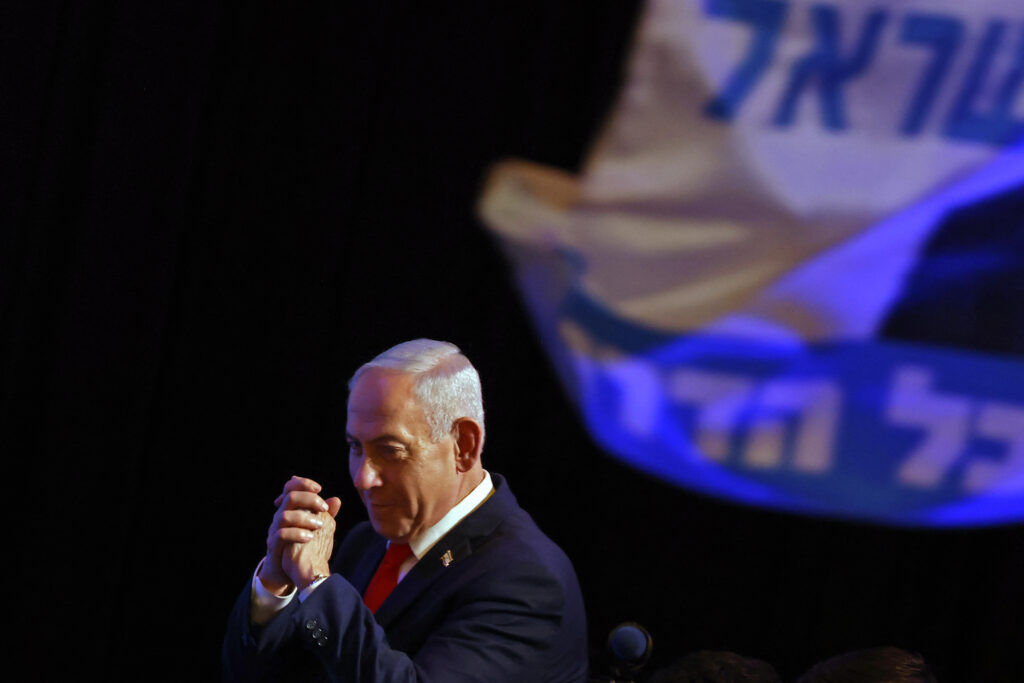
As revelers danced Tuesday at Netanyahu’s election night party, Michael Loeb, a marketing consultant and Likud official, said Netanyahu could force Eisenkot to join a unity government if Israel was to return to war alongside the United States in the coming weeks and Israel’s national security was at stake.
“We say in Judaism, ‘An emergency is bigger than everything, even the Torah,’” Loeb said. “If it’s an emergency and Netanyahu puts [a unity government] on the table, I think Eisenkot will have to say yes.”
For now, Netanyahu appears to be pursuing a strategy of simply preventing Eisenkot from forming a government.
As early as spring, Netanyahu said in campaign ads that Eisenkot would have to ally with Arab parties to become prime minister, raising pressure on the opposition camp to downplay the prospect.
On Tuesday, Netanyahu warned in last-minute statements that Arab voters and “Muslim Brotherhood supporters” were “raiding” polling stations and that Jewish Israelis had to “fight for our home.” After voting closed, Netanyahu repeated the message that Palestinian Israelis, who make up a fifth of the population, were a threat.
“We must not endanger Israel by forming a government that relies on anti-Zionist Arab parties,” he said before a rapturous crowd of Likud supporters before dawn Wednesday. His right-wing bloc, Netanyahu said, had secured “a clear majority among the Zionist public.”
So far, Eisenkot allies such as Liberman and Bennett have been tight-lipped about whether they would reconsider forming a government with Arab parties.
But the leaders of the major Arab parties, the Joint List and Ra’am, said they were willing to embrace partnership.
“We are ready and prepared to pave the way for ousting the Netanyahu government,” said Joint List chairman Yousef Jabareen. “Against the government of bloodshed, against a politics of supremacy, racism and exclusion, we offer a completely different alternative. Change runs through Jewish-Arab partnership, a real and equal partnership.”
Meanwhile, the retired general Yair Golan, the furthest-left member of Eisenkot’s opposition camp, urged his partners to embrace Palestinian Israelis and not squander the opportunity to unseat Netanyahu.
“We have no future here unless we stop being afraid, and unless we stop the racism,” Golan said. “We can no longer accept Netanyahu’s racist division between Jewish votes and Arab votes.”
“Whoever tries to erase the votes of Arab citizens is surrendering to Netanyahu and giving up on Israel,” Golan added.
The post Israeli election results show Netanyahu is far from defeated appeared first on Washington Post.