How big is the battleground for Senate control?
It might be at least one state wider than generally assumed.
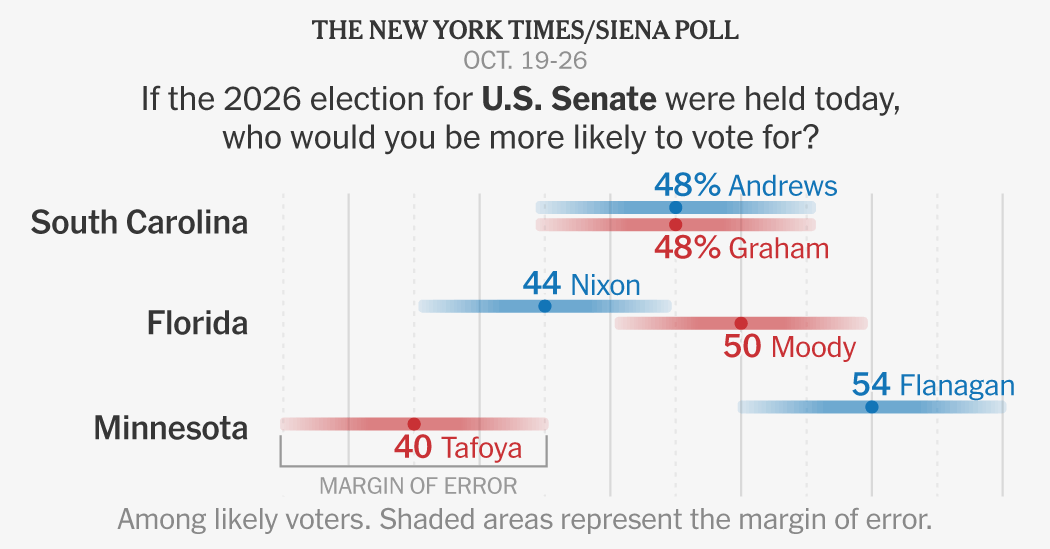
Our latest New York Times/Siena University polls of three states on the periphery of the competitive Senate map — South Carolina, Florida and Minnesota — show Democrats running well, and well enough to make South Carolina seem like a serious contest in the final stretch.
The headline is the essentially tied race in South Carolina, where Darline Graham led by less than one percentage point in a state that no one was watching at the beginning of the year. Since then, Senator Lindsey Graham has died, and his sister, Ms. Graham, has been elevated to the Senate with President Trump’s support.
The poll is far from the first sign of trouble in her bid to win a full term. In an August debate, she said national security was not “my thing,” and she’s been attacked as a beneficiary of both nepotism and Mr. Trump’s favoritism. A majority of voters in the poll disagree with the statement that she has the experience to be an effective senator. A majority say Dr. Annie Andrews, a pediatrician, does.
Over the last few weeks, both parties have started pouring money into the state, and Mr. Trump is set to visit again Thursday. There are signs of division in Republican ranks: A former Republican governor endorsed Dr. Andrews, and Ms. Graham’s main primary opponent, Representative Ralph Norman, criticized Ms. Graham’s qualifications Tuesday and said he had no plans to help her campaign.
The poll found that Ms. Graham’s weakness was particularly pronounced in the Greenville-Spartanburg area, where she lost to Mr. Norman in the primary. Dr. Andrews ran 19 points ahead of the G.O.P.’s advantage in leaned party identification in this part of the state. Elsewhere, Ms. Graham ran only four points behind the Republican Party’s advantage.
With all that in mind, the overall poll result in South Carolina is not necessarily a major surprise.
The least surprising finding is in Florida, where Republicans hold a six-percentage-point lead in the Senate race and a four-point lead in the governor’s race. It’s worth observing that the poll suggests there will be a relatively robust turnout of Florida Republicans — reflecting the turnout history of Republicans in the state, even though Democrats have gotten off to a strong start in early voting.
The most surprising result might actually be in Minnesota, where the Times/Siena poll found the state’s lieutenant governor, Peggy Flanagan, leading the Republican Michele Tafoya, 54 percent to 40 percent.
This is one of the biggest outliers we’ve ever published. No nonpartisan poll of the race has shown Ms. Flanagan up by more than four percentage points since Labor Day.
If the polls (or our polls) wind up underestimating Republicans’ strength this year, we may look back and say this was the canary in the coal mine — something like a 2026 equivalent of the Selzer poll showing Kamala Harris ahead in neighboring Iowa in 2024. In hindsight (and even at the time), that result was clearly a warning sign that pollsters were struggling to reach white working-class voters rather than any indication of Democratic strength.
There are good reasons such a warning might come from Minnesota. Unlike every other state we’ve polled this cycle, Minnesota doesn’t have party registration or partisan primary participation on the state voter file. As a consequence, we have fewer tools for correcting nonresponse bias if it turns out that one party’s voters are likelier to respond than the other’s. This poll might offer an unvarnished look at what the polls look like without their best tools.
On the other hand, it’s not unreasonable to imagine that Democrats could win big in Minnesota. This state voted for Ms. Harris by more than four points in 2024 — or nearly six points to the left of the country as a whole. Right now, Democrats are up by around nine points on generic ballot polls nationwide and by 10.5 points in our last Times/Siena poll. So, on paper, a double-digit lead for Democrats in Minnesota is basically what you would expect.
It’s also worth noting that the parties and campaigns haven’t treated Minnesota like a top-tier battleground, even though the public polls have been similar to those in states like Maine, New Hampshire and Michigan, where both parties have spent tens of millions of dollars. Instead, the most contested race in Minnesota appears to be the state’s First District, where the Democratic House Majority PAC recently bought more than $2 million in ads in a district that voted for Mr. Trump by 12 points. If Democrats are highly competitive there, it wouldn’t be surprising to see a clear Democratic victory in the Senate race statewide.
The race has been viewed as potentially competitive because Republicans nominated a solid candidate in Ms. Tafoya, a former N.F.L. sideline reporter, against Ms. Flanagan, a progressive Democrat in a state where Democrats have slogged through a social services fraud scandal.
The poll does bear some of the hallmarks of that case for Republican optimism. Ms. Tafoya is actually viewed more favorably than unfavorably by six points — a rare feat for a Republican in a blue state, let alone in what looks like a pretty blue poll of a blue state. A greater share of voters say Ms. Flanagan is too far to the left than say Ms. Tafoya is too far to the right — yet again, quite a feat in a blue state.
My guess? Our Minnesota poll is probably too hot for Democrats, given what we know about nonresponse bias in general and the challenges of dealing with it in Minnesota specifically. Nonetheless, the poll may not be as far off as one might usually guess for a big outlier. This race might not be a real battleground.
The post What Our New Senate Polls Tell Us About the State of the Midterms appeared first on New York Times.