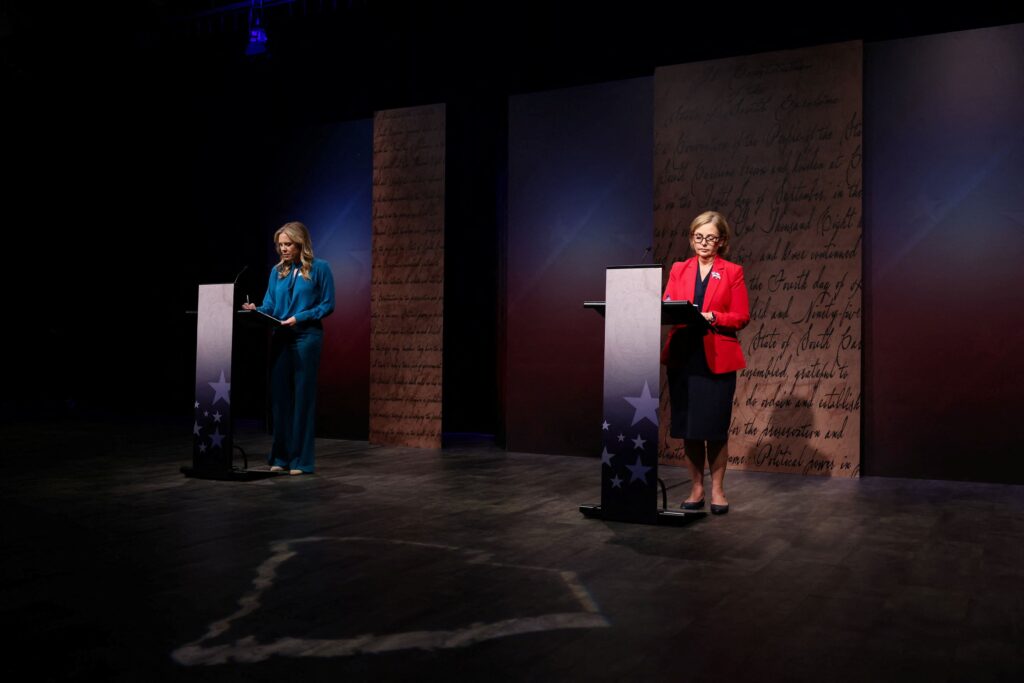
At a Rhode Island debate last week, two candidates for governor turned into hall monitors. Democratic front-runner Helena Foulkes and Republican Aaron Guckian each called out independent businessman Ken Block for bringing typed notes onstage in violation of the rules. The payoff for tattling came in the ensuing made-for-TV moment: Everyone watched a sheepish Block eat crow, tucking his cheat sheet away and showing his hands to the audience.
Fear of such minor missteps going viral is just one reason there have been fewer debates this midterm year. A review by ABC News found that 21 of 36 gubernatorial races will pass without a debate. In 2018, just two states skipped them. The same trend holds for Senate elections — 21 out of 35 races will not feature a debate, a 50 percent increase from four years ago. For all the advantages that can be gained from a solid performance, a gaffe or shaky showing can be disastrous. Today, a candidate’s calculus increasingly hinges on a simpler question: Why bother?
Their reasons for opting out are all over the place. In Alabama’s gubernatorial election, Sen. Tommy Tuberville (R), a MAGA firebrand sitting on an 11-point polling lead, refused to debate on pragmatic grounds, declaring, “There’s no reason to get up there and argue about differences of opinion.”
In Florida, Democratic nominee for governor David Jolly took an ideological stance, saying the nation’s politics are broken, and debates only “further the division, further the toxicity, further the insults, further the mistruths, further the bad faith.” And in North Carolina, both Senate candidates have taken a strategic approach: be open to debate but never agree to one; better to spend that time on cable news appearances and curated events to rally the base. No matter the explanation, the outcome is the same: Voters are denied the chance to see the candidates face scrutiny and each other.
Political debates are most useful when they have clear rules and formats, when candidates believe engaging their opponent is worthwhile to the campaign and the public, and when they serve as important civic rituals in a democracy. Since the late 20th century, televised debates have been common and widely expected for candidates competing for federal and statewide office. They offer a rare chance to speak to large audiences, followed by extensive media coverage. And they provide voters an opportunity to see the candidates largely unscripted and in the hot seat — conditions favorable to getting a glimpse of character and preparedness rather than monologued quips in safe spaces.
Sometimes they’re successful. The Senate race in South Carolina has gone from a safe GOP seat to a virtual tie in the weeks following Republican Darline Graham’s widely panned debate-stage admission that she’s “not that informed on national security.” Sometimes they’re informative. The Michigan gubernatorial and Senate debates pinned candidates down on their support for past policies and presidents, their platforms and agendas, and their character, providing stark contrasts for still-deciding voters. And sometimes they are revealing. Texas state legislator James Talarico (D) has repeatedly challenged Attorney General Ken Paxton (R) to a debate; Paxton, laden with scandal, plays indifferent, and his dodging is its own closing argument.
But extreme polarization, alongside candidates’ ability to bypass traditional media for direct-to-voter social platforms, has upended the landscape. The civic ritual now is to flood airwaves and mobile devices with attack ads and caricatures of opponents. If the age of debate is ending, then what replaces it should be worrisome to voters.
Ohio offers proof. In the tight gubernatorial race there, Democrat Amy Acton declined to debate Republican Vivek Ramaswamy, labeling him a “scam artist who spreads baseless lies.” Her decision last month seemed prescient when Ramaswamy surreptitiously released an ad last week featuring Acton’s estranged mother — whose husband was indicted for raping Acton as a child — claiming her daughter is a liar unfit to govern. Ramaswamy then turned hypocrite, chiding Acton for not settling “disagreements through dialogue, through respectful, civil, open debate.” But while free speech tolerates unethical and bad-faith attacks, weaponizing personal trauma and marketing it as civic discourse poisons the very democratic society that debates are meant to enrich.
In a well-functioning democracy, debates help inform the public, give candidates the floor to persuade voters, and serve to legitimize the process and the outcome. But in the hands of unprincipled candidates playing “gotcha” politics, the best one can hope for is something akin to a joint news conference. More often, they devolve into chaotic shouting matches where candidates talk about each other rather than to one another. These stages are among the last remaining in-person forums where campaigning politicians can appear together and model tolerance and constructive dialogue. Today, candidates are more likely to view debates as traps with no upside.
Besides, what advantage does debating offer candidates when there’s little penalty for skipping them altogether? The rebuttal from Republican candidates can be summarized this way: “Well, what are you going to do — vote for communism?” Democrats who opt out suggest that elections are not helped by giving credence to MAGA politicians co-signed by the historically unpopular President Donald Trump. Better to avoid the unpredictable made-for-TV moment by producing short ads clipping an opponent eating crow, perfectly curated for a media-saturated electorate to devour.
The post Why won’t candidates debate? The reasons go beyond this viral gaffe. appeared first on Washington Post.