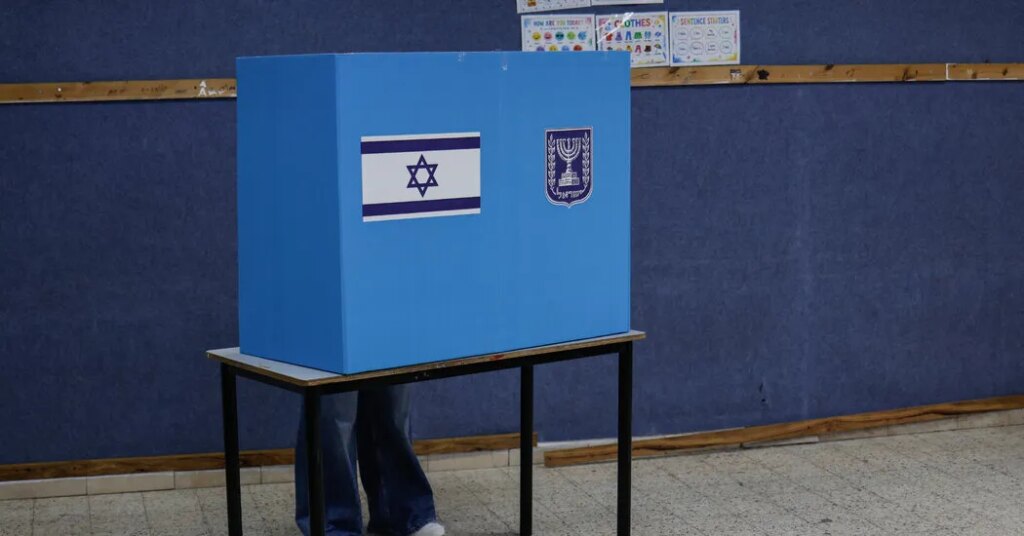
Israelis turned out in huge numbers on Tuesday to choose their next government. But with exit polls suggesting no clear winner, it could take weeks, months or longer to determine who will be prime minister.
The exit polls showed that the right-wing alliance of the incumbent prime minister, Benjamin Netanyahu, and the opposition bloc led by a former military chief of staff, Gadi Eisenkot, were nearly even, with neither in a firm position to form a government. Most votes were expected to be counted by Wednesday, though it could take longer to reach a final tally.
In Israel’s parliamentary democracy, voters choose a party or alliance, and the leader of the party with the greatest number of seats in the 120-member parliament, or Knesset, does not automatically become prime minister. Forming a government could take lengthy negotiations among the various factions — and if those fail, the country could face another election.
Here’s what to know.
What happened on Election Day?
Turnout nationally was 77.7 percent when the polls closed, according to Israel’s Central Elections Committee, the highest since 1999.
Both Mr. Netanyahu and Mr. Eisenkot struck triumphant notes in speeches to supporters. Mr. Eisenkot declared that “the public opted for change,” while Mr. Netanyahu said that his party, Likud, had emerged with the most seats and called for “a strong right-wing government.”
Israel’s Arab citizens, who make up about 20 percent of the population, voted in large numbers with the stated desire to oust the far right. Exit polls pointed to a strong showing by Arab parties, putting them in a position to play a possibly decisive role in forming a government. Mansour Abbas, the leader of Raam, an Islamist party, told a television interviewer on Tuesday night that the turnout showed that “frustration and despair” in Israel’s Arab society had “turned to hope.”
How are votes counted?
Israel’s electoral system uses nationwide proportional representation. Each voter casts a ballot for a list of candidates affiliated with one or more parties or slates. Each list receives the number of Knesset seats proportionate to its share of the national vote, so long as it got at least 3.25 percent of valid votes. About 10 parties are expected to clear that threshold.
How is a government formed?
No single party has ever won a majority on its own in Israel. That means parties have to negotiate to forge coalitions that can reach a majority in the Knesset of at least 61 lawmakers.
Within seven days of the announcement of the official election results, Israel’s president meets with elected representatives from the parliamentary factions. He can take recommendations and is not obligated to select a potential prime minister from the party that won the most votes. He may instead determine that another leader is more likely to be able to form a coalition that can win a vote of confidence in the Knesset.
The absence of a clear winner in Tuesday’s election could leave the president, Isaac Herzog, facing a difficult choice over whom to ask to form a government.
Once the president decides, that candidate has 28 days to negotiate with other factions. A 14-day extension to the deadline can be requested.
If that effort fails, the president can select another candidate, who also has 28 days to try to form a government but has no option to extend. If the second attempt fails, a majority of Knesset members can ask the president to have a third candidate try. That person would be granted 14 days to form a government, and if that fails, new elections are announced.
Technically, the law allows for a minority government if the relative majority supporting it is larger than the minority opposing. Mr. Eisenkot has floated that possibility.
Historically, it has taken about 20 to 100 days to form a government, according to the Israel Democracy Institute, a nonpartisan think tank.
Who will likely lead Israel?
The initial exit polls do not always give an accurate sense of the final results, so it may be some time before the picture becomes clear. For example, exit polls do not reflect the votes of hundreds of thousands of Israelis who cast ballots at special polling stations, including on military bases and in hospitals, prisons and embassies abroad.
In the 2022 election, those votes tended to favor Mr. Netanyahu and his allies.
What the exit polls do suggest, however, is that neither of the main coalitions — the far-right bloc led by Mr. Netanyahu and the center-right alliance led by Mr. Eisenkot — is likely to reach a majority, meaning they would have to negotiate with smaller players and possibly have to make significant compromises.
Two Arab parties were projected to win as many as 18 seats in the Knesset, potentially making their support crucial to assembling a government. But Mr. Netanyahu has in effect ruled out including them in the coalition. Mr. Eisenkot and his partners have also balked at the prospect.
Some of Mr. Netanyahu’s allies have floated a unity government with Mr. Eisenkot and other centrists that could keep him in power. But that would carry a heavy political cost for Mr. Eisenkot, who has said Mr. Netanyahu is unfit to lead.
The post Israel’s Election: When Will We Know Who Will Be Prime Minister? appeared first on New York Times.