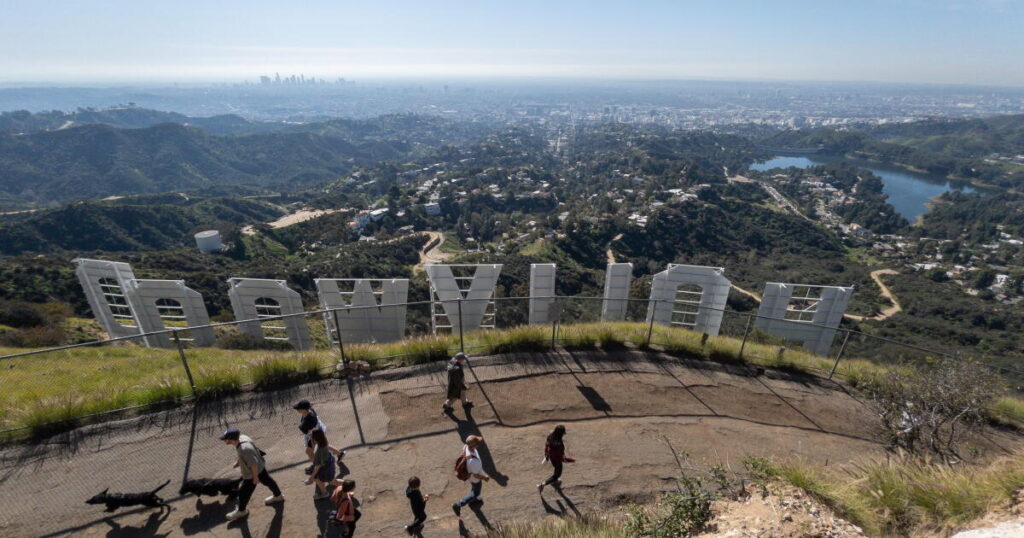
Neighbors of the Hollywood sign say crowds have made life a misery and a danger — and it’s the city’s fault in part because, some 15 years ago, a councilman decided to clear some brush to create a viewing spot.
Cynthia Cobb is one of those neighbors. She said when she and her husband moved to Lake Hollywood in 2017, they were looking for a home with a view.
The house they bought on Arrowhead Drive, several feet from Lake Hollywood Park, fit the bill perfectly, with direct views of the Hollywood sign.
Sure, a few tourists would sometimes stop by the park to snap pictures of the iconic sign, but she didn’t mind. Traffic jams weren’t a major concern, since most park visitors were locals taking their dogs out for walks.
But after the pandemic, the park got busier and busier, said the Hollywood High School counselor. Hordes of tourists started blocking her driveway and ignoring parking signs along her street. Worse, visitors would smoke and discard cigarette butts on the ground, even on high-fire-risk days, she said.
The crowd problems only get worse around the holidays, she said. Over Fourth of July weekend, a drive to a grocery store that normally takes roughly eight minutes can take more than 45 minutes.
Cobb worries about the possibility of a wildfire disaster akin to the Palisades and Eaton fires, given the narrow, winding roads in her neighborhood. Would motorists abandon their cars and flee on foot because they were stuck in traffic, as they had in the Palisades? Would the vehicles block firefighters from reaching her neighborhood? Cobb fears the answers to those questions.
On Monday, the group of Hollywood sign neighbors filed a legal complaint against the city of Los Angeles, Mayor Karen Bass and Councilmember Nithya Raman, whose district includes the neighborhood. They argue the city is responsible for nuisance conditions on public property because it promoted the area as a viewing destination and didn’t take steps to address residents’ complaints.
“They are at their wit’s end,” said attorney Ilan Wurman, who is representing the group of roughly 100 residents who live in homes in Hollywoodland, Lake Hollywood Estates and Hollywood Knolls. “They have tried in good faith to have discussions and negotiations with the city for over a decade.”
Wurman, a professor at the University of Minnesota, previously won an injunction in a high-profile public nuisance lawsuit over a homeless encampment in Phoenix. Cobb had read about the case in the New York Times and shared the story with a neighbor who then contacted Wurman.
“We think the city has actively participated in the creation of the amenity, this international tourist destination, without taking steps to compensate for the corresponding nuisance injuries that have occurred that’s sort of this necessary consequence of packing tens of thousands of people in this neighborhood of narrow and winding streets,” Wurman said.
The legal complaint argues the city “encouraged the streets, sidewalks and parks” in the three neighborhoods to become a “public nuisance” through several actions, including in 2011 when Councilman Tom LaBonge cleared brush around 3100 Canyon Lake Drive to make way for a viewing site. That spot, now labeled as the “Hollywood sign lookout” on Google Maps, attracts many tourists as well as street vendors. Wurman said, neighbors have documented numerous instances of unsanitary behavior, including public urination and defecation.
In a statement, Mayor Karen Bass’ office said it had not yet seen the lawsuit. But, the office said, the Los Angeles Police Department dedicates additional units during peak periods of congestion in the Lake Hollywood area to conduct traffic and parking enforcement. The LAPD has also worked with the city’s transportation department to implement a traffic plan for the area, the office said.
Councilmember Nithya Raman’s office said in a statement that it could not directly comment on active litigation but that neighbors living beneath the sign “shouldn’t have to absorb the gridlock and safety risks that come with [visitors] on narrow hillside streets.”
“Every year since taking office, we have funded additional presence from LAPD and LADOT, adjusting both staffing levels and deployment locations in response to community feedback,” the statement read. “Since May, our office has arranged and funded LAPD and LADOT deployments every Friday through Sunday from the Fourth of July through Labor Day, which has increased ticketing and towing in the area.”
Raman’s office said it had identified funding for a pilot plan to address traffic around the Hollywood sign on peak visitor days and holidays. The plan will be tested before the 2028 Olympics, the office said.
The city attorney’s office did not respond to The Times’ request for comment Tuesday night.
Concerns over Hollywood sign crowds aren’t new. The Times reported in 2011 that neighbors were unhappy with crowds and then LaBonge showed up with shovels and a few aides, interns and field deputies to remove brush and spread gravel to make room for tourists to take pictures. One neighbor, Sarajane Schwartz, then-president of the Hollywoodland Homeowners Assn., worried the roadside improvement would “act as a huge magnet for even more tourists.”
Wurman said the residents are seeking an injunction, not monetary compensation. The residents want a court to rule that Los Angeles must abate the nuisance on its properties, Wurman said. The city would have discretion over how exactly to do that, but one possibility is that L.A. could follow Paris’ lead in restricting tourist crowds around the Eiffel Tower. Or the city could replant vegetation at the Canyon Lake Drive lookout area, he said.
Cobb, who estimated that she picks up diapers and bottles filled with urine once or twice a week, said she’s not sure what the solution is. Tourists regularly knock on her door to ask to use her restroom, she said. Adding a restroom to Lake Hollywood Park might help, but it won’t fix the traffic jams that make her anxious about fire access. The park was never supposed to be a tourist destination, Cobb said. “It’s like taking an aspirin for a headache when you have a brain tumor,” she said.
But she’s hoping that an injunction will push the city to take some action.
“I’m hoping to feel safe in my neighborhood again,” Cobb said.
The post Living near Hollywood sign means cars, diapers, bottles of urine. Neighbors say they’ve had it appeared first on Los Angeles Times.