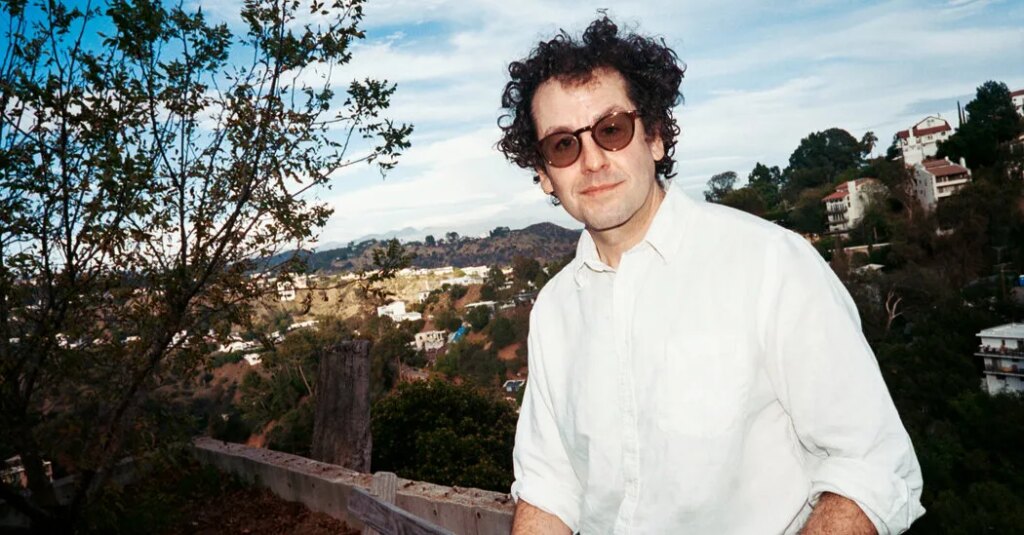
Sam Wasson, a Hollywood obsessive and chronicler of a shrinking industry, was sitting at the kitchen table in his charmingly ramshackle Laurel Canyon home, describing how — and why — he came to write a mammoth biography of his hero, the film director Frank Capra.
Wasson still remembers the “spiritual experience” of watching “It’s a Wonderful Life,” the director’s most enduring film, for the first time in his Wesleyan University dorm room. Later he was inspired, too, by 1930s Capra classics like “Mr. Smith Goes to Washington” and “Mr. Deeds Goes to Town,” movies that showed the triumph of the Everyman in Depression-era America.
Capra directed 36 feature films, as well as many documentaries, but after World War II his career went into a long slide; eventually he couldn’t get a movie made. By the end of his life, he was volunteering as a greeter in the lobby of a resort in the California desert. He died in 1991.
As cinematic sensibilities changed, the filmmaker’s emotionality came to be derided as “Capra-corn.” A highly critical biography further diminished his reputation.
Wasson, now 45, with a mop of dark curly hair, had a strong conviction that the director deserved another look, and a more generous hearing. “First of all, it’s love,” he said by way of explaining his motives. “But what makes it important to share that with the world is to elevate Capra in people’s esteem.”
Wasson’s 752-page “Frank Capra: A Life,” which comes out on Oct. 27, will be his ninth book. Three have been New York Times best sellers, including “Fifth Avenue, 5 A.M.: Audrey Hepburn, ‘Breakfast at Tiffany’s,’ and the Dawn of the Modern Woman,” published when he was 28. His biography of the choreographer and director Bob Fosse was adopted into the TV mini-series “Fosse/Verdon.”
How does he get it all done? In an elegant office he enters through his garden, the shelves lined with volume after volume of Hollywood history. “I walk in here every morning at 9 with my coffee, and I come out at 5, with a martini,” he said.
He isn’t married; he has no children. He becomes so immersed in his subjects that when he was working on his Fosse biography, he told his girlfriend at the time, “Just know you’re getting into a threesome.”
And why does he get it all done? Hollywood artists are “misunderstood,” Wasson said. “I want to smooth out America’s relationship with Hollywood because it’s unnecessarily complicated. And it shouldn’t be.”
Wasson, a Los Angeles native, went to Wesleyan to study with Jeanine Basinger, the prolific scholar and renowned director of the school’s film studies program.
Thanks to Basinger, Capra was in the air on campus. The two had become friends in the 1970s, and she secured his papers for the university’s cinema archives, which she spent years building.
Wasson and Basinger have stayed close; in 2022 they collaborated on “Hollywood: The Oral History,” described in The Times as a “fat, showbiz-nerd-satisfying tome.” Indeed, Wasson can seem like a man from another era.
It’s Capra’s era, the 1930s and 1940s peak of the studio system, that he would choose to inhabit, if he could, as a writer, director or producer, “just to have a creative place at the party.”
Wasson, who attended U.S.C. film school after Wesleyan, is unabashed in his devotion to the “utopian premise” of mid-20th-century Hollywood. “We made the world better,” he said. “We were creative and we gave myth meaning. And artists made money.”
For Wasson, Capra was the Hollywood director par excellence, the first to put his name above the title (a phrase that became the title of his 1971 autobiography) and draw attention to the idea that movies are, as a director’s medium, an art form unlike any other.
But his life was rife with contradictions. Francesco Capra immigrated to the United States from Sicily at the age of 6. His father shined shoes on the streets of downtown L.A.; a teacher had to convince his parents to let him attend high school rather than go to work.
Capra was the first member of his family to go to college. He grew up to be a Republican who opposed Roosevelt and the New Deal, and seems to have been ambivalent at best about the progressivism his movies celebrate.
And after World War II, when the Red Scare arrived in Hollywood, Capra named names. Many of them.
These complexities were amply described in “Frank Capra: The Catastrophe of Success,” Joseph McBride’s blistering 1992 biography. McBride, an accomplished film historian, began his research in the 1980s, gathering firsthand accounts from Capra and more than a hundred of his contemporaries who were still alive.
The newly donated Capra papers were still in boxes when McBride went to examine them at Wesleyan. But Basinger promised him full access, he said in a recent interview.
McBride homed in on a file that Capra had sent to the military security board in 1951, listing several colleagues and acquaintances as Communists or likely sympathizers. Capra wrote the letter after discovering that the Army had revoked his own security clearance.
“The naming of names really changed my belief in Capra,” McBride said. “I found out he was a fraud, basically. He purported to be this liberal Gandhi-like lover of humanity, but I found out he was pretty much a misanthrope.”
McBride said his relationship with Basinger and with Knopf, his publisher, disintegrated as he delved into his research and “iconoclastic” focus.
Eventually, Basinger precluded him from quoting freely from Capra’s papers, including his personal writings, McBride explained in a follow-up book he self-published about the experience. He referred to Basinger as his “antagonist.” (Basinger, who retired from Wesleyan in 2020 after 50 years of teaching, flared when asked about this history and declined to comment.)
Published by Simon & Schuster, McBride’s 768-page biography drew positive reviews, in The Times and elsewhere, helping to rebrand Capra in an unflattering light.
Wasson said his own account is the first to draw on the entirety of Capra’s papers, including the diaries he kept in the last 20 years of his life, access that brought him “one step closer to the heart and soul” of the man himself.
Of McBride and his book, he said: “It makes me sad because I don’t like profoundly disagreeing with such a formidable historian.”
Yet he maintained there is a fundamental difference in their philosophies.
“How much compassion do you afford your subject?” Wasson said. “This is a biographer’s challenge, prerogative, gift, curse. I always want to give the most possible. I think with a rare exception you’re not doing the job if you don’t.”
By the late 1940s, Capra had worked for the Army making war films; suffered the loss of his 3-year-old son; and sold his independent production company, Liberty, after releasing only two movies. He was shadowed by illness and depression. “Capra lost his nerve,” Wasson said.
Finding himself under suspicion by the Army was personally devastating. He was “an immigrant who had to take care of himself when no one else would, who was out for Number One because his life depended on it,” Wasson said.
Structured with a screenwriter’s panache, his book has its own share of disturbing details. He describes how Capra singled out a young man he had known since childhood, whom he’d seen playing a prank with college friends, flying a flag that said “Communist Youth Outing.” His father was the screenwriter Jo Swerling, with whom Capra had fruitfully collaborated. But that didn’t stop Capra from alerting the F.B.I.
In an interview McBride predicted that the director’s cheerleaders would welcome Wasson’s biography.
“There are a lot of fans who don’t want to hear the bad news about Capra,” McBride said. “I think a lot of people will like the fact that he just sort of prints the legend again — with some exceptions.”
Among his objections, McBride faulted Wasson for soft-peddling Capra’s tendency to minimize the roles of his collaborators, most notably the screenwriter Robert Riskin.
But for Wasson, “movies are not plays. They do not need great scripts; they need great directors.”
In an enthusiastic review in The New Yorker, Anthony Lane called Wasson’s book “hefty and dense,” like McBride’s, but “altogether less corrosive in tone.”
“The moral is: Like a movie star, Capra can be shot from multiple angles,” Lane wrote. “Take your pick.”
It’s an assessment Wasson likely wouldn’t dispute.
At the end of the interview, he drove us through the fierce L.A. heat to Hollywood Forever, the splendidly kitschy cemetery where many movie legends are buried, located just beyond the old Columbia Pictures sound stages where Capra made some of his best movies.
Harry Cohn, Columbia’s notorious studio head, who hired Capra and profited from his talent, is buried here in a lavish marble crypt.
Working on his book, Wasson said he occasionally visited Cohn’s grave to remind himself that he was writing about real people, not two-dimensional symbols all good or all bad.
“I hope the reader sees it from both sides,” Wasson said. Of Capra, he added: “I hope the reader says I love you and I’m mad at you.”
The post How Wonderful Was the Man Who Made ‘It’s a Wonderful Life’? appeared first on New York Times.