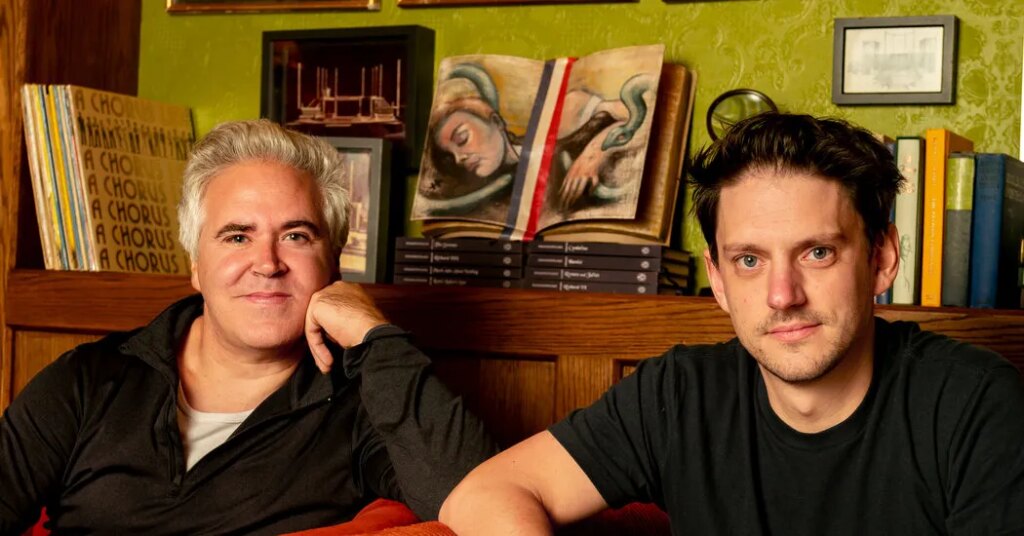
Jethro Compton wasn’t yet 30 when he read “The Curious Case of Benjamin Button,” F. Scott Fitzgerald’s 1922 short story about a man who ages backward. Compton plucked the story from a list of works in the public domain, partly because he had recognized the title from David Fincher’s 2008 film adaptation. He thought that the tale might make a good play.
“It was larger than life, and there was an impossibility to it and something inherently theatrical in that,” said Compton, a playwright, director and producer.
Nearly a decade later, “The Curious Case of Benjamin Button” is making its U.S. debut in an Off Broadway production at the Public Theater (and scheduled to run there through Dec. 20). What took so long for a musical about aging in reverse to grow up?
“We want to get the show right before we send it out around the world,” Compton, now 38, said in September, during a conversation at the Public and before rushing off to rehearsal, where he was still refining the script. And onto Broadway? “There have been conversations about every possible thing,” Compton added.
Back in 2017, Compton was tinkering with two projects — the “Benjamin Button” adaptation and a folk musical set in a Cornish fishing village. Eventually, he realized that even though the Fitzgerald story begins in Baltimore, these shows could be one and the same. “I don’t think the themes of the short story are American themes,” he said. “It deals with a universal idea that can work in any setting.”
He booked a London fringe theater for the spring of 2019 and then arranged for a workshop with a composer, but that composer arrived late and never produced any music. Eventually, a colleague steered him to Darren Clark, who had recently composed a folk musical called “The Wicker Husband.” They met up in the spring of 2018 for a long conversation over beers, and then they worked together on a song, “The Gulls.”
“I was like, yeah, this is something for me,” Clark, 45, said.
The pair wrote, together and apart, for the next nine months. Just before rehearsals started, Compton, Clark and some of the show’s designers traveled to Cornwall, England, where Compton grew up, to gather materials for the set (fishing nets, lobster pots) and to absorb the feeling of the place. That trip altered the music. Originally, clocks were a leitmotif, but in Cornwall, Clark realized that before clocks, people told the time by the tides. “The music started to be less mechanical and more elemental and flowing,” Clark said.
After three weeks of rehearsal, the whole company of actor-musicians traveled to Cornwall for a week, and then headed back to the Southwark Playhouse in London. That run opened to packed houses and rave reviews. Soon commercial producers were circling. “‘Bidding war’ sounds too fabulous and aggressive, but I’m going to say bidding war,” Compton said.
Those producers had a lot of ideas. Some of them wanted Compton and Clark to ditch the actor-musician conceit. Others wanted to scale up too abruptly. Eventually the pair partnered with ATG Productions, which allowed them to develop the musical in their own time. Pandemic lockdowns slowed that development, but as soon as possible, Compton and Clark returned to the show, holding more workshops, letting go of some roles and songs (including “The Gulls”), adding others. “Putting it on ice and giving it that time to breathe was the best thing for the show, because it really just allowed it to grow up a bit and mature,” Compton said.
They were aiming for the West End, with an out of town tryout at one of England’s regional theaters on the way. When that theater backed out, the production returned to Southwark Playhouse, which had recently opened another space, for a new run in 2023. That production eventually transferred to the West End, where it ran a year and won three Olivier Awards, including best new musical.
Oskar Eustis, the artistic director of the Public Theater, saw the show in the West End and was immediately smitten. “I was completely blindsided,” he said. “Normally I don’t go to West End musicals, scouting them.” He asked for a meeting with Compton and Clark, mostly to congratulate them, but eventually they all decided that the Public would be a good place to continue to refine the show. (A separate production will open in South Korea next year.) In rehearsals, they tightened the structure, fine-tuned the music and lyrics, tamping down the sentimentality.
Still, the show is plenty sentimental. Andrew Durand, who plays Benjamin from 70 to infancy, said that he was crying in rehearsal almost every day. “In a good way,” he clarified. “It is one of those great moments where doing your art can be therapeutic and cathartic.” He sees the show, which has more than its fair share of tragedy, as ultimately life-affirming. “It’s about being in the moment and seizing the moment with the people that you love,” he said.
Eustis echoed this, describing the show as “a bummer exactly in the way life is a bummer.” A memento mori in song form, it emphasizes life’s shortness and strangeness. “Yes, there’s loss,” Eustis said. “But that’s also where all the joy comes from, in recognizing that it’s limited and in figuring out how to appreciate and fully embrace the time you have.”
In the years that Compton and Clark have been working on the show, time has of course moved forward. Compton opened and closed a furniture business and moved back to Britain from Austria; Clark married and had a baby. But they’re happy to have arrived here, with a show that finally feels grown and ready. They love it. They hope audiences will, too.
“I just want people to love it and to come out with a sense of the joy of life,” Clark said.
The post How ‘The Curious Case of Benjamin Button’ Grew Up appeared first on New York Times.