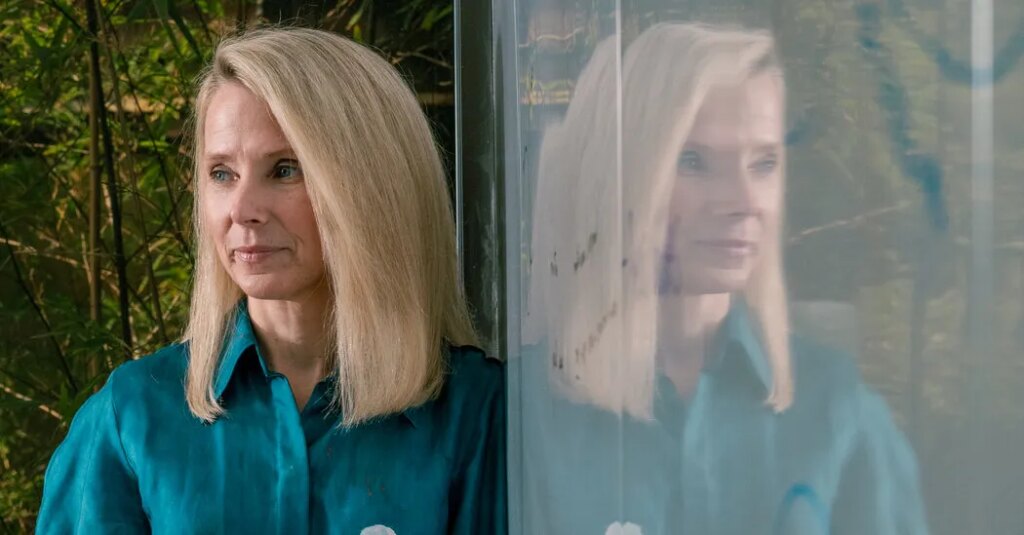
Late last year, Marissa Mayer was struggling with what felt like an impossible task.
Her daughter Marielle was turning 10, and Marielle’s teacher wanted three bullet points summarizing what made her special. Mayer — the former chief executive of Yahoo and a pioneer at Google, where she was the first female engineer — likes cracking a hard problem. But she felt overwhelmed by the range and complexity of potential answers.
So Mayer asked her personal A.I. assistant, Dazzle. Within a few seconds, Dazzle delivered an answer.
“It came back and was like, your daughter is empathetic, creative and an animal lover,” Mayer said. She thought it was perfect.
Dazzle is a new consumer tech product from Mayer’s start-up, and her first push into the competitive marketplace for A.I. personal assistants. With Dazzle — which analyzes images in users’ camera rolls to answer questions, perform tasks and make suggestions — Mayer is aiming to build an A.I. tool that can handle everyday hassles, like buying a pair of pants you took a photo of, or finding a birthday present for your picky spouse.
“A lot of what excites me is taking something that used to take you hours or minutes, and now getting it done in seconds,” Mayer told me at her company’s office in Palo Alto last month.
Dazzle may seem smaller in scope than the monumental challenges Mayer tackled earlier in her career — leading search at Google, or working to resurrect Yahoo when the company was flailing. And other people are using artificial intelligence to cure diseases and solve impenetrable problems in physics and math. Yet to Mayer, harnessing A.I. to tackle mundane tasks feels big.
She thinks normal people who are not tech obsessives — and busy women in particular — will be drawn to an A.I. assistant that’s trained on their visual aesthetic.
“Women, this is my own bias, tend to take more photos and are more visual, and so being able to work with A.I. in a visual medium is fun,” Mayer said. “It essentially understands your personality, your likes, your dislikes, because it knows what you think looks good.”
And maybe what overextended professional women need is an A.I. wife, an emotional labor bot that can plan a birthday party and knows when it’s Crazy Socks Day or Crazy Hat Day at the kids’ school, because it has photos of the fliers that came home crumpled in a backpack.
Mayer is rolling out her A.I. product at a moment when high-profile women in Silicon Valley are worried A.I. has a gender problem. Even Anthropic’s own Daniela Amodei, the leading lab’s president and co-founder, has raised alarms about A.I. becoming “a tool that’s just for the guys.” Women don’t use it as much as men do. The models themselves have been forged by a male-dominated culture and, some studies have found, have ambient sexism baked in. And there are very few women leading frontier A.I. companies, which are shaping not only the future of tech, but the future of basically everything.
“I’m very disappointed in what’s happening in tech and across the board,” said Sheryl Sandberg, the former chief operating officer of Meta, whose organization, Lean In, has been tracking the gender gap in A.I. “There is deep cultural stagnation for growth of women in leadership roles. It’s a very scary moment for women.”
All of that could be fertile ground for launching an A.I. assistant that promises to shoulder some of the domestic load, a product that might bring more women into the world of constant A.I. users.
Building a life-hacking A.I. assistant is in some ways a fitting move for Mayer, 51 — who was once a widely recognized avatar for ambitious women trying to have it all.
In her nearly three decades as an engineer and tech titan, Mayer has shaped some of industry’s biggest innovations. At Google, she led search for a decade and oversaw Google maps, news and Gmail — products that changed the way billions of people use technology.
She has also faced intense scrutiny as one of the most visible women in tech. As the chief executive at Yahoo, she drew withering criticism for failing to revive the struggling company, and was often judged in sharply contradictory ways, as frivolous and attention-seeking when she threw lavish parties, or as too hard-driven when she worked during her abbreviated maternity leave.
Now Mayer has reinvented herself as a start-up founder, with a team of 10 engineers — a fraction of the armies of programmers she once commanded. And she is doing so during another technological revolution, as women in tech are once again feeling pushed to the sidelines.
Mayer said she is more excited than scared by the promises and perils of A.I., firm in her belief that artificial intelligence will help humanity and not destroy it, and in her conviction that eventually, women will rise in the ranks.
“I think gender balance will come in time, because this is a field that’s moving so quickly,” she said. “I’m generally an optimist.”
Ready to Dazzle
Dazzle’s headquarters sit in a bland, brown shingled commercial office building in downtown Palo Alto. But through the glass doors, it’s all rainbow hues and sparkles.
Small and cheerfully decorated, with whimsical touches like glittery rainbow sequin pillows, a foosball table and a giant teddy bear, the office looks like the set of a children’s television show, except for a poster with Dazzle’s mission statement: “To close the gap between what people want and what people can do with A.I.”
It was a sunny day in late September, the week before Dazzle’s launch. At an all-hands meeting, Mayer’s two chief technology officers updated her on design tweaks and Dazzle’s ability to search the web and make purchases.
“I know it’s a busy time,” Mayer said, glancing around the conference table. “But is there anyone who’s like, Wait, I need more on my plate?” she asked, drawing silence.
Mayer has a startling staccato laugh. When she’s excited about something, which she often is, she speaks in a frenetic rush, as if her words are racing to keep up with her thoughts. As we sat in her office, which is festooned with family photos, artwork by her three children, and knickknacks and souvenirs she’s collected, Mayer’s human assistant brought her a mug of tea, anticipating that she would need it during a long day of meetings.
“She never gives me tea, but obviously, I’ll take advantage of it today,” she said.
Mayer was eager to show me what Dazzle, which she called “one of my babies,” could do.
“The play dates are better, the travel is better,” she said of her be-Dazzled life.
She’s used it to find a family activity during a vacation in Venice (Dazzle proposed a Venetian mask-making workshop that the whole family loved); to plan a play date for one of her twin daughters (Dazzle knows Marielle is into magic, and suggested visiting a magic shop in San Francisco); and to choose a theme for her son Macallister’s 14th birthday party (Dazzle recommended a glow-in-the-dark pool party, and found glowing pool toys and corn hole).
“He was like, ‘Mom, I don’t want to hit the theme that hard,’” she said. “I just can’t help myself.”
Mayer has also turned to Dazzle for advice on what to wear, and asked it for Halloween costume ideas. “Halloween is very big in our house, and I’m terrible at Halloween, I never know what to be,” she said.
She held out her phone to show me the image Dazzle sent her of a woman in a gown shaped like a frosted layer cake, inspired by the famous cake paintings by the artist Wayne Thiebaud. (Dazzle knows she loves baking and art; she’s going to wear the cake dress to take her kids trick or treating, she said.)
It’s a tricky moment to launch an A.I. assistant, and not just because Mayer is competing with giants like Meta and OpenAI. Each week brings disturbing revelations about A.I. agents escaping human control; many people, one imagines, might not want A.I. loose in their camera rolls.
Even setting aside doomsday predictions about the A.I. apocalypse, there’s still widespread anxiety that A.I. is siphoning away what makes us human, shaping not just how we work, but how we celebrate life’s milestones and spend our leisure time.
To Mayer, outsourcing some of the mental load to the machines isn’t a bad thing. (At one point, she mused enthusiastically about the potential efficiency gains of having her A.I. assistant talk directly to her husband’s A.I. assistant).
Emotional labor, after all, is still labor.
“A lot of these things, like figuring out what you want to be for Halloween, figuring out the theme for your child’s birthday party, they should be fun, but in many cases, they become such a chore and so time consuming,” she said.
When I asked Mayer if it’s somewhat depressing to imagine a frictionless future when birthday celebrations, holiday gifts and family vacations are planned by A.I., she seemed caught off guard.
“I haven’t really thought that through,” she said.
The Reluctant Trailblazer
Long before the A.I. boom, Mayer was fascinated by the promise of artificial intelligence, which she studied as a computer science major at Stanford.
At the time, there were few women in her field, and Silicon Valley had a “bro culture,” she said. Still, as an engineer who describes herself as “data driven maybe to a fault,” Mayer thrived. In 1999, she became the 20th hire at Google, where she eventually oversaw a team of thousands of engineers.
“I don’t remember her as someone who was constantly evangelizing for women at Google, but behind the scenes she was very conscious of hiring women and helping the women that worked for her,” said Jonathan Rosenberg, an adviser at Alphabet who worked with Mayer at Google.
When Mayer was tapped to lead Yahoo in 2012, her appointment was hailed as a breakthrough for women in tech, and for women in general. Then she announced that she and her husband, the venture capitalist Zachary Bogue, were expecting their first child. Once again, Mayer was an unwitting pioneer — as the first pregnant chief executive of a Fortune 500 company.
The media frenzy escalated when Mayer returned to the office two weeks after Macallister was born. Her choice was endlessly dissected in the media, stirring up a ferocious debate about whether a new mom could successfully lead a floundering company, and whether a hard-charging chief executive could be a good mother.
A swarm of bloggers, columnists and even the a German government official condemned her choice. Outlets ran articles with headlines like “Is Marissa Mayer a Role Model or a Feminist Failure?”
Mayer mostly tried to tune out the backlash.
She did read one snarky listicle.
“The article headline was something like, five things that Marissa could do on the maternity leave she so stubbornly won’t take,” she said. “I was like, right, the company’s in total turmoil, I’m telling everyone it’s all hands on deck — but I’m going to go peace out for three to six months and watch soap operas and scrapbook at home. So that one was a good laugh.”
In 2016, after Verizon agreed to buy a much diminished Yahoo, Mayer took a rare shot at her critics, noting how “gender-charged reporting” undermined women leaders, largely focusing on their personal lives and appearance.
A decade later, it’s a source of bitter disappointment to many women in tech that the ascension of Mayer, Sandberg and a few other women to C-suite roles didn’t lead to sweeping change. Now, some worry the push to recruit and promote women has not only stalled, it’s been largely abandoned.
Bro culture is back: Meta’s Mark Zuckerberg lamented to the podcaster Joe Rogan last year that corporate culture has become “neutered” and needs more “masculine energy.”
“Even women themselves have decided that they’re not going to bring this up because the backlash is so strong,” said Timnit Gebru, a computer scientist who has spoken out against gender bias in the tech world.
Given Mayer’s history, it can be jarring when she says she doesn’t see gender inequality in tech as a pressing issue. She acknowledges that women are underrepresented “There could always be more and there should be more, I’ll leave it at that,” she told me. But she also maintains that being a woman isn’t a barrier to succeeding in Silicon Valley. It’s a position that seems to require some cognitive dissonance.
“To me, gender fades into the background. I talk about passion as a gender neutralizing force,” she said. “If you’re excited about something, gender doesn’t matter.”
When I asked Mayer if she worries about the apparent gender bias that’s built into A.I. models, and whether it can be fixed with so few women leading frontier A.I. companies, she seemed conflicted.
At first, she name-checked women who have become A.I. titans, like Fei-Fei Li, who recently struck an $8.2 billion deal to sell her A.I. lab to a chipmaker. Then her optimism seemed to waver.
“A lot of interest, capital, technology, is all getting concentrated in a really small number of companies, so the management of those companies starts to matter disproportionately” she said. “Selfishly as a woman, you always want to see more people like you at the table, making those decisions.”
But just as suddenly, her idealism returned.
“At the same time,” she quickly added, “I feel like it will happen.”
The Secrets in Your Camera Roll
Mayer has an estimated fortune of $1.4 billion. After leaving Yahoo in 2017, she could have turned to a glamorous life of parties and philanthropy — or done any of the things on that hypothetical maternity leave listicle.
Instead, a year later, she started a tech incubator focused on artificial intelligence.
From the beginning, Mayer wanted to build an A.I. product that would catch on outside of Silicon Valley. But the start-up’s early efforts, like Sunshine Contacts, an address book manager, and Shine, a photo sharing app, failed to take off, and were scrapped.
The idea for Dazzle came from the defunct photo app, when Mayer realized how much information is buried in images. Dazzle functions like other A.I. agents, but it trains on images to build a detailed dossier of the user. With that information, it can answer questions and make proactive suggestions including by creating a to-do list called “Get it Done,” and an “Ideas” list of possible fun activities.
Mayer didn’t set out to design an A.I. assistant specifically for busy women and working moms, and she stressed that Dazzle “works as well for the guys” as it does for women. Still, she thinks Dazzle could help overburdened women who’ve been reluctant to use the technology, perhaps, in Mayer’s view, in part because of the technical expertise it requires.
“So much of what I see with these assistants, they’re quite technical,” she said. “There’s definitely a cohort of people, probably more women than men, that are too busy for that, and it’s also extremely jargon loaded and intimidating. So we built Dazzle to be more approachable.”
After lunch with her employees at a restaurant near the office — Mayer had a kale salad and picked up the tab — Mayer and Dazzle’s tech and design team gathered in the conference room. A young mother who described herself as someone who took lots of photos and rarely used A.I. was there to test the app.
The session revealed some potential flaws. Dazzle asked the woman if she wanted help finding a replacement for a screen; in fact, she’d taken the photo because there was a bee. Dazzle suggested the woman might like to go golfing. The woman is not a golfer.
Mayer noted that her own Dazzle had recently suggested she go golfing.
“I don’t know what’s happening with golf,” Mayer told her team after the meeting. “We should figure out why it suddenly thinks everyone’s a golfer.”
Other early feedback has been promising. Mayer was encouraged to see power users spending hours a day with Dazzle; some reported they were “interacting more with Dazzle than their spouse,” she said.
In the late afternoon, Mayer swapped her high heels for sneakers and we took a brisk walk around Palo Alto, past busy restaurants and multimillion dollar homes. She was planning to head home to have dinner with her kids, and then return to the office.
All the while, her Dazzle assistant had been at work in the background, occasionally texting her with ideas. It had found an indie folk rock concert and an immersive theater experience it thought Mayer would enjoy, and helped find a present — a pair of retro Nike sneakers — for her son’s friend’s birthday.
She wasn’t sold on the concert. “I’m not sure I’m cool enough,” she said. But the shoes were perfect.
The post Maybe We All Need an A.I. Wife appeared first on New York Times.