Inside an abandoned work truck in northern Orange County one recent Saturday sat a steaming cup of coffee and a Danish with a bite taken out of it. The remnants of an ordinary morning, suddenly interrupted.
The truck belonged to a man who had gone out for gas and a car wash before the workweek. He never made it home. ICE agents had taken him into custody after a roadside stop, leaving his truck in a nearby parking lot.
Shortly afterward, I accompanied another community volunteer to tell his wife what had happened. She cried out, and her body began to shake. Her husband had lived and worked in the United States for decades. Now she, a U.S. citizen and their U.S.-born children faced the urgent task of locating him, ensuring he received lifesaving medication, and figuring out how their family would survive without him. His story is becoming increasingly familiar across Orange County.
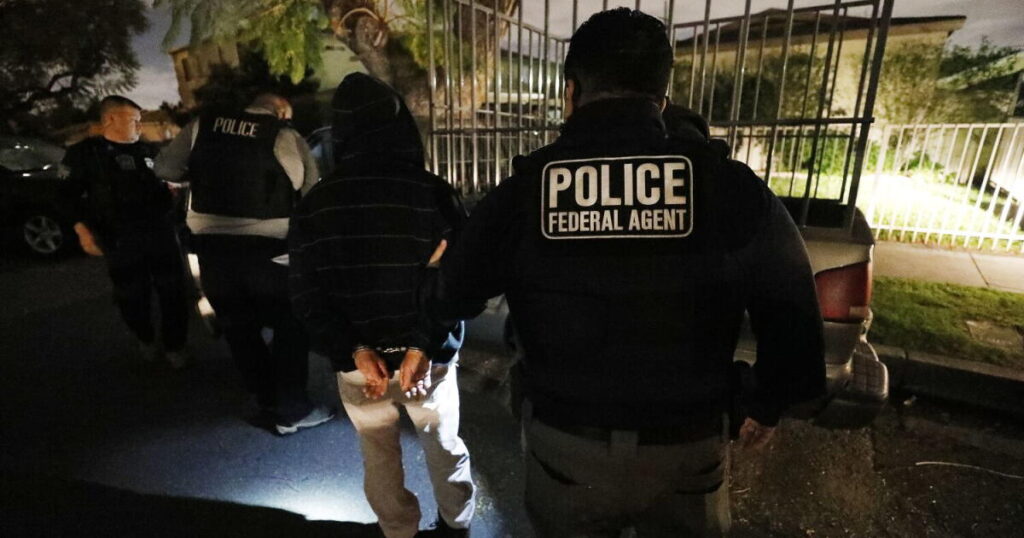
As the Trump administration escalates immigration enforcement across Southern California, local rapid-response groups report a disturbing new pattern: federal agents stopping Latino men driving landscaping and construction trucks, taking them into custody and leaving their vehicles behind.
These arrests raise troubling questions: How are immigration agents identifying the people they stop? What role are government databases and surveillance technologies playing? As a sociologist who studies immigration, I see two connected issues: the devastation enforcement inflicts on families and communities, and the expanding surveillance infrastructure that gives the government greater power to identify and target people in their everyday lives.
According to research I co-authored at USC’s Equity Research Institute, approximately 211,000 undocumented immigrants live in Orange County. Roughly three-quarters have lived in the United States for more than a decade. They are deeply rooted residents who have built families, businesses and community ties. Undocumented immigrants account for approximately 33% of workers in building and grounds cleaning and maintenance occupations and 29% in construction trades. Fifteen percent of employed undocumented adults in the county ages 25 to 64 are small business owners. These workers are integral to our economy. Removing them from the workforce disrupts businesses, reduces household spending and can create labor shortages that raise costs throughout the county.
Immigration enforcement is often framed as removing individuals who lack legal status. But people do not live as isolated individuals. Our research estimates that approximately 491,000 Orange County residents are undocumented or live with undocumented family members, including more than 216,000 U.S. citizens.
Detaining one person can destabilize an entire network of relationships and economic support built over decades. These deeply rooted lives can be upended in an instant through routine encounters facilitated by an expanding infrastructure of immigration surveillance.
A new investigation by the University of Washington’s Center for Human Rights documents how federal immigration agents use state motor vehicle records to facilitate roadside arrests. Researchers describe a process that can unfold in minutes. Agents identify a vehicle, run its license plate to obtain the registered owner’s name and cross-reference that information against federal databases. The information can then be used to identify people for detention.
The researchers identified four pathways through which immigration authorities obtain motor vehicle information: direct DMV access, interstate law enforcement networks, commercial data brokers, and information shared by state or local police. One important pathway is Nlets, the International Justice and Public Safety Network, which allows law enforcement agencies to query driver’s license and vehicle registration records across state lines. California Vehicle Code 1808.48 prohibits the use of noncriminal DMV records for immigration enforcement. Yet interstate networks like Nlets raise questions about whether federal authorities can obtain information through indirect channels despite these restrictions.
In just the first five months of 2026, the University of Washington study found that DHS agencies conducted more than 1 million searches of Washington state’s driver and vehicle records. These searches occurred despite Washington’s Keep Washington Working Act, which restricts state agencies’ participation in federal immigration enforcement and limits certain disclosures of personal information. Maryland has faced similar concerns despite a state law requiring a judicial warrant for federal immigration authorities to access protected motor vehicle information.
The findings expose a troubling reality: States can enact laws to protect residents’ privacy, but those protections can be undermined when federal agencies obtain the same information through interconnected law enforcement networks. Privacy protections mean little if the government can simply find a way around them. California was among the states researchers sought to examine, but they could not obtain the records needed to determine whether its protections are working. Evidence from Orange County shows why these concerns are far from hypothetical.
A June 2025 CalMatters investigation documented more than 100 instances in roughly one month in which Southern California law enforcement agencies shared license plate reader data with ICE, despite California law prohibiting such sharing. The Orange County Sheriff’s Department was among the agencies identified.
The searches involved technology provided by Flock Safety, whose license plate readers have sparked “bipartisan backlash” over mass surveillance, police misuse and the erosion of civil liberties. By recording vehicle movements and making that information searchable across jurisdictions, these systems can enable law enforcement to reconstruct people’s movements, associations and daily routines without individualized suspicion or a judicial warrant.
The danger is not simply that the government has access to more information about us. It is that this information can expand the government’s power to decide who becomes a target of suspicion, surveillance and detention. And these surveillance systems are not socially neutral. The decision about whose plate to search is made by human beings. If ICE agents disproportionately single out landscaping trucks, construction vehicles or drivers they perceive to be Latino, seemingly neutral technology can facilitate racial profiling while giving discriminatory enforcement the appearance of objective policing.
This expanding surveillance does not stop at immigration enforcement. University of Washington researchers also documented federal immigration agents querying the license plates of U.S. citizens observing ICE operations. The same infrastructure used to identify people for immigration enforcement can be used to monitor those exercising their 1st Amendment rights to legally observe law enforcement. This signals not simply a loss of individual privacy, but a weakening of the democratic freedoms that allow people to challenge government power. Immigration enforcement is becoming a testing ground for the expansion of surveillance and the limits of constitutional protections.
California cannot allow these practices to become normalized. Protecting civil liberties requires more than laws on the books. It requires meaningful oversight and accountability. California’s attorney general should investigate whether federal immigration authorities access DMV records, particularly through Nlets. In July, Atty. Gen. Rob Bonta issued guidance under SB 580 addressing database safeguards, audits and vendor oversight. California must ensure these protections are enforced, not merely adopted on paper.
Today, these surveillance systems are being used to identify and target our immigrant community. But the infrastructure being built does not distinguish between immigrants and citizens. Once we normalize the government’s power to track people, monitor their movements and transform ordinary activities into opportunities for surveillance and enforcement, we put everyone’s civil liberties at risk.
Jody Agius Vallejo is a professor of sociology at USC and associate director of the USC Equity Research Institute.
The post ICE enforcement in Orange County raises red flags for misuse of government databases appeared first on Los Angeles Times.