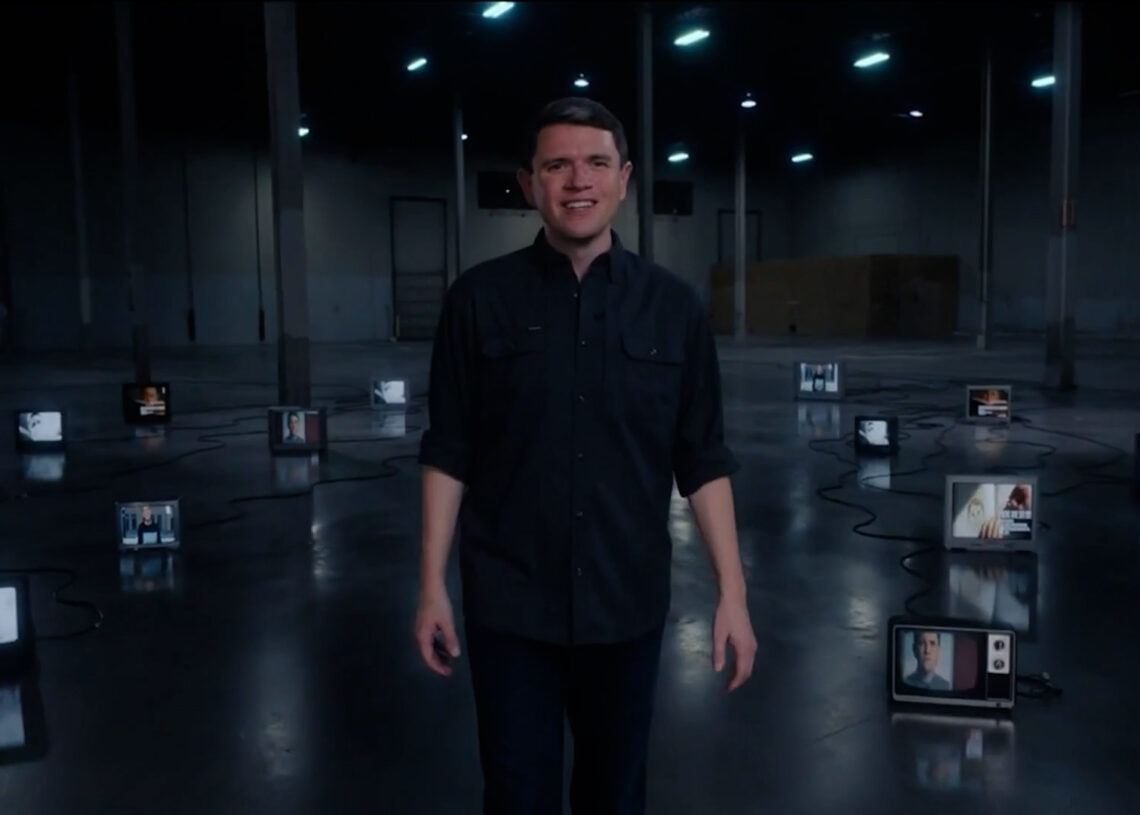
Texas Senate candidate James Talarico strolls through a dimly lit warehouse with rows of television sets arrayed on the floor in a recent campaign ad.
The TV sets are airing Republican attack ads that portray the Democratic candidate as a Bible-defacing radical who advocates for sex change surgery for minors.
“No, I’m not a member of the Chinese Communist Party,” Talarico says as he faces the camera and walks around the room TED Talk style. “No, I don’t support sex change surgeries for kids.”
Talarico blasts the AI-generated ads as an effort by GOP Senate nominee Ken Paxton and his allies to lie to voters about Talarico’s record.
“I don’t have to use AI, because the truth about Ken Paxton is bad enough,” Talarico says in the ad.
The Talarico spot highlights a clear trend in the ad wars of the 2026 midterm campaign cycle. Republicans are going all in on AI-generated ads. Democrats, meanwhile, are shunning them and trying to turn the tables on the GOP, suggesting the ad campaigns are emblematic of a party that doesn’t care about the truth and can’t be trusted.
Another Talarico ad, for example, accuses Paxton of “selling off Texas” for the construction of data centers. It includes the disclaimer: “Made by humans, not AI.”
The 2026 midterms offered the first real showcase of AI campaign ads. Campaigns spent over $137 million on ads generated or enhanced by AI this midterm cycle, up from $50,000 in the 2024 elections, according to an estimate from the Wesleyan Media Project, which analyzes political advertising.
Republican candidates and groups have aired the overwhelming majority of those ads, accounting for 88 percent of spending, or around $120 million.
Multiple Democratic strategists and campaign advisers told The Washington Post they believed voters’ concerns about cost of living, corporate power and political authenticity outweighed the edge Republicans might gain from using synthetic video.
“Right now, Democrats are focused on winning on our values, on affordability, on our issues, and delivering [that message] in a way that is true and honest, in the way the electorate can interpret it fairly now. Republicans just want to win,” said Kelly Dietrich, founder of the National Democratic Training Committee (NDTC), which offers tools and training aimed at helping Democratic candidates win elections.
Dietrich’s group rolled out a course last year on “AI for Progressive Campaigns” that advises against creating fake videos of opponents, saying they undermine “democratic discourse and voter trust.” Dietrich said more than 1,000 people have taken the training, which was created with Higher Ground Institute and helps progressive groups tap into emerging technology.
Valentina Perez, a senior vice president at the Democratic ad firm GMMB, said her firm advises clients to consider whether obvious AI use would undercut an ad’s intended message.
“AI is part of the larger conversation about what we’re telling voters when we are asking for their vote, which is something I think should be held to a higher standard,” Perez said.
Some voters might appreciate the restraint. Around 9 out of 10 likely general election voters in one recent poll said “using AI to create a video of an opponent saying something they never said” was “completely unacceptable,” regardless of whether the video included an AI disclosure. The survey, of 1,568 likely general election voters, was conducted by the AAPC Foundation, a nonprofit associated with the American Association of Political Consultants.
In a campaign cycle focused on affordability issues, wariness of AI could also reflect broader anxiety about its influence on the economy, said Karthik Ganapathy, co-founder of the Democratic hybrid PAC Tomorrow Together, which advocates for guardrails on AI.
Ganapathy said many Americans see themselves as being “on the losing side” of the technology, when it comes to its potential for eliminating jobs and uses such as automated denials of insurance claims.
“I think everyday Americans want someone to stand up to Big Tech,” Ganapathy said. “They’re not against AI in absolute terms, but they’re nervous that if nothing is done, this tech will benefit just a small handful of billionaires and basically no one else.”
How Democrats are using AI behind the scenes
Democrats are employing AI for behind-the-scenes work, not eschewing it altogether.
Take the tool CampSight, which keeps tabs on what chatbots might be telling voters who ask about candidates and offers guidance to campaigns on how to improve those results. The practice — called “answer engine optimization” or “generative engine optimization” — includes advice like ensuring that campaign websites have full, written policy proposals.
Around 200 campaigns are using CampSight, from federal races down to school board candidates, according to Jordan Haines, chief technology officer of the progressive group Run for Something, whose advocacy arm — Run for Something Action Fund — operates the tool.
Sometimes, the whims of AI bots can tempt candidates to reconsider their stances on issues.
“I do think — I know — these answers are influencing the way that they not just write about their policies, but think about their stance on a policy, too,” he said. Haines compared campaigns’ monitoring of chatbot answers to how candidates have historically worked to shape press coverage.
“Now, there’s just a new information domain where that contrast is taking place,” he said.
Sometimes, the technology simply fails. Jonathan Barnes, CEO of the Democratic fundraising firm Authentic, described a test in which AI was used to create a synthetic group of small-dollar Democratic donors. The made-up donors were sent fundraising emails as the firm tried to gauge which pitches would be most successful.
The tool was shelved after the AI-created donors resorted to stereotypes about “coastal folks and people of color,” Barnes recalled.
Other AI uses have streamlined what used to be entirely human work, such as drafting new fundraising pitches in reaction to breaking news events.
“Immediately, as soon as something breaks, it can have the email drafted,” Barnes said.
And the technology is only getting better. The NDTC’s AI course was launched last summer. Just a year later, Dietrich said, AI tools can continually update themselves to match a candidate’s voice and reflect incoming data from the field.
Last year’s training module suggested campaigns think about AI tools like “having a very capable intern.”
Now, Dietrich said, “You’ve got a really good deputy.”
The post AI ad mocks Talarico as Bible-defacing radical. Democrats bet it will backfire. appeared first on Washington Post.