Janeese Lewis George, D.C.’s presumptive next mayor, is nearly two months from ascending to her likely new role, but she’s already indulging in a rhetorical pastime embraced by generations of city leaders.
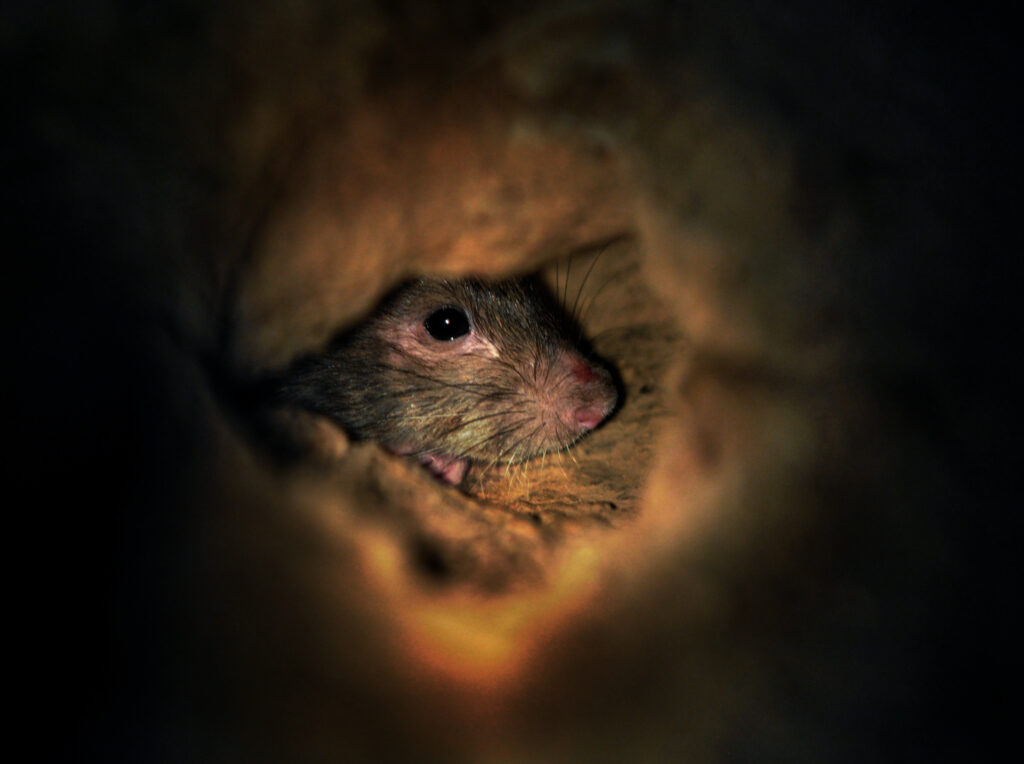
A promise to finally — finally! — do something about rats, that ever-teeming population of whiskered vermin that has gnawed its way into Washington’s civic imagination like no other urban nuisance.
“Okay, what’s it going to take to get rid of you?” the city’s Democratic nominee for mayor said to a toy version of a rat she held in a recent social media video, conveying that she has heard Washingtonians’ complaints “loud and clear.”
“We’re going to focus on the streets and neighborhoods that have been taken over by the rats, because we’ve got to start somewhere,” Lewis George pledged in the video, which she ended by kicking her toy rat down an alley and proclaiming, “One down.”
Lewis George’s anti-rat salvo is not to be confused with an initiative the city’s outgoing mayor, Muriel E. Bowser (D), announced in April, or the one she initiated at a 2017 news conference where city officials chanted, “One, two, three … rat-free!”
Declaring war on rats is a D.C. political tradition that stretches deep into the recesses of last century, signaling to each new wave of audiences that officials are listening to their constituents and addressing a problem that has long plagued cities nationwide.
The fact that renewed promises of a rat blitz are as predictable as the churn of the seasons raises (again) a litany of questions, not the least of which includes: What will it take to solve the problem?
“I’d like to have the attitude of maybe this time it will make a difference, but it’s always the same old, same old,” said Phil Carney, a Northwest Washington retiree who has been griping about rats since moving to town in 1978. “I’ve been in these same meetings for 30 or 40 years, and it’s the same complaints — rats and garbage. It’s déjà vu all over again.”
The outrage that the vermin has inspired in D.C. over the years has generated a few indelible moments, including in 1964 when civil rights activist Julius Hobson rounded up a posse of rats in a poor neighborhood, stuck them in cages atop his car and threatened to free them in wealthy Georgetown. (He got plenty of press attention without having to carry out his threat.)
Carney himself entered D.C. rat lore in the early 1990s when he went to a community forum and presented then-Mayor Sharon Pratt Kelly with a dead rat. Despite his ire, he was thoughtful enough to wrap the corpse in two plastic bags “so I wouldn’t put her at risk.”
“It was out of character for me, but I was just fed up that nothing was being done, and not much has been done since,” Carney said. These days, he refrains from such demonstrations because “I’m worn out at this point.”
Evidence that D.C.’s rat population has endured as a persistent source of agita exists in a multitude of forms, including a 1943 Washington Post editorial asserting that the “Capital City is overrun by vermin.” The writer described how a mother was “so frightened of rats biting her children that she slept with the lights on.”
“How long will it be before the stench of Washington’s over-crowded and rat-infested slums will make an impression on Congress and the White House?” the editorial asked.
More than a half-century later, a filmmaker named James Felter was inspired enough by the rodents to make “Rats,” a documentary he shot on Willard Street NW near Dupont Circle. Felter chose the location as a nudge-nudge-wink-wink tribute to the 1970s horror flick “Willard,” about a misfit who trains an army of rats to terrify his tormentors.
Felter, 68, said his interest resulted from growing up in Dupont Circle and becoming so familiar with rats that “we called them ‘city kitties.’ There were rats all over the place.”
“Nothing is unwinnable,” he said of the city’s endless battles with the vermin. “But how much change can you expect? If people were better about their garbage, or if the city had better control of the garbage, it could be contained. It wouldn’t be a losing battle.”
Over the past dozen years, D.C. invariably has landed on an annual list of the top American cities besieged by rats, an honor roll dominated by Chicago, Los Angeles and New York, where a 2015 video of a rat lugging a slice of pizza down a flight of subway stairs drew more than 12 million YouTube views.
The sight of a rat at Gracie Mansion, New York’s mayoral residence, inspired then-Mayor Rudy Giuliani in 1997 to mount his own resistance campaign, one that he built on several years later when he tapped a deputy to become the city’s unofficial rat czar.
More than two decades later, then-Mayor Eric Adams declared war on rats and anointed an actual rat czar. Under Adams’s successor, Zohran Mamdani, the rat czar is gone, but the city is deploying new rat-killing technology, a machine that pumps carbon monoxide into underground burrows.
Whether tech will make a meaningful difference in New York or anywhere is an open question, since so many once-touted strategies have come and gone, and “the reproductive capacity of rats will outpace the solutions,” said Jonathan Richardson, a University of Richmond biology professor who studies the species.
“Not a lot of progress is made, and whatever progress is made is short-lived,” he said. “That’s pretty much universal.”
In D.C. in the 1960s, Marion Barry, as a leader of Pride Inc., the civil rights organization he helped start, organized teams of Black teenagers to clean up streets and help eliminate rats. By the mid-1980s, when Barry was D.C.’s mayor, the city’s rodent-control campaign was successful enough that a headline in The Post declared “City winning war on rats.”
The celebration was short-lived.
By 1999, then-Mayor Anthony Williams convened a “rat summit” and, at a news conference to introduce a new abatement team, reportedly said, “Let’s go out there and kill some rats!”
Bowser, when it was her turn to contend with the vermin, introduced high-tech garbage cans in 2017 after the number of rat complaints to the city’s 311 line had surged by 65 percent. This year, the mayor announced yet another multipronged pilot program that included liquid birth control to prevent pregnancy, an experiment New York officials tried 12 ago without success.
Lewis George, a D.C. Council member for Ward 4, said in a social media post that her administration would “upgrade our trash cans and expand composting because if rats don’t feed, they don’t breed.”
She also promised to appoint a rat czar to “coordinate” abatement “across agencies so we can get this” — she pointed at her toy rat — “under control.”
A sense of control when it comes to rats is often fleeting, said Gerard Brown, who served as the city’s de facto rat sheriff for 27 years before retiring in December.
“It goes up and down. It gets worse, then it gets better,” said Brown, who still advises neighborhood groups on how to combat rodents. “The only reason we have them is because we feed them — sanitation, food waste and human behavior are the problems. People should be serious about it all the time, not just when the rats show up in a baby stroller.” (This happened, he says).
Brown is not a proponent of rhetoric that evokes warfare to combat rats, saying that a “campaign is better because in a campaign you can get everyone involved. It’s not like an army is going out, and you get to sit at home. People are ready to get involved.”
He said he likes the idea of an appointed “rat czar,” as Lewis George has proposed, though he advised that the next mayor will have to “listen to their recommendations” for the post to be effective.
Is he interested in putting in for the job?
“It looks tempting,” Brown said, though after 40 years in the rat trenches, a view from the sidelines is fine by him.
The post Rats have long gnawed at D.C. mayors, and its likely next leader says she’s on it appeared first on Washington Post.