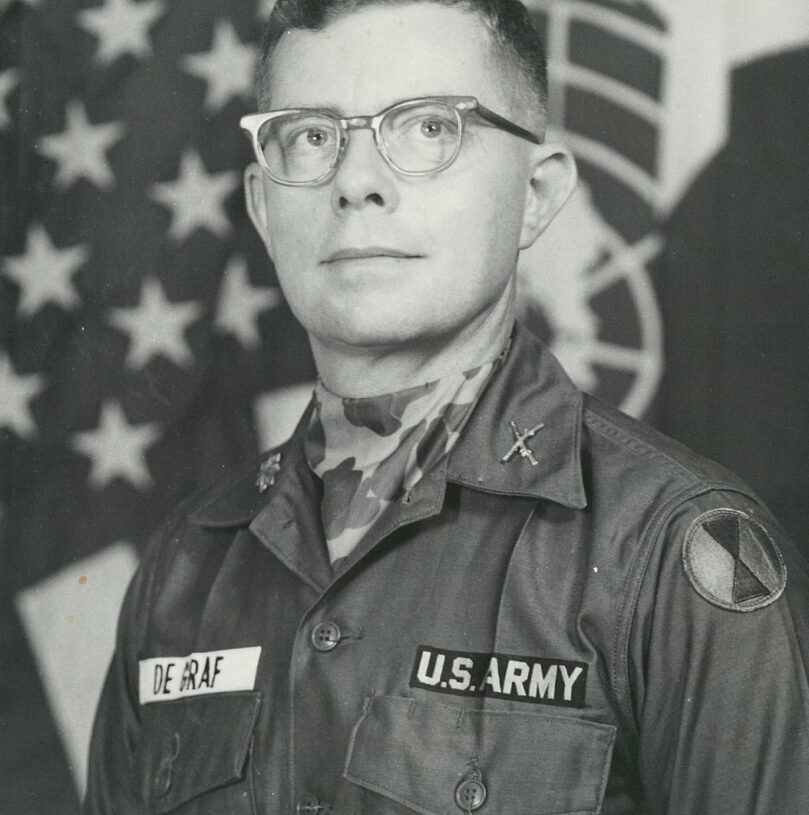
On the frigid night of Jan. 4, 1945, amid fierce combat in France, 18-year-old Army Staff Sgt. William DeGraf volunteered for a perilous job. With communication by field telephone cut off between his unit and a distant command post, new transmission wire had to be laid while German troops pressed an attack.
Under the cover of darkness, the young squad leader set out alone through dense woods, unspooling cable.
A year earlier, after graduating from high school, Mr. DeGraf had come close to realizing a dream: The U.S. Military Academy at West Point had offered him a spot in its next class, starting in July 1944, provided he passed a physical exam. Because of a sinus ailment and his less-than-perfect eyesight, he failed — twice.
Instead, he landed in France as an infantry private first class in October 1944 and rose quickly in the enlisted ranks before that January night near the Vosges Mountains, during the Battle of Bitche.
“While laying the line,” a report reads, “he was ambushed by two enemy who had infiltrated through our positions.” In a firefight, he “wounded one and forced the second to flee.”
Mr. DeGraf, who was awarded a Bronze Star for valor, died Oct. 4 at 100 in a retirement community on the grounds of Fort Belvoir, Virginia. He had recently been treated for pneumonia, said his eldest daughter, Gwyneth DeGraf.
A Notable Life
This article is part of A Notable Life, an obituary feature telling the stories of remarkable people every Saturday. Read more from the series here:
After her son came out, she helped propel South Carolina’s gay rights movement
He called himself the ‘most violent drunk in baseball.’ Then he found redemption.
That winter of 1944-45 marked the beginning of an illustrious military career spanning three decades, from the so-called Good War, imbued with patriotic clarity to the morass of Vietnam. There, Mr. DeGraf, a brigade commander, stuck to his principles in strategic disagreements with his superiors in 1969-70, effectively ending his chance of becoming a general, he told his family late in life.
After two years on the staff of the National Security Council in the Nixon White House, he retired from the Army in 1974 as a colonel.
“He was a really humble guy his whole life,” said his son Brad DeGraf, one of four siblings. He said his father never griped about being passed over. “I never got any sense of resentment from him,” the son said, adding, “My father loved the Army.”
A week after his 19th birthday in January 1945, Sgt. DeGraf was given a battlefield commission as a second lieutenant — “the youngest American soldier in World War II” to receive such a promotion, one of his contemporaries wrote after researching the question. Offered another chance at West Point, he flunked the physical.
He went back to the fighting, earning two Bronze Stars for meritorious service in a combat zone before being winged by a bullet in March 1945. He spent the final weeks of the European war in a hospital, a soon-to-be Purple Heart recipient whose West Point dream seemed dead.
But Mr. DeGraf would not be deterred. After somehow passing the academy’s physical on his fourth try, in 1946, he graduated with West Point’s Class of 1950, honored as “first man” academically and second militarily among 671 classmates. Three weeks after their commencement, the Korean War broke out.
Mr. DeGraf took part in desperate fighting to hold the vital South Korean port city of Pusan in the early weeks of the war — a battle so crucial that a three-star general issued an extraordinary “stand or die” order to his troops. After finishing his year-long deployment with two more Bronze Stars for meritorious service, he earned a master’s degree in nuclear physics from Purdue University in 1954, then returned to duty.
In the 1950s and ’60s, he climbed the officer ranks, commanding infantry units, attending Army schools, serving in the Pentagon and teaching at West Point, before he arrived in Vietnam in 1969 as a colonel.
The Nixon administration, trying to wind down the war, had adopted a strategy that de-emphasized search-and-destroy missions in favor of aiding rural villagers, winning hearts and minds in the hamlets. Decades after retiring, Mr. DeGraf told his daughter Gwyneth that he had resisted superior officers who wanted higher enemy body counts.
“He said his boss wanted the numbers to be more dramatic,” Gwyneth DeGraf recalled, adding, “My father was honest, and there was no way my father was going to jimmy the figures.” She said, “That was when the career stopped.”
Col. DeGraf returned from overseas with three more Bronze Stars for meritorious combat service, a third Combat Infantryman Badge for his third war and a Distinguished Flying Cross for heroics aboard a helicopter under intense fire.
In the Nixon White House in the early 1970s, he worked on nuclear nonproliferation for national security adviser Henry Kissinger, who urged Defense Secretary James R. Schlesinger Jr. to promote Col. DeGraf, according to a classmate who was an aide to Schlesinger and later became a four-star general.
“I saw a letter [Kissinger] wrote on your behalf,” the general, John A. Wickham Jr., said in a handwritten note to Mr. DeGraf in 2000. “Jim sent the letter to the Army Chief of Staff. … It was very laudatory, as you may know.” But it came to nothing, and in August 1974, the colonel hung up his uniform.
“My father had principles,” Gwyneth DeGraf, 74, said. “He told me, ‘You have to abide by your principles, even when it costs you, or otherwise it’s not a principle.”
William Bradford DeGraf was born Jan. 10, 1926, in San Francisco. His father ran a hardware store during the Great Depression and served in the California National Guard. Watching the guard company’s military drills sparked the boy’s early attraction to Army life. As a high school senior in 1942-43, he was named commander of all schoolboy ROTC units in the city.
Throughout his career, Mr. DeGraf was described as levelheaded, calm and rational. He was also that way with his children, none of whom served in the military.
“I never once saw my father mad,” said Brad DeGraf, 72, who was “a radical hippie” at Princeton in the early 1970s, a fixture at campus anti-war demonstrations.
He recalled hitchhiking home to Alexandra, Virginia, for a protest march in Washington in 1972, when his father was teaching at the National War College. The son traveled most of the way in a station wagon filled with college women headed to the demonstration. When they pulled up outside his residence — a half-dozen counterculture activists, all looking the part — the colonel smiled and welcomed them in for a meal.
“He had no ideology,” Brad DeGraf said. “There was never any judgment.”
Besides his elder son and daughter, Mr. DeGraf is survived by son Scot DeGraf, daughter Leslie Jones, five grandchildren and seven great grandchildren. His wife, the former Robin Wilde, died in 2020, three months shy of their 70th wedding anniversary.
After his Army career, Mr. DeGraf worked in private industry for 13 years, then busied himself in retirement by volunteering and competing in bridge tournaments while keeping track of his aging comrades. As of September, about a dozen of the 671 graduates, including Mr. DeGraf, were known to be alive.
“That was part of the sadness at the end,” Brad DeGraf said. “He lost most everyone he knew from the past.”
Grieving a loved one? Tell us what made them special.
The Post is publishing reader-submitted obituaries as part of a weekly feature, What We Remember.
Last week’s installment included an artist who expressed herself in all she did.
The post An Army colonel who stuck to his principles, even when it cost him a dream appeared first on Washington Post.