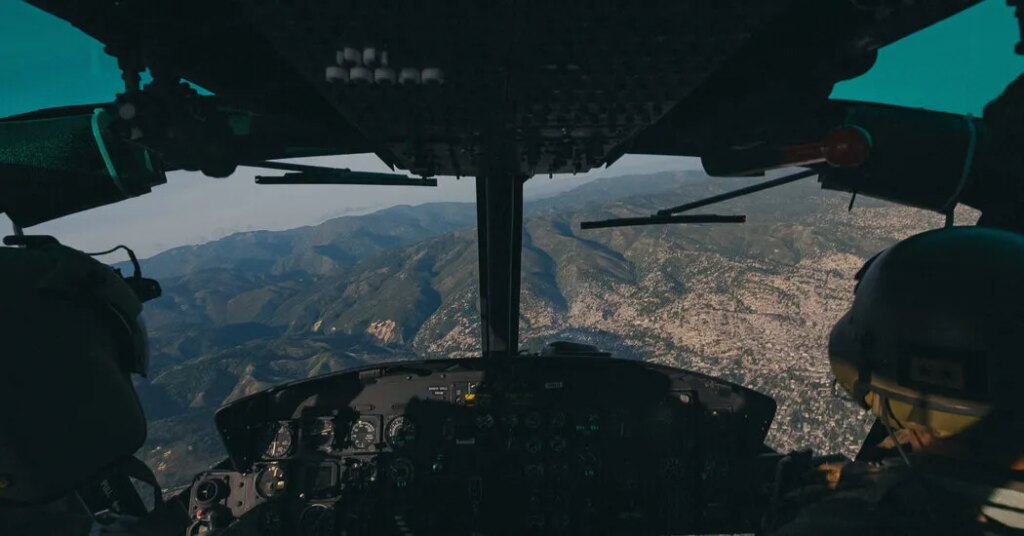
The skies above the slums and hills of Port-au-Prince are buzzing with helicopters.
Some of them are manned by a team of Salvadoran soldiers, medics and technicians who flew at 4,500 feet with machine guns at the ready.
The Salvadorans are deployed to Haiti as part of an international mission called the Gang Suppression Force aimed at eradicating rampant gang violence. Often tasked with evacuating the injured and transporting soldiers over gang territory, the Salvadorans once flew across the country to pick up a Sri Lankan soldier who had broken his legs.
The Salvadoran contingent in the U.N.-backed force is now the focal point of a high-stakes rescue operation after four of its members were ambushed on Sunday and went missing. Hundreds of Salvadoran special forces are expected to arrive in Haiti in the coming days, according to a person familiar with the matter who was not authorized to speak publicly.
The episode marks a critical flashpoint in the Gang Suppression Force’s deployment, quickly escalating what critics worried was a slow, underwhelming start to the mission. With El Salvador’s president, Nayib Bukele, warning of a severe military response if his soldiers are not returned alive, the U.N.-backed mission threatens to become a showdown between Haiti’s armed groups and El Salvador’s contentious leader.
For the first time, the understaffed Gang Suppression Force, known as the G.S.F., is conducting operations in Croix-des-Bouquets, a town outside the capital where the Salvadorans were abducted that is one of the country’s most entrenched gang strongholds.
“I think this is a wake up call,” said Louis-Henri Mars, senior adviser of the Institute for Research and Action for Peace, a peace-building organization in Port-au-Prince, the capital. “Wake up call for the international community, for the U.S., for everybody: ‘Hey, we’ve been fooling around here, and those guys are not fooling around. Let’s get it on.’”
The New York Times spent three days last month with the G.S.F., including with the Salvadoran helicopter unit. Troops from a Chadian contingent conducted patrols in armored personnel carriers. The commander of the international mission is from Mongolia.
But the G.S.F. has been dogged by late deployments and logistics problems, which experts say have led gangs to meet the mission’s arrival with a collective shrug.
Haiti’s gangs control many parts of Port-au-Prince, forcing residents to flee some neighborhoods that have become no man’s lands. In others, gangs are so entrenched that even the police do not dare enter.
More than 22,000 people have been killed in a spiral of gang violence that worsened since the assassination of Haiti’s president five years ago — more than 5,000 so far this year alone. Gangs, once controlled by powerful elites and politicians, outgrew their overseers and banded together, taking over major roads and entire communities.
Touring a former school that the G.S.F. had cleared of gangs, Maj. Tahir Bahar, of Chad, acknowledged that his troops faced a steep learning curve: They’re used to deserts, not cramped urban terrain.
Expectations from Haitians are high, but he promised improvements.
“They want results,” Maj. Bahar said. “We must do it. I cannot promise a timeline.”
Haiti’s ability to hold cleared areas remains a critical obstacle for long-term results, including elections that had been scheduled for December that many here consider an extremely unrealistic goal. The school, in the Tabarre neighborhood of Port-au-Prince, is an area so dangerous that it still lacks residents and basic services.
“We need someone to come in after us,” Maj. Bahar said. “The civilians want to come back. They need electricity, and they need schools. We cannot bring electricity.”
The G.S.F. arrived in April with a mandate to take the fight to the gangs and take back control. Unlike a previous international initiative known as the Multinational Security Support mission, it would be five times larger, conduct intelligence-led operations, have arrest powers and work independently without having to coordinate with the Haitian National Police.
It is also funded by contributions to a dedicated U.N. trust fund. Expected to cost about $400 million a year, the fund has received $194 million, according to U.N. records.
The mission is supposed to have 5,500 soldiers, with contributions from countries around the world. Six months later, it only recently reached 2,000 troops, from six nations.
Troop contributions have been delayed, and moving people, vehicles and equipment across the world has proved a challenge.
The G.S.F. has cleared gang roadblocks, seized weapons and regularly conducts patrols in downtown Port-au-Prince, freeing up the Haitian National Police to respond to serious outbreaks of violence.
But of 26 arrests the G.S.F. has made since its arrival, 18 people were released for lack of evidence. In one city, Gros-Morne, gangs killed civilians in retaliation for G.S.F. operations.
“We’ve got a long way to go, we totally recognize that,” Jack Christofides, the G.S.F. special representative, said in an interview last month. “I don’t believe the gangs can sustain a fight against professional soldiers coming from so many different countries. We’ve got real capabilities coming — not just infantry, but police, we’ve got a maritime unit, we’ve got an air unit.”
The G.S.F. should have most of its forces on the ground by the end of this year and be making more progress by early next year, he said.
“We’re not saying that in two years’ time there will be no gangs in Haiti,” he said. “What we’re saying is that in two years’ time the Haitian state will no longer need an international force such as ours, because they can look after their own security and eventually stabilize the situation.”
From his social media posts, it does not appear that President Bukele plans to wait that long. In a message written in Creole directed to the Haitian gang members who abducted the four Salvadorans, he warned military operations would only get more intense.
“We have already finished with the gangs in El Salvador, and we can finish with you too,” he wrote.
Mr. Bukele, in office since 2019, is both praised and criticized for a harsh crack down on Salvadoran gangs that put tens of thousands of people in prison. El Salvador used to be one of the world’s most dangerous countries; now it’s among the safest.
The Salvadoran technicians went missing on Sunday after coming under attack while driving back from a supermarket through a gang-controlled area. Their vehicle was discovered burned, but the four Salvadorans have not been heard from since.
Although the attention is focused on finding them, the episode has raised serious questions about what they were doing driving through what is widely considered a “no-go” zone for foreigners and even most Haitians. While the incident is being treated as a kidnapping, many experts fear the men have been executed.
On Thursday, Lanmò Sanjou, a gang leader in the area where the Salvadorans were taken, released a video in which he refers to Mr. Bukele and shows buckets full of bullets.
“We will fight to stay alive,” he said.
Gédéon Jean, the director of the Center for Human Rights Analysis and Research in Port-au-Prince, said Haiti needed an international force to help shore up the local police, but that requires adequate technological and human resources.
“Unfortunately, this is still not the case, although the efforts are commendable,” Mr. Jean said. “We are still waiting for a full and complete deployment, and especially for tangible results.”
The ambush of the four Salvadorans will be a turning point for the G.S.F., he said.
“The disappearance of the four Salvadorans changes the situation,” he said, “because now it is the G.S.F. that is the victim of gang violence.”
André Paultre and Michael Anthony Adams contributed reporting.
The post Ambush of Salvadoran Soldiers Escalates Haiti’s Anti-Gang Mission appeared first on New York Times.