As Heisenberg pointed out: you can’t watch something without changing it. Observers are never neutral.
In a new documentary, “You Can See Everything,” Lance Oppenheim and Nathan Fielder take this idea and bolt in a new direction. While their film is nominally about the noted Silicon Valley fraudster Elizabeth Holmes and her partner, Billy Evans, it has a much more universal message: Every person has a unique perspective, and that makes it impossible for anyone to produce a narrative that is absolutely true.
This is surely part of the reason for the movie’s rave reception and wild popularity. There is something titillating about being drawn into the action, about watching and even about wanting to watch. In our media ecosystem, the reaction to something is often a story unto itself. We look to one another — on Twitter, Twitch streams, podcasts, group chats — to make sense of what is right in front of us.
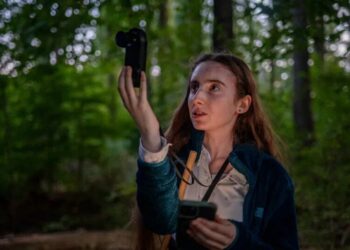
In the film, Mr. Oppenheim (and a small crew) films Mr. Fielder watching Ms. Holmes and Mr. Evans; we, as the viewers, watch all of them watching one another. The filmmakers are being manipulated by Ms. Holmes and Mr. Evans, but they’re also manipulating their subjects — and us, their audience. There’s no gotcha moment, exactly. Everything is a performance. Everyone is implicated.
Reviewers have praised the movie for being “of this moment” and for capturing “what a decade of post-truth has done to us.” Meanwhile, critics of the film and of Ms. Holmes’s role at the company she founded, Theranos, have taken issue with Mr. Fielder and Mr. Oppenheim’s relative disinterest in the actual facts of Ms. Holmes’s criminal case. Each camp wants its own take on Ms. Holmes and this movie to be the right one.
But the genius of Mr. Fielder and Mr. Oppenheim’s approach is that once the idea that truth is slippery has lodged in your mind, you can’t really get rid of it. This sleight of hand has commandeered the attention of viewers in sold-out theaters across the country. And it’s a move that was pioneered by Janet Malcolm, a writer and longtime New Yorker journalist who also took flak for proposing that the truth is unknowable, especially in so-called nonfiction.
Ms. Malcolm, whom Mr. Oppenheim has named as a favorite writer of his, made a career out of interrogating the limits of any one individual’s perspective. She wrote nonfiction that openly wrestled with the ethics of the genre, complicating the notion that a journalist can be an authority on someone else’s story. She often placed herself in her work as a character, in part to expose the skewed power dynamics and inevitable unscrupulousness of telling “true” stories.
Undoubtedly the most famous example of this — and the work of hers that most obviously shares DNA with “You Can See Everything” — is the two-part New Yorker story “The Journalist and the Murderer.” When it was published in 1989, it sent shock waves through American journalism. (Those were different times.)
The story explored the unlikely and ill-fated relationship between Jeffrey MacDonald, a convicted triple murderer, and Joe McGinniss, a journalist who befriended Mr. MacDonald while reporting on him. Trouble arose when Mr. MacDonald, who stood to share some of the profits from Mr. McGinniss’s book, discovered that the person he was collaborating with portrayed him as a psychopathic killer. Mr. MacDonald, who was found guilty of killing his then-pregnant wife and their two young daughters, was far from a sympathetic character. Yet readers of Ms. Malcolm’s book were prompted to question Mr. McGinniss’s actions. Ms. Malcolm used this episode as an allegory: Journalists, by their very nature, cannibalize other people’s words to tell their own stories.
Ms. Malcolm’s peers and critics responded to “The Journalist and the Murderer” with shock and anger. She was chastised for asserting her point of view about the case while also trying to situate herself above the fray. (It didn’t help that she neglected to mention in the piece that she, too, was battling a former subject — Jeffrey Masson — in court.) But by positioning herself this way, Ms. Malcolm did two important things: empower her readers to take their own perspective seriously and go further, implicating them in the dubious ethics of attempting to tell a “true” story.
In the explosion of think pieces and online discourse surrounding “You Can See Everything,” a similar effect is at work. I have spent the past eight years, on and off, poring over Ms. Malcolm’s papers, reading and rereading her work, trying to better understand her thorny, convoluted, occasionally maddening, utterly singular perspective. In the intensity and strangeness of Mr. Fielder’s gaze especially, I recognize how captivating it is to be invited to pay such close attention — the kind that elicits multiple interpretations.
“You Can See Everything” is a chronicle of Mr. Fielder’s Sisyphean efforts to understand what he is seeing and why he sees it that way. We watch Mr. Fielder peer at Ms. Holmes and Mr. Evans from the shadowy corners of their San Diego-area home, observing them doing things that normally don’t merit close observation, like beating eggs. Mr. Fielder meets Ms. Holmes’s unnervingly wide blue eyes with befuddlement. We can see him thinking: Is this all an act, or what? It’s a fun twist, watching the comedian famous for making other people uncomfortable squirm.
In the second part of the film, after Ms. Holmes begins her prison term, the story takes a new shape. To compensate for the fact that they no longer have access to their purported subject, the filmmakers call on Amanda Seyfried, who played Ms. Holmes in Hulu’s “The Dropout.” Having Ms. Seyfried act out interactions with Ms. Holmes that Mr. Fielder could not film is a clever narrative trick that exposes the filmmakers’ attempt to make sense of what’s in front of them. When the actress asks Mr. Fielder whether his own feelings are getting in the way of depicting Ms. Holmes honestly, those of us in the audience are hit with yet another reminder that we probably shouldn’t believe everything we’ve seen.
No nonfiction story ever mirrors life one-to-one, and Mr. Fielder and Mr. Oppenheim’s ambitions appear to lie elsewhere — less in journalism and more in provocation. “You Can See Everything” follows in the tradition of Janet Malcolm to say something that is, on a cellular level, true: There is artifice present in any work of nonfiction, and in every aspect of our lives.
You can’t will that away. But you can try to understand how you are warping what you see; in the end, that’s probably more interesting.
Eve Sneider is the author of the “The Absent Woman: The Genius of Janet Malcolm,” forthcoming in November.
Source photograph by A24/Everett Collection.
The Times is committed to publishing a diversity of letters to the editor. We’d like to hear what you think about this or any of our articles. Here are some tips. And here’s our email: [email protected].
Follow the New York Times Opinion section on Facebook, Instagram, TikTok, Bluesky, WhatsApp and Threads.
The post The Question Hanging Over ‘You Can See Everything’ appeared first on New York Times.