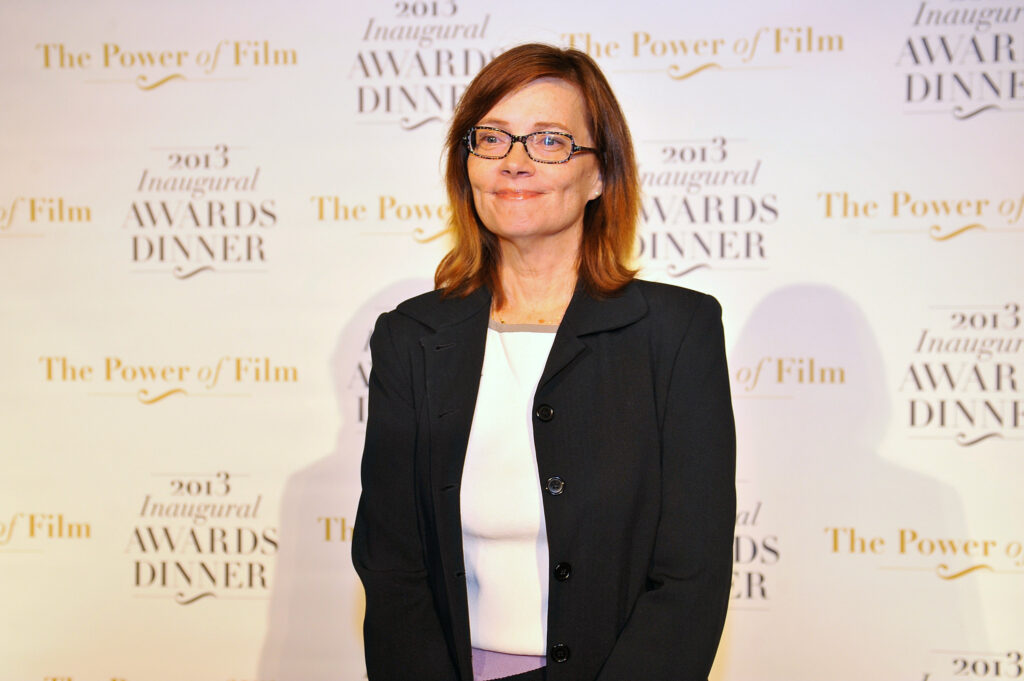
Ann Hornaday, who championed the craft of filmmaking and helped readers understand the enduring magic and occasional disappointment of movies as The Washington Post’s longtime chief film critic, died Oct. 18 at her home in Baltimore. She was 66.
The cause was glioblastoma, a form of brain cancer, said her husband, Dennis Greenia.
Ms. Hornaday brought a casual, if knowledgeable, approach to her reviews, writing more from the viewpoint of a popcorn-eating moviegoer than from the lofty perch of a scholar of cinema. She wrote hundreds of reviews for The Post over more than 20 years and was a Pulitzer Prize finalist in criticism in 2008. She was also the author of “Talking Pictures,” a book about how to watch films with a deeper level of discernment.
“For many years, Post readers were blessed by Ann’s informed, insightful, warm, accessible, and totally unique voice,” Washington Post Executive Editor Matt Murray said in a statement. “Reading her work was like talking with a close — if much more knowledgeable — friend.”
Ms. Hornaday was among the first critics to draw attention to the work of filmmakers such as Tom McCarthy, Ryan Coogler, Greta Gerwig and Alexander Payne. She wrote in-depth profiles of people in the film world and often interviewed them at festivals and other public forums.
“Ann was a compassionate, trusted voice whose film reviews inspired a deep appreciation for all aspects of the filmmaking process,” producer Albert Berger, whose credits include “Election,” “Little Miss Sunshine” and “Nebraska,” wrote in an email. “She understood the collaborative nature of making a movie and spread her praise beyond those who are afforded the spotlight. Filmmakers and moviegoers alike relied on her to help us better understand our work and enrich our viewing experience.”
Ms. Hornaday wrote about intimate art-house theaters, about pilgrimages to filmmaking locations and about darker issues, such as Hollywood’s long pattern of sexism and exploitation of women. If there was an overarching theme in her work, it was to highlight the role of film as a cultural touchstone and its outsize place in the nation’s collective memory.
“Of all artistic mediums,” she wrote in 2022, “cinema occupies the trickiest space between fabrication and reality, exploiting the porous nature of both to become a third thing entirely: the distortion of the literal truth that becomes internalized as consensus history.”
Ms. Hornaday’s reviews were anchored in her high standards, but she was not a cinematic snob. Her favorites tended to be deeply in the American grain, including such classics as “Casablanca” (1942), “Sweet Smell of Success” (1957) and “The Best Years of Our Lives” (1946) — which, Ms. Hornaday said in a 2019 interview with her alma mater, Smith College, “checks every box in terms of a well-crafted, beautiful film” — and the 1967 romantic comedy “Two for the Road.”
“She especially loved meeting and talking with readers about movies,” said Liz Seymour, a former managing editor and features editor at The Post, fellow Smith graduate and close colleague of Ms. Hornaday’s for many years. “Every year, she was the featured guest for a gathering of Smith alums in the D.C. area before the Oscars. She was so smart, and she was also just so interested to hear what other people thought of the movies. It was a highlight for her, and it was a highlight for me.”
Ms. Hornaday didn’t care for “Forrest Gump” or “The Lord of the Rings” trilogy, but she admired “This Is Spinal Tap,” “Goodfellas” and “Thelma & Louise,” noting in 2023 that the film “had nothing to do with my real life, other than the exhilaration of watching two women light out for the territory, with zero figs to give and needing only each other for support. Is this what ‘Easy Rider’ felt like to baby boomer men?”
“Her writing was elegant,” former Post executive editor Martin Baron noted in an email. “Her tone was warm and empathetic, qualities that defined her own personality. When a movie achieved its ambitions, there was no more enthusiastic champion. When it fell short, she made her disappointment abundantly evident. But cheap shots were never in her portfolio.”
A surprising choice for best year in film history
In evaluating a film, Ms. Hornaday was guided by three questions: What was the artist trying to achieve? Did they achieve it? And was it worth achieving?
For her, a thumbs-up or thumbs-down review was insufficient; she wanted readers to grasp exactly why a film like “The Hurt Locker,” the 2009 drama about a bomb disposal unit in the Iraq War, was the best film she ever reviewed.
“‘The Hurt Locker’ is about Iraq,” she wrote, “in the same way that ‘Paths of Glory’ was about World War I or ‘Full Metal Jacket’ was about Vietnam — which is to say, utterly and not at all. ‘The Hurt Locker’ is a great movie, period.”
The film won the Academy Award for best picture and earned Kathryn Bigelow the first Oscar for directing by a woman.
In a never-ending debate among movie buffs about what was the best year in film history, Ms. Hornaday offered an unexpected choice: 2007. “No Country for Old Men” came out that year, along with “The Great Debaters,” “American Gangster,” “Zodiac,” “Juno,” “Superbad” and “Michael Clayton.” It was also the year of Paul Thomas Anderson’s “There Will Be Blood,” set during the California oil boom of the early 1900s and starring Daniel Day-Lewis.
In her review, which was included in her Pulitzer finalist package, Ms. Hornaday described the film as “a sweeping epic of enterprise, aspiration, greed and hubris” and an “audacious portrait of California’s founding and, by extension, the forging of the American identity.”
In 2023, she found a similar ambitious grandeur in “Oppenheimer,” director Christopher Nolan’s three-hour film about the development of the atomic bomb during World War II, calling it “a film of magnitude, profundity and dazzling artistry.”
She was less charitable toward its blockbuster bookend of the same summer, “Barbie,” which she described as a “hot-pink mess of a movie.”
In her profiles of Hollywood figures, Ms. Hornaday made such luminaries as George Clooney, Shirley MacLaine, Dustin Hoffman, Cicely Tyson and Sally Field seem simultaneously down to earth and larger than life.
A book on filming “All the President’s Men”
In 2017, Ms. Hornaday published “Talking Pictures,” which examined different elements of filmmaking, including the acting, directing, production design, music, editing and, most important of all, the screenplay.
“Within the first ten minutes,” she wrote, “a well-written movie will teach the audience how to watch it.”
Shortly before her death, Ms. Hornaday had completed work on a book about the filming of “All the President’s Men,” the 1976 journalism thriller directed by Alan J. Pakula about the pursuit of the Watergate story by Post reporters Bob Woodward and Carl Bernstein, played by Robert Redford and Hoffman, respectively.
Ms. Hornaday wrote for The Post in 2025 that the movie was a “masterpiece” that “exemplified film as a supremely collaborative medium, with all the artists and technicians involved demonstrating superb craft, skill, taste and smarts.” The book is tentatively scheduled for release in 2028.
(Listen here for a Washington Post podcast in which Ms. Hornaday discusses “All the President’s Men.”)
Ann Mills Hornaday was born March 9, 1960, in Iowa City. She was adopted at birth by William R. Hornaday Jr., a urologist, and his wife, the former Mary Mills, who was active in civic and charitable work.
Ms. Hornaday grew up in Des Moines and graduated in 1982 from Smith College in Northampton, Massachusetts, where she majored in government. She spent two years at Ms. Magazine in New York as the personal assistant to the magazine’s co-founder and feminist activist, Gloria Steinem, who died in September.
She worked as a freelance writer in New York for several years, contributing to the New York Times, Premiere magazine and other publications. She was the film critic of the Austin American-Statesman from 1995 to 1997 and later the Baltimore Sun before joining The Post in 2002. In addition to writing for The Post, Ms. Hornaday often appeared on former Post sports columnist Tony Kornheiser’s radio program and was a regular reviewer for the “PBS NewsHour.”
In 2014, Ms. Hornaday wrote a first-person essay in which she described “the tensions, contradictions and fleeting moments of grace I have experienced as a film critic who also happens to be a practicing Christian.” She was a parishioner and Sunday school teacher at the Episcopal Cathedral of the Incarnation in Baltimore.
Ms. Hornaday took a buyout and left The Post in 2025.
She is survived by Greenia, her husband of 26 years; their daughter, Victoria Greenia; a stepdaughter, Leila Greenia; and a brother, William Hornaday III.
In one of her final essays for The Post, in 2025, Ms. Hornaday looked back fondly at the 50th anniversary of Steven Spielberg’s “Jaws,” often considered the progenitor of the summer blockbuster.
“As a movie,” she wrote, “it’s an exercise in superb technique in every area: Take one element away, and it doesn’t work.” For all its spectacle, special effects and shock value, “‘Jaws’ still keeps us coming back, reminding us that the fundamentals — character, visceral storytelling, authenticity and humanism — will always be the greatest show on Earth.”
The post Ann Hornaday, longtime Washington Post film critic, dies at 66 appeared first on Washington Post.