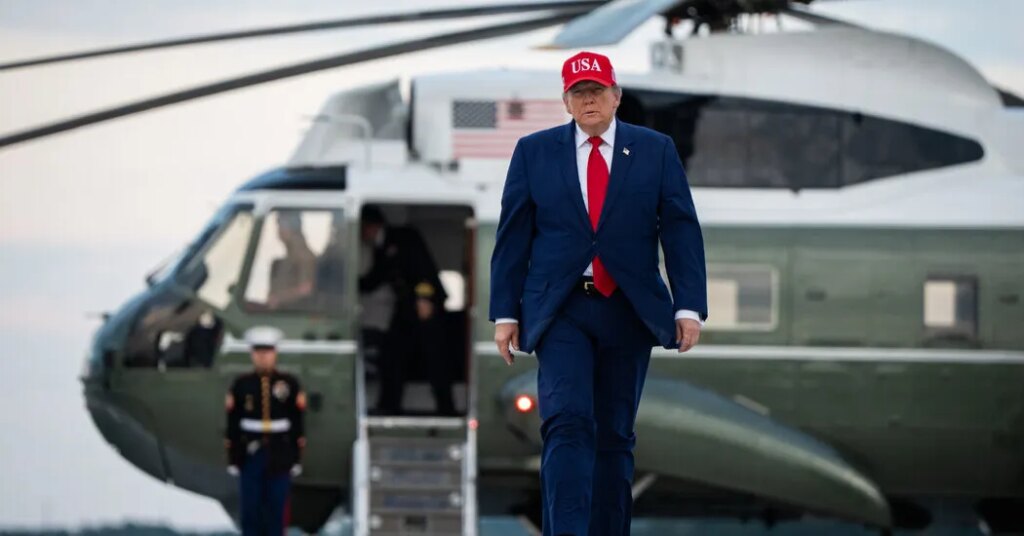
President Trump has embarked on a campaign swing across a remarkably conservative swath of America in a six-day blitz that began Monday, trying to boost Republican turnout in places the party did not view as competitive just a few months ago.
With just two weeks to go until the midterm elections, Mr. Trump’s itinerary reflects how worried the G.O.P. is about its prospects for holding onto the House and Senate, and winning governor’s races nationwide.
Traditionally Republican strongholds have become battlegrounds this cycle. Polling in these places shows that Mr. Trump’s policies on tariffs and the war in Iran — and their effect on the prices of gas, diesel and groceries for everyday Americans — have gravely threatened the party’s fortunes.
The president started his barnstorm in Kansas, with plans to pass through the Carolinas, Florida, Iowa and Georgia. He will stump in five House districts he won in 2024 by more than 20 points, and for the most part in states with unusually competitive Senate races.
Notably, he is staying away from traditional battleground states such as Maine and New Hampshire, where Republican candidates have distanced themselves from the president in hopes of winning over more moderate voters. His choice appears to signal a political strategy that focuses not on persuading swing voters but on shoring up support from the base that powered his rise.
“He goes where the battles are,” said John McLaughlin, a longtime pollster for Mr. Trump. “And this is where the battles are.”
In a more favorable political environment for Republicans, the party would be looking to pick up a seat in Georgia and defend one in North Carolina, in addition to using the president to defend its Senate seat in Maine.
But Mr. Trump and his political team have all but given up on the first two states, and have accepted the president’s inability to help Senator Susan Collins, the Republican incumbent in Maine, two advisers to the president said in interviews. This cycle, the White House sees Texas, Ohio, Iowa and Michigan as the battlegrounds, they said. Michigan represents the rare setting this year for a competitive race for a seat held by a Democrat.
“This idea that he’s going to red states, well yeah that’s where the races are right now, which tells you all you need to know,” one of the advisers said. “But also we’re playing to a national audience in terms of motivating Republicans.”
The swing will also allow Mr. Trump’s political operation to generate good “pictures” to use in advertisements beyond his actual itinerary, the adviser said.
“We play to visuals,” the adviser said. “And if we’re in a congressional district that’s next door to a competitive congressional district, what difference does it make? It’s all the same people, it’s all the same media.”
Mr. Trump remains his party’s most effective motivator a decade after he descended a golden escalator at his namesake building in midtown Manhattan to announce his first bid for the White House. Yet his popularity has dipped to historic lows, with about 37 percent of Americans approving of how he is handling his job.
The Republican National Committee, in announcing his travel, said the itinerary is intended to shore up the party’s vulnerable candidates. But the president is also known to go where he will find adoring crowds, and the midterm blitz through ruby red America provides him ample opportunity for that experience.
Mr. Trump will start the week in a House district in Wichita, Kansas, that backed him over former Vice President Kamala Harris two years ago by more than 23 points. He will then travel to Greenville, North Carolina, which, under the state’s new congressional map, would have broken for him by 14 points, before swinging through Clemson, South Carolina, to a district that he carried by a whopping 43 points. Mr. Trump will end the week with stops in deep-red Sioux City, Iowa, and Fort Myers, Florida, before a final rally Saturday in Macon, Georgia.
Next week, he will rally in Lubbock and Waco, Texas, said Republican National Committee Press Secretary Natalie Baldassarre.
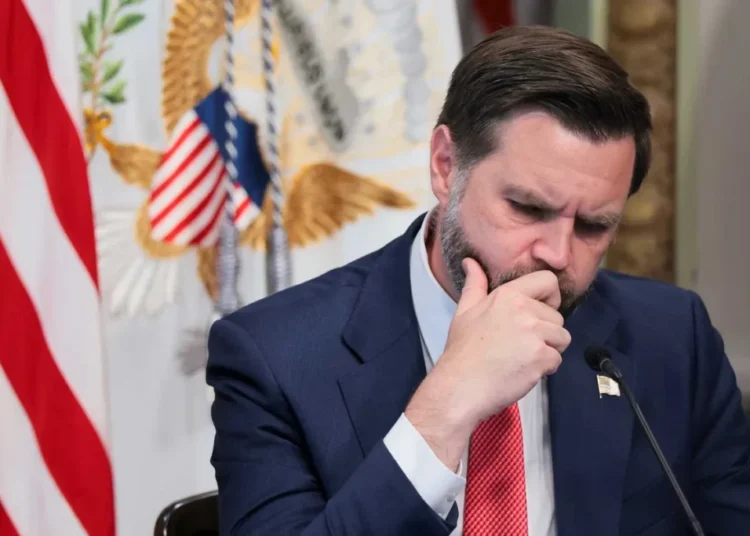
Vice President JD Vance, who has also embarked on a campaign swing this month, has taken a similar approach. He kicked off the week in North Carolina, and will end it in a district in Nebraska that backed the president by more than 50 points.
Kevin Madden, a Republican strategist who worked for the campaigns of former President George W. Bush and Mitt Romney, called the White House’s posture “defensive.”
“Two of the most valuable assets on any campaign are money and time,” Mr. Madden said. “Where you are spending your money and where you are spending your time in the last two weeks says a lot about your strategy.”
It isn’t just the last two weeks. This fall, the president has campaigned in the southeast corner of Oklahoma, the reddest part of one of the reddest states in the country, and swung through Western Nebraska, Northern Kentucky and Mobile, Ala., the latter being where he held his first presidential campaign in 2015 and began building his vaunted MAGA base after drawing some 30,000 to an open-air football stadium.
Nebraska and Kansas should be slam dunks for his party, even in years when Democrats do well. His Friday night visit to Dalton, Ga., was perhaps most symbolic of the party’s dire view of its position: The city sits in the heart of a congressional district once represented by Marjorie Taylor Greene, the longtime Trump ally who broke with him over the Epstein files and the war in Iran.
The approach relies on motivating less reliable voters whom Mr. Trump has shown a singular ability to motivate. At rallies over the past month, he has pleaded with them to pretend he is on the ballot. So far, the results have been mixed.
At Mr. Trump’s rally last week in Youngstown, Ohio, entire sections of the arena remained empty. But some voters who had watched from home said the event had given them more confidence in Senator Jon Husted, the Republican of Ohio in a tough race to retain his seat against Sherrod Brown, the Democrat.
“What Husted said at the rally,” said Steve Zawilinsky, a pastor who watched the rally on TV, “that is what I wanted to hear.”
Reid J. Epstein contributed reporting.
The post Trump Blitzes Through Deep-Red States Amid Fears About G.O.P. Enthusiasm appeared first on New York Times.