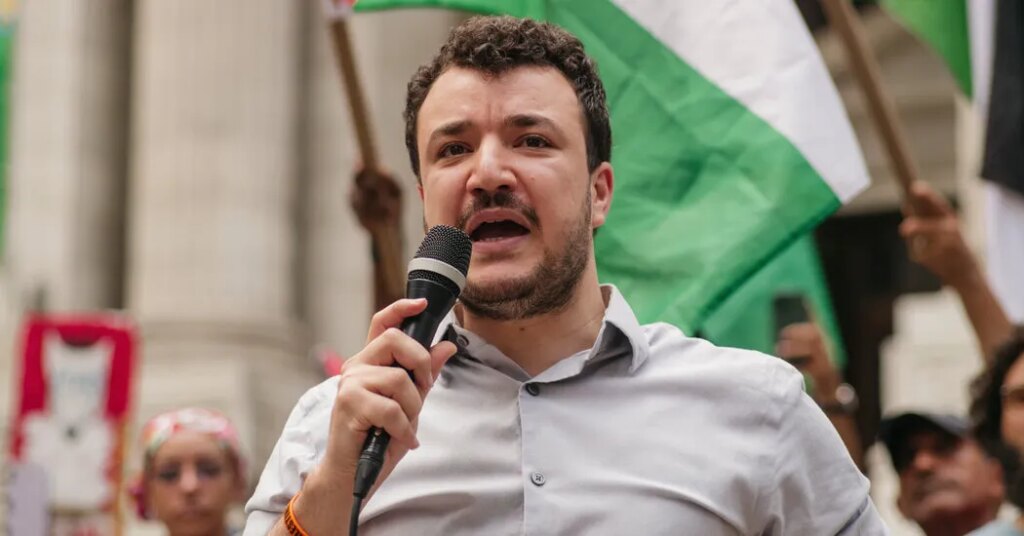
Mahmoud Khalil, the Columbia University graduate arrested last year by Immigration and Customs Enforcement agents amid campus protests, appealed to the Supreme Court on Monday in an attempt to prevent his deportation.
Mr. Khalil, a legal permanent U.S. resident who is married to an American, became an early and high-profile example of President Trump’s crackdown on pro-Palestinian demonstrations on college campuses.
His case presents the justices with another test of the Trump’s administration’s aggressive efforts to deport people who are in the country both legally and illegally.
The administration has said that Mr. Khalil’s prominent role in protests at Columbia against Israel’s war in Gaza and his continued presence in the United States spreads antisemitism and is at odds with Mr. Trump’s foreign policy goals. Mr. Khalil has denounced antisemitism and said that criticism of Israel is not inherently antisemitic.
Mr. Khalil had recently gotten his master’s degree from Columbia when he was arrested in March 2025 and detained on the basis of a determination by Secretary of State Marco Rubio that his presence in the United States undercut the national interest. Mr. Rubio cited a rarely used provision of a statute that gives the secretary of state sweeping power to expel foreigners.
A district court judge found that the law cited by Mr. Rubio was most likely unconstitutional and ordered Mr. Khalil released, but the Trump administration has continued to try to deport him, resulting in a series of legal maneuvers in different courts.
Mr. Khalil’s appeal to the Supreme Court comes after the U.S. Court of Appeals for the Third Circuit cleared the way for him to be arrested again and potentially deported.
If the Supreme Court lets that decision stand, it will likely not end the wrangling over the legality of the administration’s moves, but it could remove one of the remaining obstacles preventing Mr. Khalil from being deported. The justices will now decide whether to hear his case, a process that could take months. If they agree to review it, they would then schedule oral arguments likely in the spring and issue an opinion by the end of the court’s term in late June or early July.
Mr. Khalil has argued that the attempt to deport him violates his free speech rights. The appeals court decision did not address that question but instead dealt with a more technical dispute over which court has the authority at this stage in the litigation to review the constitutional issues in his case.
Mr. Khalil has said that his case should be heard in federal court; the Trump administration has said the case should be heard in immigration court, which is controlled by the executive branch and overseen by the Justice Department.
Judge Michael E. Farbiarz of the District Court of New Jersey sided with Mr. Khalil and ordered him released. But a closely divided appeals court agreed with the administration and said the district court had not been the proper venue to weigh his petition for release. The matter, the court said, should have initially been addressed by an immigration court.
In their filing Monday, Mr. Khalil’s lawyers told the justices that immigration law gives the federal courts the authority to review an immigrant’s constitutional challenges to punitive and retaliatory detention.
“The federal government jailed Mr. Khalil for his speech,” one of the lawyers, Alina Das, director of N.Y.U.’s Immigrant Rights Clinic, said in a statement. She urged the Supreme Court to uphold the power of federal courts to “free people from retaliatory detention and prevent the weaponization of the immigration system to punish dissent.”
The Trump administration has separately asked the Supreme Court to review the case of Badar Khan Suri, a postdoctoral fellow at Georgetown University whom officials have accused of promoting Hamas and tried to deport. D. John Sauer, the solicitor general, has asked the justices to reverse an appeals court ruling siding with Mr. Suri.
The court could decide to consolidate the two cases, which raise similar legal questions.
Monday’s request from Mr. Khalil, a Palestinian who was born and raised in a refugee camp in Syria, comes as he has been traveling the country to promote his memoir, “No Land to Stand On.” The book recounts Mr. Khalil’s harrowing experience of being arrested in the lobby of his New York apartment building and held in a detention camp in Louisiana. Mr. Khalil was held there for months and missed the birth of his child.
His case in immigration court has continued on a separate track. In April, an immigration court affirmed that Mr. Khalil could be deported, an unusually quick decision that was also characterized by other abnormalities.
Mr. Khalil can appeal the ruling of the immigration court to the conservative U.S. Court of Appeals for the Fifth Circuit, potentially providing another avenue to eventually seek Supreme Court review.
Jonah E. Bromwich contributed reporting.
The post Mahmoud Khalil Appeals to Supreme Court to Halt Deportation appeared first on New York Times.