Last week provided a final snapshot of the state of the economy before voters head to the polls for next month’s midterm elections.
The flood of government data clarified a familiar picture — and thus a grim one for President Trump and incumbent Republicans.
True, much of the data pointed to strength, or at least stability. Retail sales rose at a healthy pace in September. Filings for unemployment benefits remained low. Industrial output hit a postpandemic high.
But there was no relief on the issue that matters most to many voters, inflation. Consumer prices rose last month at their fastest rate since May, outpacing wage growth for the sixth month in a row. Producer prices, too, came in hot, as did prices for imported goods. And gasoline — the most visible price in the economy, and one that few Americans have any choice about paying — stayed above $4 a gallon nationally, where it has been for most of the past six months.
Little wonder, then, that measures of consumer sentiment have worsened, and that polls show voters are poised to punish Republicans for failing to keep the economic promises they made on the campaign trail two years ago.
The cost of living “is going to be the first issue on the scorecard in 2026,” said John W. Lettieri, president of the Economic Innovation Group, which last week published a survey of voter attitudes on the economy. “The results are not good on that top issue.”
Still, the state of the economy is more nuanced than the dour mood of voters might suggest. Economists point to areas of weakness and others of strength, and say the outlook — for inflation and more broadly — is highly uncertain.
Affordability challenges go beyond inflation.
Inflation, as measured by the Consumer Price Index, had fallen to about 3 percent when Mr. Trump returned to office, from a peak of 9 percent in 2022. Most economists expected it to drop further.
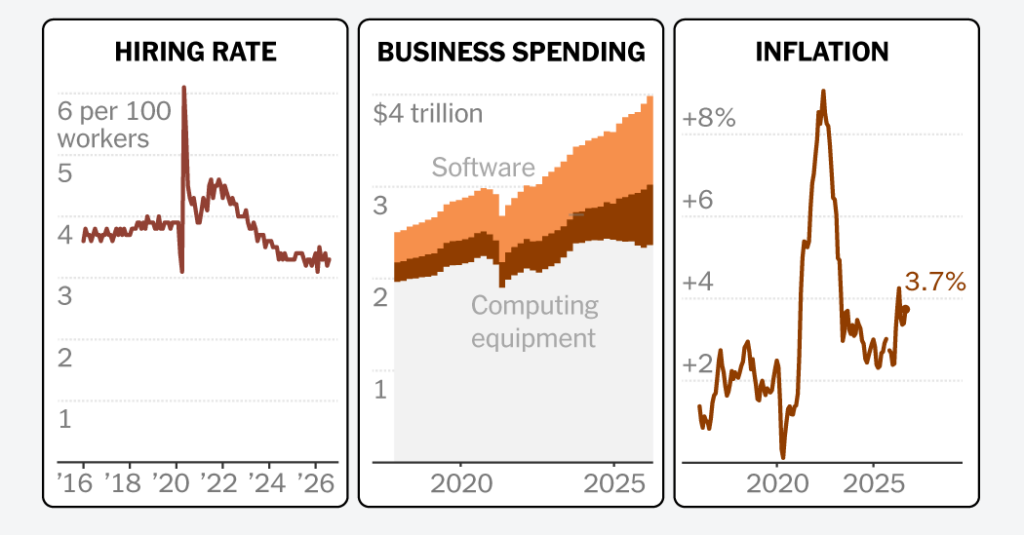
Instead, progress stalled in 2025, partly because of Mr. Trump’s tariffs, which drove up prices of many imported goods. Then, just as the tariff effect was beginning to fade, Mr. Trump led the United States into war with Iran, which pushed energy prices and inflation back up. Consumer prices were up 3.7 percent in September from a year earlier.
“Voters had the sense that President Biden’s policies were leading to higher prices, and voters have the sense that President Trump’s policies are leading to higher prices now,” said Michael Strain, an economist at the American Enterprise Institute, a conservative think tank. “In both cases, I think voters made the right judgment.”
Gas prices are just the most visible piece of a broader affordability challenge. Record prices for diesel fuel are threatening to ripple through to food and other goods. The artificial intelligence boom has led to a surge in demand for computer chips and related equipment, which has raised costs for smartphones, tablets and other consumer electronics. And some economists say they believe companies are still waiting to pass along some of the cost of tariffs to customers.
Higher inflation has also forced the Federal Reserve to reverse course and begin raising interest rates again, which is making it more expensive to borrow money as many Americans are relying on debt to make ends meet. Mortgage rates have jumped this year, dashing hopes of a rebound in the housing market and pushing homeownership further out of reach for many families.
Then there is the other side of the affordability equation: income. Wage growth slowed to just 3 percent in September, down from nearly 4 percent a year earlier. The combination of higher prices and weaker earnings growth means that, at least by one measure, the average worker has experienced no wage growth, adjusted for inflation, since the beginning of Mr. Trump’s second term.
The labor market is solid, but stagnant.
American households, at least in the aggregate, have weathered higher prices better than many economists predicted. That is partly because the job market has held steady — workers may not be getting big raises, but at least most of them have jobs.
The unemployment rate, at 4.2 percent in September, remains low, and has been at or below 4.5 percent for five years — a record. Layoffs, despite fears of job losses from A.I., remain low by historical standards. Nearly 81 percent of adults of prime working age, 25 to 54, were employed in September, close to a 25-year high.
But while the labor market is solid, it is hardly robust. Companies are not cutting jobs, but they are not adding many, either — a “low-hire, low-fire” stasis that makes it hard for anyone who needs a job to find one. The average unemployed worker has been looking for a job for nearly six months.
The slow pace of hiring also makes it harder for people to change jobs, or threaten to, in search of higher pay. The rapid rate of job-switching after the pandemic, sometimes referred to as the “great resignation,” helped many workers keep up with higher prices. The slower pace of turnover now may be part of the reason wage growth has slowed. It is particularly hard on younger workers, who typically change jobs frequently as they seek a foothold on the career ladder.
“You have to scramble pretty hard to find another job that is better than your current job,” said Skanda Amarnath, executive director of Employ America, a research group focused on the labor market. “There’s a level of fragility in that. How am I supposed to feel like I can get ahead if I’m not earning a higher wage increase?”
Spending and investment depend on A.I.
Strong retail sales data last week was the latest evidence that Americans are spending despite their dour mood. Consumer spending, adjusted for inflation, grew at a 3.8 percent annual rate in the second quarter, and most forecasters expect strong numbers for the third quarter as well.
Business investment, too, has been robust, with companies pouring money into equipment and software. Corporate profits continue to set records, helping to push the stock market — despite some jitters — to fresh highs.
But much of that strength stems from sectors connected to A.I., and the trillions of dollars in infrastructure needed to enable it.
Seemingly insatiable demand for microchips, data centers and the electricity to power them is responsible for much of the increase in investment. The companies that benefit from that demand, like Nvidia, the chipmaker, are helping to fuel the surge in corporate profits. And the market’s gains are helping to prop up consumer spending, especially among the wealthy households that own most stocks.
That could leave the economy vulnerable if investors lose confidence in the A.I. boom. There are hints that could already be happening. Shares of CoreWeave and other data center operators have tumbled amid questions about whether their enormous spending will ever pay off. In a research note published on Friday, Torsten Slok, the chief economist at Apollo Global Management, warned that a pullback in investor enthusiasm for A.I. could expose “a stagflationary environment in which growth slows even as price pressures persist.”
At the same time, a growing number of economists and technologists, including leaders of the A.I. companies themselves, are warning the technology could lead to widespread job losses. To many workers, that has created the impression that A.I. portends something of a Catch-22 for their well-being: If A.I. achieves its promise, it could put them out of work. If it falls short, the bursting bubble could wipe out their retirement portfolios and cause a recession.
“For two or three years, we have been waiting with bated breath for this A.I. bubble to pop or for this mass displacement to occur,” said Elizabeth Pancotti, vice president at Groundwork Collaborative, a progressive research organization.
That is adding to a more general sense of economic uncertainty that is eroding voters’ confidence. And it has been a long time since most Americans felt stable.
“The thing that people want more than anything, more than economic opportunity or economic growth, they want economic stability,” Ms. Pancotti said.
The post 3 Charts That Explain the Economy as Voters Head to the Polls appeared first on New York Times.