As a Howard University student in the early 1980s, Ambrose Lane Jr. recalled Malcolm X Park as more than just a shortcut to campus, but as a space for political activism for students.
Lane’s time at Howard was an “eye-opening” experience that immersed him in the institution’s political atmosphere. The university held two community festivals at the park, which brought political figures including Louis Farrakhan, Muhammad Ali and Nelson Mandela, he recalled.
“I’ve met so many different types of people that were in the freedom struggle, and so Malcolm X Park became a very important and iconic place and location during my formative years in D.C.,” Lane said.
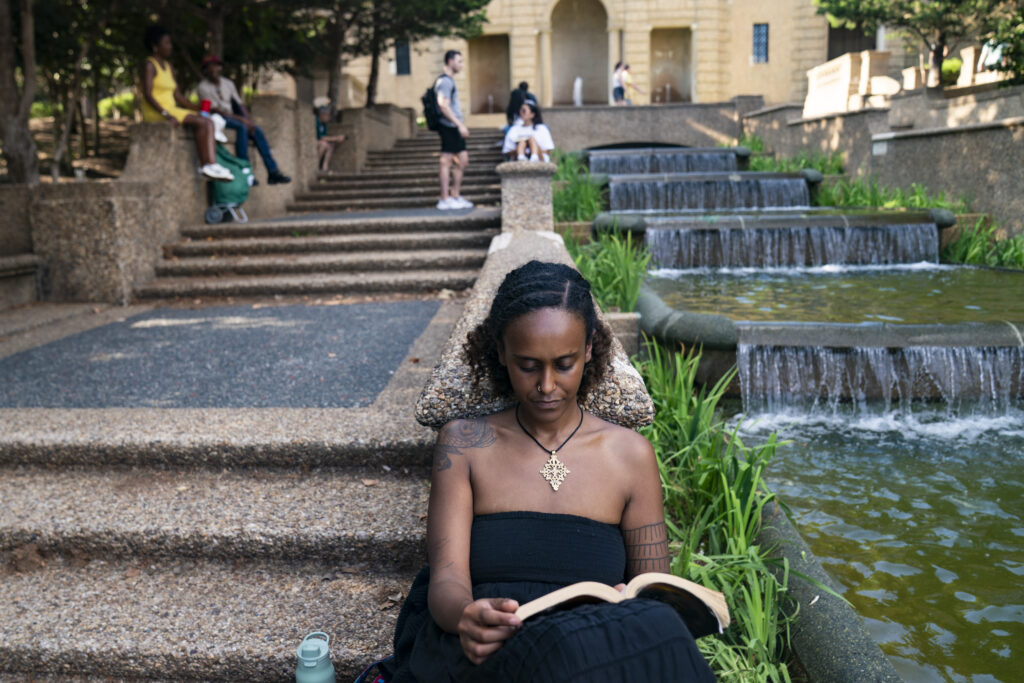
This week, people gathered to celebrate the 90th anniversary of the park — officially known as Meridian Hill Park — that has long been a place for people to connect with each other and nature, and a hub for local activism. It frequently hosts events, including a Sunday drum circle, and has been a gathering spot for demonstrations.
The 12-acre park — bounded by 15th, 16th, Euclid and W streets in Northwest Washington — opened to the public on Sept. 26, 1936.
The milestone anniversary was commemorated with a Jazz and Justice Festival from Washington Parks and People and WPFW radio station. Although the park’s anniversary was last month, the celebration was delayed due to weather. In addition to live performances in the park, film screenings and discussions were held at the nearby Josephine Butler Parks Center. Around 4,500 people gathered throughout the day, organizers said.
Steve Coleman, executive director and president of Washington Parks and People, said the event was organized as a way to use music to uplift the community.
“When you bring people together in joy and community, you also get a chance to stand up for the world as you want it to be, as you believe it should be,” he said.
Coleman said his organization started through efforts to save Malcolm X Park. It was founded in 1990 as Friends of Meridian Hill when D.C. was the murder capital of the country and the park was a center of violence. The death of a young boy in the neighborhood shook locals enough to start a community crime patrol, he said.
The focus of their first patrol was Malcolm X Park, where Coleman said they were met with a scene they didn’t expect.
“We felt serenity amid the broken glass and graffiti and the lights out,” he said. “There was something about it that pulled us in that was peaceful. It turned out that it was so dangerous, by the way, that it was safe because there was nobody there.”
Coleman said the nightly patrols helped improve the park’s safety through what he described as community connection by saying hello. This led the organization to help 300 parks and playgrounds throughout the District.
“[Parks are] not just about pretty trees and birds and bees and stuff. Parks are village greens,” he said. “They’re the heart of what it means to get people to come together.”
Jani Cook, who has participated in the Sunday drum circles, said the park has meant “freedom and peace, and serenity” in the midst of chaos.
“This is like the only place you can really ground when you’re getting back to nature and getting back to the land,” she said. “It’s very spiritual. It is a very special place.”
The park has been through a lot of changes this year. The Trump administration restored a cascading fountain on the park’s lower level that had gone without flowing water for years. The upper grass areas were also renovated, which closed parts of the park over several months.
One attendee referred to the restoration of the fountain as “quite a surprise” and that “one has to be grateful.”
Looking ahead to the future, there are some aspects of the park that people don’t want to change.
Jocephus Weeks, who has visited the park since 1978, said his hopes for the park are simple: “That it maintains its aura, so to speak, and that they don’t cut down any more trees.”
Lane said he hopes it remains “a drawing point and iconic location for not only city residents but also Howard University students as well.”
“It’s been the center of political activity and organizing for a long time before me and after me,” he said, “and it should remain that way.”
The post D.C. residents share memories as ‘iconic’ park turns 90 appeared first on Washington Post.