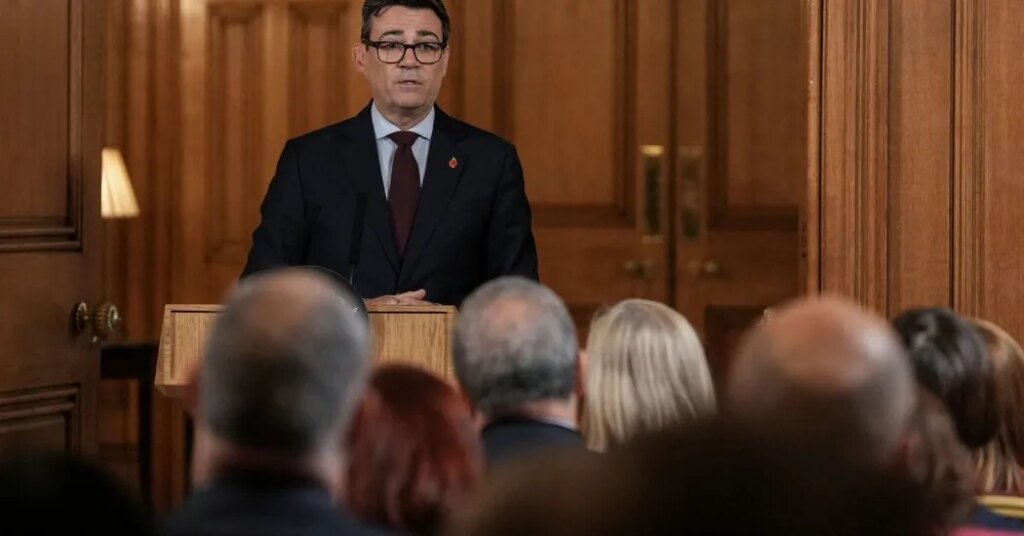
Andy Burnham became the prime minister of Britain three months ago with a promise to restore hope and make what he called “radical” changes to the country’s economy.
It will soon become apparent how much of that change he and his government can deliver quickly.
On Wednesday, John Healey, the chancellor of the Exchequer, will present in Parliament the first budget of Mr. Burnham’s administration. The new government will have to contend with an increasingly challenging economic environment. High oil prices, resurgent inflation and a surge in global borrowing costs spurred by the war in Iran are expected to constrain its plans for spending and taxes.
Still, Mr. Burnham and Mr. Healey have been offered some respite in modestly good economic news. The British economy has performed better than expected so far this year. And while borrowing costs have jumped sharply, Britain is no longer in the eye of the storm of the bond market. That distinction has gone to France, which is grappling with its own combination of high debt, political uncertainty and social unrest.
“The U.K. economy is resilient, and my budget will protect Britain’s resilience through this turbulent time,” Mr. Healey said this month. He added that “fiscal discipline is the foundation for supporting families and businesses today, and building hope for the future.”
Mr. Healey’s immediate task of presenting a budget that supports the economy and doesn’t spook investors has been helped by his predecessor, Rachel Reeves, who introduced plans that would shrink the deficit and funnel more money toward investments. Mr. Healey has also vowed to stick to rules that Ms. Reeves designed to bring down the government’s debt burden and fully pay for day-to-day spending from tax receipts.
This is “a good time to muddle through,” Andrew Wishart, an economist at the bank Berenberg, wrote in an analyst note, suggesting that the government could hold off on major changes on taxes and spending, even as higher interest rates have eaten into its fiscal buffer.
“Tax hikes to pay for much higher interest costs would probably prove unnecessary, and risk doing more harm than good by damaging the incentives to produce, work, save and invest,” Mr. Wishart wrote.
But doing little may not be politically palatable. Long-term issues are festering. Britain’s budget faces enormous spending pressures, not least from a social security and welfare bill that amounts to more than 300 billion pounds (about $400 billion) or 10 percent of the size of the economy, about half of that goes to pensioners. At the same time, taxes are already a heavy burden and debt levels have left an interest payments bill that far exceeds defense spending.
That all means the government has little fiscal room to maneuver to deliver on its stated ambition of “growth in every postcode.”
Mr. Burnham has promised a break from Britain’s economic model of the past 40 years. He has said he wants to give more power to local authorities to spur growth throughout the country. He also wants necessary services like water, housing, energy and transportation to come under more public control. And there have been other big ideas, such as a national care service for older people, modeled on the free-to-access National Health Service.
Analysts have low expectations for how much of these big plans will appear in Wednesday’s budget. Instead, they foresee more modest steps. The government has already announced a plan to give more money to mayors and other local leaders, as well as an effort to slash red tape for businesses. There has been speculation that Mr. Healey may increase taxes on banks to help raise the revenue needed for some small cost-of-living support measures.
Mr. Healey, who resigned as defense minister this year to protest a lackluster commitment from the previous government, will also be under pressure to show how he will increase Britain’s spending on defense.
The post How to Tax and Spend in a ‘Turbulent Time?’ U.K. Tries a Balancing Act. appeared first on New York Times.