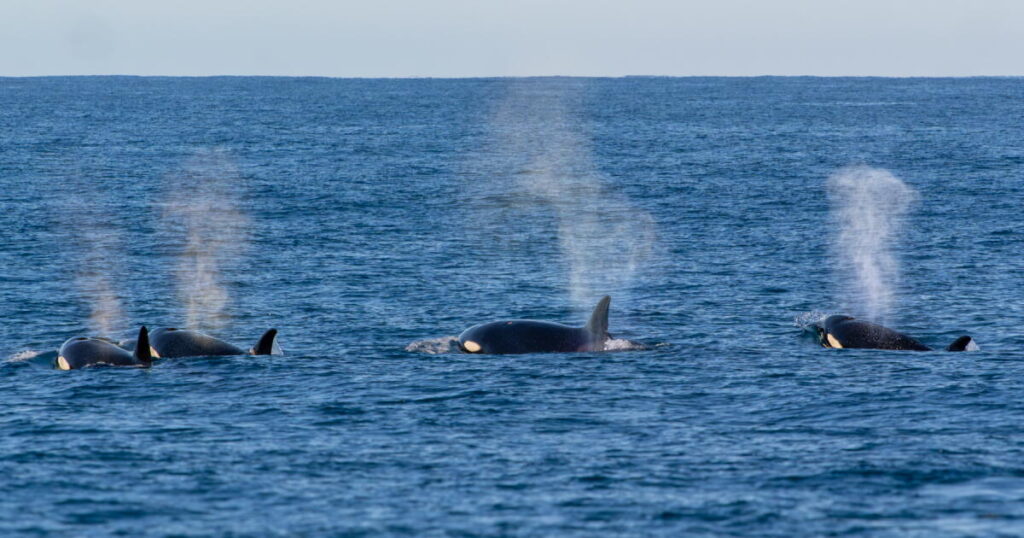
A visit from Baja orcas in Southern California and a kayaker’s close encounter with a great white shark in the San Francisco Bay Area highlighted a weekend of unexpected visitors along California’s shoreline.
Personnel and guests with Dana Point-based Capt. Dave’s Whale Watching Safari recorded a rare sighting of 13 Eastern Tropical Pacific orcas off Laguna Beach on Saturday.
“On a good year, we expect to see maybe one such orca,” said Capt. Matt Stumpf, who has sailed with Capt. Dave’s since 2020. “We may get one day where one or two trips get to see it, but that’s again one day in a good and typical year.”
Social media footage showed the whales traveling in a pod and within feet of a few boats, leaving guests awed.
Stumpf said the aquatic mammals were tracked throughout the day and first spotted by boats off the coast of Newport Beach. The sighting was at least the third for the company over the last three weeks, he said, fueling speculation as to what the whales, normally found off Baja and farther south, are doing so far north.
“I couldn’t tell you exactly the cause,” Stumpf said. But “our water is so warm much later than it usually is” as a result of El Niño.
Normally, he said, the maximum ocean water temperature in the area would range from the mid-50s to the mid-60s at this time of year, and visiting whales are usually the type that can handle colder temperatures.
But October has not brought a cooldown, he said. “The temperature off San Clemente Island is over 70 … That’s tropical.”
As the Orange County whale watchers were enjoying their unusual brush with warm-water orcas, a kayaker to the north had a brush with a great white shark.
Bay Area resident David Slavich told a local television station that he was kayaking off Half Moon Bay on Sunday when a great white approached. Slavich’s footage shows the apex predator pulling within a couple of feet of the kayak.
“I hear this woosh, and I look over my shoulder, and I see this massive, massive silhouette and the distinctive fin,” Slavich told KRON. “This is not a killer whale, this is not a dolphin.”
Slavich can be heard repeating “Oh my God” in the video. He said he “braced for impact,” but the fish didn’t disturb the small craft.
Chris Lowe, professor of marine biology and director of Long Beach State’s Shark Lab, said the great white was in a well-known migration pattern.
“This is the time of year when adult male white sharks are returning from their offshore migrations,” Lowe said, “and that stretch of coastline is a good hunting spot for them due to the northern elephant seal rookery there.”
Incidents involving people are generally rare, according to John Ugoretz, Pelagic Fisheries and Ecosystem Program manager for the Marine Region of the California Department of Fish and Wildlife.
“There is really no correlation between sightings and incidents,” he said via email. “Incidents where a shark actually touches a person or their boat/kayak are extremely rare in California, while sightings (especially those reported to the media, given ease of reporting) are somewhat common.”
San Mateo County has had the second-most incidents of any California county since 1950, according to the Department of Fish and Wildlife tracker. The department defines an incident as “any documented case where a shark approached and touched a person in the water, or touched a person’s surfboard, kayak, paddleboard, etc.”
There have been 22 such incidents in the county. San Diego County has had the most shark-related incidents with 27, according to the tracker, and Santa Barbara County is third with 21. There have been 238 incidents statewide — five this year. The most recent San Mateo County incident was July 12 at Pillar Point, which also involved a kayaker, who was not injured.
Surfing, with 81, is by far the No. 1 activity associated with incidents involving sharks.
The post Surprising close encounters with marine predators in California bring awe and fear appeared first on Los Angeles Times.