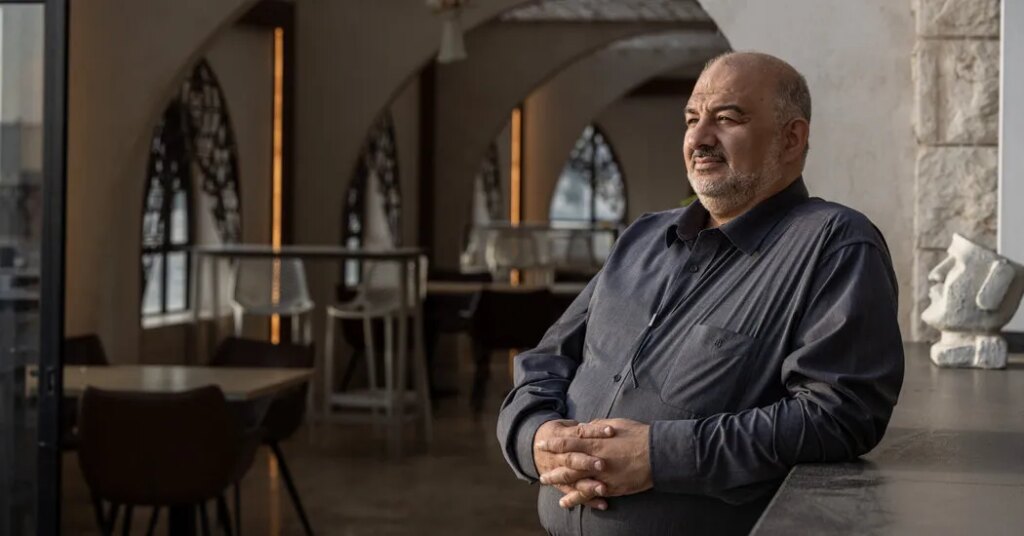
A casual consumer of the advertising ahead of Israel’s Oct. 27 election could be forgiven for thinking that the gravest threat to the country’s future is a dentist-turned-politician named Mansour Abbas.
For months, Mr. Abbas, the head of an Islamist party called the United Arab List, or Raam, has been involuntarily starring in campaign ads for Prime Minister Benjamin Netanyahu. In them, Mr. Netanyahu warns Jewish voters that, if he is voted out, Mr. Abbas will be the real power in the next government, a danger to Israel from within and a driving force in establishing what many right-wing Israelis fear most: a Palestinian state.
In fact, Mr. Abbas’s stated priorities have little to do with the West Bank and Gaza, and everything to do with Israel’s Arab citizens, who make up about 20 percent of the population and are plagued by violent crime and discriminatory housing policies.
What makes Mr. Netanyahu’s relentless attacks on him especially charged is that Mr. Abbas may turn out to be the kingmaker in the election — a role he has played before. In Israel’s multiparty system, if opposition leaders do not accept Mr. Abbas’s support, it could be impossible for them to form a big enough coalition to force Mr. Netanyahu from office.
That makes Mr. Abbas arguably the most influential Arab politician Israel has had. It is all the more unlikely given that Raam — created in 1996 by a branch of the Islamic Movement in Israel, which works to strengthen Muslim identity and empower the Arab minority in Israel — is a socially conservative party, making for strange bedfellows with the liberal parties.
What motivates him most, Mr. Abbas said in an interview, is the desire not merely to defeat what he calls “this racist, fascist government,” but to replace it with one in which Arab citizens “are partners, in which we have a voice, and in which we have influence.”
“We will not remain orphans at the table of the powerful,” he assured hundreds of voters at a rally in Tuba-Zangariya, a Bedouin town in northern Israel, where he extolled the need for partnership between Arabs and Jews.
Some call him the country’s most cunning politician.
Mr. Abbas first seized attention in 2021 by negotiating with Mr. Netanyahu to join what would be his new government — effectively gaining the prime minister’s blessing for what would be a milestone for an Islamist party — but then allying with Mr. Netanyahu’s opponents to oust him instead.
Mr. Netanyahu reclaimed the premiership the next year and formed the most right-wing government in Israel’s history. And the Oct. 7, 2023, Hamas-led attack, in which about 1,200 people in Israel were killed and some 250 were taken hostage, prompted many Israelis into seeing all Palestinians, including Arab citizens of Israel, as potential threats.
Mr. Abbas, 52, responded by redoubling his efforts to reach out to and gain acceptance from Israeli Jews. He condemned the Oct. 7 attack the day it occurred, and helped find housing for Israelis fleeing the Gaza border. He repeatedly denounced Hamas and said that the use of violence had only harmed Palestinians.
Yet heading into Israel’s Oct. 27 election, he is under attack from every direction. Mr. Netanyahu and his allies are portraying him as a terrorist sympathizer or worse.
Zionist opposition leaders, who once hailed Mr. Abbas as a courageous trailblazer, are now publicly distancing themselves from him, vying to appeal to right-wing voters. The leaders of other Arab parties — who choose the less complicated path of protesting all Israeli governments and joining none — have come close to calling him a sellout.
He is undeterred. In Tuba-Zangariya, hundreds of Muslim men sat in white plastic chairs at dusk, listening as Mr. Abbas, who is also an imam, invoked the Prophet Muhammad’s teachings about leadership. “A leader,” he said, “must have confidence in the path he is taking.”
Days later, at a news conference in Nazareth, he made his boldest gambit yet, announcing that Yoav Segalovitz, a center-left lawmaker and former top police official, would be the No. 2 candidate on Raam’s slate — a first-of-its-kind alliance between mainstream Arab and Zionist Jewish politicians.
“To make change,” Mr. Abbas said in Hebrew, with Mr. Segalovitz at his side, “you need to look at the other person as a human, and not as an enemy.”
‘Burning issues.’
Born in Maghar, a Druse, Christian and Muslim city in the Galilee, Mr. Abbas never aspired to enter politics.
The son of a grocer who was a muslih — a peacemaker often turned to by townspeople to settle bitter disputes — he said that, in high school, he was often asked to mediate between students.
Years later, after he had become a dentist, clashes between Druse and Christians in his hometown led to houses being torched and thousands fleeing. Mr. Abbas closed his practice for a month as he brokered a resolution that saw calm restored and homes rebuilt.
Wanting to do more to help people, he said, he decided that the only way was “through the tools of the state.”
Since entering the Knesset in 2019, Mr. Abbas, who is married with three children, has focused on what he calls “the burning issues” for Israel’s Arab citizens, especially the rampant violent crime and racketeering in Arab areas.
Driving back from Tuba-Zangariya, Mr. Abbas said that his efforts had made him a target, too, and that he had received threats of violence from organized crime networks, as well as Arabs, Jews and West Bank Palestinians.
Nationally, Mr. Abbas has drawn far more attention for his outreach efforts toward Jews. In May 2021, when rioting broke out between Arabs and Jews in Israel, he toured a burned synagogue in Lod with the city’s right-wing Jewish mayor, offering to help rebuild it and denouncing the violence.
Some Arabs called for his resignation, saying that, as Israeli police were rounding up Arab citizens, his focus was misplaced.
“This was so unacceptable at the time,” said Mohammad Magadli, an influential Arab journalist. “One of the biggest leaders in the Islamic Movement called me and said, ‘You can say that Mansour Abbas is done with us.’ But he succeeded to convince them that it was the right thing.”
A shared future?
Raam’s entry into the coalition government led by Naftali Bennett in 2021 was a watershed. Arab parties usually criticized and protested Israeli policies from outside government.
Mr. Abbas argues that major achievements can be won only by wielding power. If that means being saddled with blame for policies that Arab citizens find objectionable, he said, “We are ready to pay the price.”
For some Arab citizens, he is already paying too high a price. Mr. Abbas rarely speaks about Palestinians in the West Bank and Gaza, wary of how unpopular Palestinian statehood has become among the electorate in Israel.
When he briefly mentioned his support forit at a party conference in August, several opposition leaders — his potential coalition partners — blasted the remark.
Arab citizens have also questioned why Mr. Abbas did not speak out more against Israel’s war in Gaza that killed tens of thousands of Palestinians.
“The trade-offs are very controversial within the Arab community,” said Basha’er Fahoum-Jayoussi, co-chair of the Abraham Initiatives, an organization that works to improve Arab-Jewish relations in Israel.
“Some would say that the trade-offs are too expensive,” she continued. “They say he’s playing too much on the Zionist parties’ terms — whereas other Arab parties would say, ‘Take me as I am.’”
Safwat Freij, the chairman of the Islamic Movement, said that while Arab citizens of Israel might not love everything Mr. Abbas says, many accept that compromise is part of his approach.
At the same time, Mr. Abbas is under ferocious attack from the right over pro-Palestinian statements from his past, such as when he once declared that Israelis had “no right” to Jerusalem and were “trespassing in this land.”
Before entering politics, he said, he had little interaction with Jewish Israelis, and that had affected his “understanding of the situation, the circumstances, and intentions.” His views have evolved, he said: “Maybe, if I look back, there’s a sentence here, a sentence there that I wouldn’t say today.”
Mr. Abbas says that, far from abandoning the Palestinian cause, he takes a longer view of how to resolve the conflict.
It begins, he said, by showing that Arabs and Jews can collaborate to solve problems in Israel — to create hope and restore “confidence that we can work together for a shared future.”
An unlikely partnership.
His teaming up with Mr. Segalovitz could be a blueprint.
The two once joked on the Knesset floor about running together, Mr. Segalovitz recalled, when he was deputy minister of national security in the coalition government in which Mr. Abbas served.
Mr. Segalovitz had made it his mission to fight crime in Arab communities, and set up a task force to fight organized crime. Under his watch, the homicide rate fell by 16 percent, he said.
That gives Mr. Segalovitz currency with Arab citizens of Israel. When Mr. Netanyahu returned to power in 2022, he put Itamar Ben-Gvir, a far-right extremist, in charge of the police. Mr. Segalovitz’s efforts were abandoned, and killings skyrocketed. Last year, a record 252 Arab citizens were killed, according to the Abraham Initiatives.
It is not a perfect marriage: Mr. Segalovitz speaks no Arabic, making for awkward campaign scenes. Mr. Abbas opposes gay rights; Mr. Segalovitz, who is secular and has a gay daughter, supports them. On many other issues, they say they will agree to disagree.
For Mr. Abbas, running with Mr. Segalovitz, an ex-paratrooper, could help him defend against right-wing attacks and allay concerns among opposition leaders about forming a government that relies on Raam’s support.
In an interview, Mr. Segalovitz said he knew he would be attacked by “all the meshuggenehs in the Knesset” for joining an Islamic party’s list of candidates, using a Yiddish term for crazy people. “But I trust Mansour. He’s a courageous person, and he pays the price for his courage. For me, he’s a kind of hope for the future of Israel.”
Such hopes will be tested on Oct. 27.
On the campaign trail in Sakhnin, another city in northern Israel, Mr. Abbas, who has the kind of potbelly that puts his shirt buttons to the test, lingered after the last speeches, smiling for selfies and greeting familiar faces. One voter, Ihsan Bashir, 53, pleaded with Mr. Abbas to join the next government, even if it were led by Mr. Netanyahu, for the sake of lowering the crime rate.
“I have a son and four daughters,” Mr. Bashir said. “I’m afraid for them to go outside.”
Mr. Abbas smiled and nodded.
Hopefully, Raam would win many seats, he said, and the new government would have a large majority.
Heedo Abu Laban contributed reporting.
The post The Arab Kingmaker in Israel’s Election Who Wants a Partnership With Jews appeared first on New York Times.