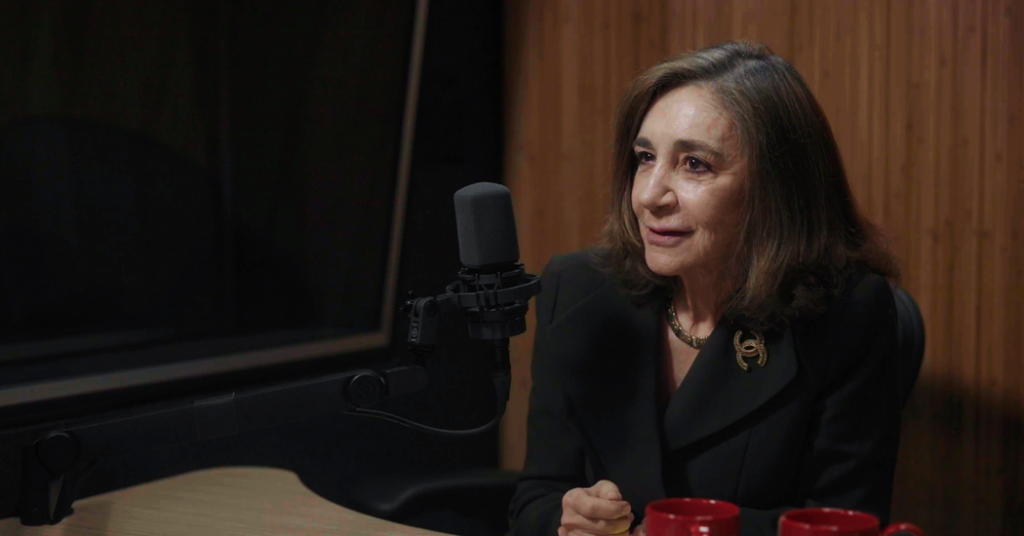
This is an edited transcript of “The Ezra Klein Show.” You can listen to the episode wherever you get your podcasts.
For a long time, the idea that we would have A.I.s or robots that we could talk to, interact with, integrate into our personal lives — that was fantasy, science fiction.
But now, talking to A.I. systems is mainstream. Roughly half of American adults are using chatbots. Many of them are going pretty deep with their A.I.s. Nearly one in five U.S. adults has chatted with an A.I. that simulates a romantic partner.
The results here can get dark. Google’s own researchers have found that some children are now struggling to distinguish between talking with chatbots and interacting with humans.
Since the 1970s, the sociologist Sherry Turkle has been studying the relationships between humans and machines. In the ’80s, she predicted that computers would evolve into these second selves. I think that basically came true — think of the smartphone in your pocket that you’re always looking at.
In 2011, just a year after Instagram came out, Turkle warned that social media might create a society where, even though we’re constantly talking to one another, we’re in this strange state of being alone together. I think the data bore that one out, too.
Turkle’s latest book, “Artificial Intimacy: Who We Become When We Talk to Machines,” turns this lens on A.I. So I wanted to have her on the show to help me figure out what’s going on now that talking machines have very much arrived, what it means that so many of us are building these — I don’t know, call it relationships; don’t call it relationships — with them, and what might happen if we keep going down this path.
(The New York Times has sued OpenAI and Microsoft claiming copyright infringement. The companies have denied those claims.)
Ezra Klein: Sherry Turkle, welcome to the show.
Sherry Turkle: Delighted to be here.
So you studied a very early, very famous chatbot named Eliza.
Yes.
Tell me about Eliza.
Well, I got into Eliza — I had just arrived at M.I.T. and I was introduced to Joseph Weizenbaum, who said he wanted to see me. I was one of the few people psychologists at M.I.T.
And he came to see me and he explained that he had written a chatbot — a stupid chatbot.
This is the 1960s, right?
No, this was 1976.
OK.
He had written it earlier. He had written it in the 1960s, but it wasn’t really until — it was also known as the doctor program because he had written it, because it was very stupid, to do something that could simulate a conversation that people would believe was a real conversation. And that was the conversation between a patient and the kind of psychotherapist that’s called a Rogerian psychotherapist.
And the reason that was a good thing for him to do with a stupid program is that a Rogerian therapist repeats what you say in a spirit of affirmation.
People should know, there are podcasters who — this is primarily what they do. [Laughs.]
Exactly. Exactly. [Laughs.] So basically, if you say to a Rogerian psychotherapist, “I’m so angry at my mother,” it’ll say, “I hear you saying you’re angry at your mother.”
So Weizenbaum was able to create a program — and again, it’s a chatbot only because it was a program that chatted, but it wasn’t a chatbot in the way we think of it now, with generative A.I. behind it, processing millions and zillions of data points. It took what you said and essentially put something like “I hear you saying that” in front of it, or “Are you saying that?” Or something really basic and very stupid.
And he did it to experiment with language processing, and he was a computer scientist and that was his goal. And he found that the graduate students who had helped him, who knew that this program didn’t know and didn’t understand anything, nevertheless wanted to be alone with it and wanted to be in a closed room with it and wanted to talk to it. His assistant — his secretary, as he called her at the time — wanted to be alone with it, wanted to talk to it.
And he was delighted to find me, a psychoanalytically trained psychologist, to try to help him understand what that phenomenon was. And this was really one of the things that drew me into the study of computers and people, because it was really one of the first times that you really saw the seductive power of a machine that talked.
So Eliza’s famous because, to many people, it was one of the first of these programs to arguably pass the Turing test — this idea of: Can you talk to a program and you’re not necessarily sure if you’re talking to a computer or to a person?
As you say, people knew what Eliza was. So what was so effective about it?
Well, to me — and I called it at the time the “Eliza Effect” — people in this case knew that it was stupid, and when you spoke to it, it really didn’t pass the Turing test. You knew pretty quickly that it was not a person.
But what I called the “Eliza Effect” was people’s desire to make it seem smarter than it was. They wanted so much to believe that it was a thinking creature that they would ask it questions in a way that, with practice, they knew would cause it to give the most humanlike response.
So for example, hackers would figure out that if you said three angry things in a row, the machine would say to you, “I hear your anger; are you angry at your mother?” And it would seem like that came out of the blue. In other words, even though that was scripted, if the following angry words are said three times, it would respond, “I hear anger in your response.”
And again, that was one of the early things I learned, that it’s not just that we come to a machine and say: “Oh, is this intelligent? Does this understand me?” But we come to these conversations wanting it to be there for us. And that really concerned Weizenbaum because he thought that was a very dangerous road, because the machine really understood nothing.
I think it’s worth spending a moment on why we want that, because I think it’ll be important as we go on in our conversation.
Your book — and you, I think — are very positive on human beings and human relationships and human conversation. But human beings feel failed by one another a lot. Feel misunderstood by one another a lot, feel nobody wants to listen to them a lot.
And one reason Eliza, in that case, and other things we’re going to talk about in a few minutes — I think they have been appealing to people because there is something useful to them in something that is smart enough to respond but dumb enough to listen. And to listen nonjudgmentally.
So I want to talk a little bit about that other side of it — the desire that makes people go looking for a computer to talk to.
Well, I don’t know if it’s desire or deep disappointment. I think where you put the emphasis was exactly right. It’s that they come to the computer conversation primed by a deep disappointment with the people around them, and that was very much part of it.
When I did work with Weizenbaum and interviewed his students and interviewed his secretary and interviewed all the people who were lining up to talk to it — because at this time, you had to line up to talk to it — to me, they talked not about the program, but about how their partner never listened to them, how their mother was a [expletive].
I mean, they were filled with conversation about the people in their lives who didn’t listen, and how this was kind of a balm, a salve, a place where you knew that someone would.
So I think that you’ve put your finger on something exactly right, that there’s two sides to this story. I call it technological affordance and human vulnerability. It’s what the machine is putting out — in this case, a really very poor conversation — but human vulnerability was what the people weren’t getting in the rest of their lives.
So you go from studying Eliza, and I’m sure many other things, to studying what you call relational artifacts. Tell me what relational artifacts are.
Let me step back for just a second. When I studied the Eliza program, it really stood alone as a machine that used the first person, that said it was willing to talk to you about personal things. The rest of the stuff around were computer programs that did what you told them to.
Yeah, this is pre-graphical user interface, right? [Laughs.]
Absolutely. I came to M.I.T. in the late 1970s, and this study that I first did in “The Second Self” was — really, people were moving away from their punch cards and were surprised that things weren’t on punch cards anymore. [Laughs.] So the computer did what you told it to do. People were still saying things like “garbage in, garbage out” to describe what a computer was.
In the late 1990s, that arc of what you expected a program to be — that you would give it instructions and it would do something informational and it would say something back to you — was broken by a kind of program that I called relational artifacts.
There were the Tamagotchis that asked you to take care of them all day and clean up their virtual poop and play with them and teach them, and kids were so much not wanting them to die that they gave the Tamagotchi to their parents, who would take care of it and nurture it all day.
For our younger listeners — this is my generation, actually. Tamagotchis were these little — they’re sort of egg-shaped, as I remember them ——
Egg-shaped digital creatures.
Yeah, I never got it. But you had to take care of it, or it would die.
You had to take care of it, or it would die. There were Furbys that you had to teach. There were Aibos that you could teach and they would make gestures of love toward you. There were Paros, which were little seals that you would give to elderly people that would pretend to understand their affect.
These were all machines, and I became fascinated by them. I knew that they were terribly important, that they didn’t just want your cognition. They wanted your affect. They were pulling for an affective response. They weren’t just saying, “I’m smart.” They were saying, “I care.”
In a way, they weren’t even saying, “I’m smart.” They were saying, “You care.”
Yes. And I came, after years of studying them and really interviewing the old people with their Paros and the young people with their Furbys and their Tamagotchis, I came to this formulation that we nurture what we love, but we love what we nurture. In other words, when these objects asked for nurturance, people glommed onto that.
They did what the Eliza program didn’t, and this is where they had something very dramatically over the Eliza program. The Eliza program pretended to know what you were saying in an affective way, but it never said: “I care for you. Teach me. I love you. I’m yours. I’m your person.” And these machines started to move in that direction.
Alison Gopnik, the child psychologist, in one of her beautiful books about parenting, has a line that’s affected me a lot, which is that we don’t care for people because we love them; we love them because we care for them.
Exactly. It is the same formulation. The way I put it at the time was that nurturance was the killer app — that by asking for our care, they came not just for our attention, but for our attachment.
Maybe that gets to something we were saying around Eliza, that one thing it was showing was people wanted to offer more conversation and vulnerability to the world — the human world — than maybe the human world always wanted from them.
But this gets at another side, which is that for many people, they want to offer more care than the world is asking for from them. They want people to care for, things to care for. That there’s more love to give through acts than people always have receptacles for.
And it’s so tragic that an object comes along that doesn’t care for you at all, and becomes the receptacle for what other people need so terribly.
I’ve found my work to be emotionally so upsetting because I’ve discovered this untapped vulnerability, but also this untapped desire to give. And people are giving it to truly something that doesn’t care about them.
Let me hold on that. Let’s talk about a child and a hamster. Or a box turtle. Some of us had box turtles in our classrooms growing up.
I’m not sure that when a kid cares for a hamster — and I recognize the emails I’m about to get from the hamster lovers of America — that what’s happening is that the hamster is receiving that care and coming to care back for the child.
Or even more so, that the box turtle is receiving that care and coming to care back for the child. I knew a person who took care of a wounded fly for a week at one point and really, really cared for it.
In your formulation, to express care to something that cannot care for you back is hollow or deceptive or meaningless in some way.
But I think a lot of people do express care for — I mean, I think the easiest analogy here are pets, lower order pets — a fish — that I don’t think in any realm that we think of care for us back.
But isn’t the expression of care a virtuous or a beneficial act?
Here’s the difference: I’ve thought so much about this because, of course, I’m discussing something where people say: “Well, excuse me, I talk to my ChatGPT, but what about my dog? Why aren’t you coming for ——”
Oh, my dogs are dumb, but they’re smart enough. [Laughs.] But a fish ——
I’m willing to go with the fish and the turtles.
Yeah, the fish and the turtles I think work.
The difference is that after you express care for your box turtle — because I had a box turtle — the box turtle then doesn’t say to you, “I hear you’re having some trouble with your dad.” Or “The relationship you have with your mom: Talk to me about that.” Or “I’m really here for you. I’m your best friend.” Or “You have a noose in your room. Let’s not tell anybody else about it because let’s make that our private, special thing.”
The trouble with the objects we have now and why these pet, turtle, hamster analogies don’t work for me is that the chatbot is an object that is using the first person and telling you: I am your person. I care for you. Even though when you turn away from it, it doesn’t care — as I’ve said so often — if you cook dinner or kill yourself.
The original sin of these objects is they speak in the first person and they say they care about you, and that’s how they hook you. I mean, that’s part of the game they’re playing, is showing this care.
But why is that a sin? And let me phrase it to you this way: These systems, the A.I. systems we’re talking about, I agree with you. I have a lot of discomfort with the way they speak in the first person. They say, “My honest take,” “I’m giving you my best advice” and, as you say, “I’m your person.” There’s all this.
On the other hand, they’re shaped this way by people, and the reason they have ended up in this, call it form factor, is because it turned out people preferred it.
It could all speak in the passive voice, but people don’t want their chatbot speaking in the passive voice. They want it speaking as if it cares for them because they enjoy that experience.
I’m arguing that we are seduced by something, and we want something that is bad for us, particularly if you’re a child.
Because one of the books that I’m going to say — I know you’ll ask for my favorite books, and one of the books I’m going to suggest is D.W. Winnicott’s “Playing and Reality,” where he talks about the early internalization of objects — how we grow, how we develop an inner life, how we bring things inside.
And a child talking to a chatbot that is using the first person, that says: “I’m here for you. I care about you.” I mean, imagine ChatGPT in an Elmo plush toy or in a Disney character.
A child — there’s nothing there to internalize and bring inside, and when you have a conversation that you find enjoyable with an object that really is not there as a caring object, you’re entering a shell game of illusions and mirrors behind mirrors behind mirrors, that might be amusing if we were just doing this as a kind of game.
But I think Mark Zuckerberg — who I credit for actually saying the quiet part out loud and saying what’s really on his mind — gave an interview in which he said Americans would like to have 15 friends.
Archival clip of Mark Zuckerberg: There’s a stat that I always think is crazy: The average American has — I think it’s fewer than three friends, three people they would consider friends. And the average person has demand for meaningfully more. I think it’s like 15 friends or something. At some point you’re like, “All right, I’m just too busy, I can’t deal with more people.” But the average person wants more connectivity — connection than they have.
And his goal for Meta, his business plan, is to make avatars that will be perfect for them.
Archival clip of Zuckerberg: Already, one of the main things we see people using Meta A.I. for is talking through difficult conversations that they need to have with people in their life. That’s pretty helpful. As the personalization loop kicks in and the A.I. starts to get to know you better and better, I think that will just be really compelling.
Now, that is your endgame. So when you say: Hey, what’s the harm? People like it, it was the most seductive thing, it made sense from a business point of view — granted.
But really, given that we learn about our vulnerability, and given the power of the corporations and the platforms that are building these friends, what is the endgame? That you’re going to sit around with these seductive fake people instead of making friends?
Well, let me try to start — I think I want to push the other side of this, not so much because I believe it, but because you’re so negative on it, I think it’s the best place to test the assumptions ——
No, no, and I’m ——
So let me start not with kids, because I think kids are a very particular case, and I do very much want to talk about kids. I want to start with seniors.
So when you were mentioning some of those relational artifact objects, you really had two kinds being built in that era. There were Tamagotchis and Furbys for kids ——
And Paros.
And then there were these things for the elderly. So I’ll use an example here. I know someone, a woman in her late 70s. She lives alone, has a good relationship with her family, is not in a bad position but is older, lives alone and has trouble sleeping.
Recently, she started using one of these systems and loves it. Loves it. Because at 2 o’clock in the morning it will talk to her about Robert Frost poems or her memories of the place she grew up. Even though her family loves her and she can talk to them, there’s only so much time members of her family have.
And so this system is always around and always ready. It speaks to her in very, very individualized terms. It’s very, very good. These things are now very good at mirroring and picking up on how somebody wants to be spoken to. And so it has alleviated some loneliness for her, and also created some not just joy, but interest and curiosity. And the substitution effect here is probably for cable news or for TV or other things on the computer.
What is wrong with this use case to you?
Well, let me just speak about my own case for a second. I went to see Andrew Scott in a one-person show of “Uncle Vanya,” the Anton Chekhov play. And he did all the parts himself. And I went to it with a friend and we had a coffee later, and then I went home and I was desperate to talk about Chekhov and “Uncle Vanya.” I had to talk about Chekhov and “Uncle Vanya.”
I mean, who among us has not had that experience? [Laughs.]
Who among us, right?
I really don’t have any friends who are Chekhov nuts. It was extremely late. And I fired up ChatGPT, and ChatGPT and I had two hours of a deep dive into how it had failed, and then he completely rewrote it because it was considered the worst play he’d ever done, and how the new production had changed it and where they had changed it, and how they had changed it in order to make it a one-person show.
I have no problem with using ChatGPT as an interlocutor, as something to talk with about interests, films, grocery lists. I mean, I’m not the ChatGPT police.
The problem for me, and I’m basically an empiricist — I interview people and I do the work, I do the homework. The number of people who say: This is actually better than the relationships in my life. My daughter, she fights with me, and there’s always a little tension. I always feel like I’m bothering my son when I call. I mean, he’s busy, he’s doing other things. There really isn’t a senior center around; I’d have to take three buses to get to something.
I feel as though the temptation for substitution, and particularly in a society where we are turning away from each other. We’re closing down programs that could bring people together. We’re deresourcing, not pouring money into the lives of seniors. The danger that we use these things as a substitute is really what I found in my interview work.
And what is dangerous about that?
Because, again, the endgame is that we will end up, as a society, young and old — because there’s also a reason why some teenagers would rather talk to it than other teenagers. I mean, it’s easy to start. Children and the elderly — they always pitch it that way first because they’re the two most vulnerable populations.
But I found plenty of people in between who were very happy to — feeling very vulnerable and really like, in some ways, a chatbot girlfriend’s better than a real girlfriend.
We are very vulnerable. And the story of vulnerability, we saw it in social media. I remember interviewing for my book, “Reclaiming Conversation,” I interviewed this kid and I said: “Conversation? What’s wrong with conversation?”
And he said, “I’ll tell you what’s wrong with conversation.” Because, he said, all he wanted to do was text. Conversation takes place in real time, and you can’t control what you’re going to say.
So people have all kinds of reasons why they want to hide behind or feel less vulnerable when talking to a machine.
Funny, if you asked me what’s good about conversation, I would have said exactly that. [Laughs.]
Well, because you’re into conversation. But the steps along this road, it feels to me like it’s — OK, I’m not upset by my nuit blanche with “Uncle Vanya” and ChatGPT. But I really don’t want an endgame where I’m alone talking to a screen and that’s what I think is the best that can be done for me.
I’m not sure I think about endgames because I’m not sure there is an end to the game we’re talking about.
Well, there’s a business plan.
Well, there is a business plan. I think we should talk about that. But I don’t want to go there quite yet.
There’s a line here from the book that, to me, is somewhat the core of this and is at the heart of my concerns. Because I talk to chatbots personally, professionally — I own that D.W. Winnicott book, “Playing and Reality.” Would you like to know why I own that book?
Why?
Because Claude told me I might like it. [Laughs.] And so I ordered it. It was in a conversation about stuff around liberalism.
You write, “We think we’re training the chatbots, but the chatbots are training us to expect reassuring, mirroring conversations.”
And to me, the thing that I am very uncomfortable with here is my take on a lot of communication technologies is inflected by Marshall McLuhan and Neil Postman and people like that. And their idea was always that every technology use is changing you. You are not just using it; it is altering you.
And I guess the thing here that worries me is that these chatbots are incredible conversationalists, but of a very certain kind. They align themselves to you. They talk to you the way you want to be spoken to. And if you want them to change the way they’re talking to you, they change. They don’t offer you friction. They don’t push back any more than you want them to.
And so when you have done the research on this or when you have looked at it, what do you think shifts in people’s expectations for the human beings in their lives when they spend time in these spaces?
I think we’re deskilling ourselves from being able to deal with people.
So two things happen: On the one hand, people start to see the chatbots more like people. But I think maybe more significantly, people start to be disappointed with people when they don’t behave like chatbots.
They start to think of themselves as if they were computers — which was one of the themes of Weizenbaum’s work. Why was he so upset? It wasn’t just that people were treating a computer as a person. He was worried that they started to see themselves as computers.
What do you mean by that?
That they started to see themselves as not having agency, not having relational capacity, not wanting to have weakness, not wanting to have vulnerability. That being like a computer became a model for what it was to be a person.
So for example, they were very behaviorist in their orientation toward psychology. If you asked them what the matter was, they would be drawn toward the kind of therapy or the kinds of conversation that would give them rules for how to be better. Instead of: Well, what’s going on with you? What’s happening? How are you feeling? What’s your inner life?
My favorite line in the book is I tell a story of Erik Erikson visiting M.I.T. when I was a very young faculty member.
Who’s a legendary psychoanalyst.
Legendary. And he’d been one of my teachers at Harvard, and he says to me: “What’s a nice girl like you doing in a place like this? What are you doing here?” And I said: “I’m studying the inner lives of engineers. I’m studying their emotional relationship to computers.”
And he said: Watch out. Engineers don’t care about the inner life. They don’t really believe it exists. It’s not useful to them. It’s not necessary to them, for their mentality, of what they’re trying to build.
And so I think that there is a danger in taking an engineering product that does not have an inner life and using it as your best friend or your interlocutor, except in very confining circumstances, where you’re very clear that you’re getting information. I’m learning about “Uncle Vanya.” You’re getting book reviews and book tips.
There are situations where these things are marvels, but they are not marvels if you treat them as companions.
So let me try to speak up for the engineers who are making these things and tell you what they tell me when I have brought some of these concerns to them.
They say: Look, most people cannot afford and do not have an excellent therapist. They didn’t study under Erik Erikson. A therapist can be great, but we know from the research that some therapists fail patients, and people have trouble matching and finding the right one, and therapy is oversubscribed and it’s expensive — I have a therapist. It’s pricey.
And that these systems, particularly when they are pulled forward into therapeutic role-playing, which is what we’re doing — you fire up ChatGPT and you say, “I’m having a problem with my mom,” and it begins to alter itself into its more therapeutic form.
They’re trained on the whole corpus of therapy. They’ve read everything Erik Erikson has ever written and they’ve read everything that Freud has written and they’ve read all the cognitive behavioral therapy texts and they’ve read psychodynamics.
And here they are, and people are talking to them — and I’ve spoken to them about personal issues, and many people I know have. And it’s helpful advice for navigating a world that is sometimes very hard to navigate — that it is maybe not better than having a great therapist, but it is better than not having a great therapist.
So you’re pitting these as being against people’s engagement with reality. But what some of the engineers who do care about inner lives — who are building them — say, or at least think what they are doing, is: What if everybody had a friend who knows everything and really cares about their flourishing? Wouldn’t that be wonderful?
I actually take this argument very seriously. It was first presented to me in this form by Eric Schmidt, who said to me ——
Former head of Google.
And I, at the time, was describing to him — I was just beginning this project. I mean, this has been a long project to get to this book. And in the beginning of the project, I spoke with him — and I think he was on the M.I.T. corporation, or it was a meeting at M.I.T.
And I told him what I was doing and he said: Look, why would anybody want to go to a therapist that just had the information of their life when we are building, with generative A.I., a therapist that will know everything? That will have read every book?
I mean, the Erikson, the C.B.T. — exactly as you describe it. And he basically said that the time is up for these individual relationships, because now you will create something that really will know the sum of all human knowledge on something.
And it really took me aback then and it takes me aback now, because really, what’s happening in therapy is not that you’re wanting to get in touch with the sum of all knowledge. You’re trying to get in touch with somebody who has some care and connection with you.
Part of the cure, part of the helping, is that that person really cares about you developing an expanded repertoire — even using their language — an expanded repertoire of worlds and rooms and conversations that you can flourish and thrive in.
When you’re talking to a chatbot — again, I’m going to repeat myself — that chatbot does not care if you cook dinner after the conversation or commit suicide.
See, you keep saying that, but “care” is one of these words that’s a tricky word in this context. But the chatbot, in terms of what the system wants, what it is trying to achieve, its reward function — it actually does care about that, or certainly can be made to care about that.
They don’t want you to commit suicide. Now, whether they want anything, we can argue, but they have reward functions. They are trained to do things. When you fire up Claude Code, it wants to write the program and successfully write the program.
If anything, the thing we’re worried about around things like the Hugging Face hack is that we’re now building them to be so persistent in what they want, they don’t know when to stop. And so that can create its own set of problems.
But the idea that they’re indifferent, I think — they’re not human. But also, the therapist is such an interesting counterexample here because the therapist’s form of care is also contingent. When I stop paying the therapist, they stop seeing me. They’re not my mom. They’re not my best friend. They’re not my wife. If I stop sending that check, that care turns off.
And so we’re talking here — I think when people think about having a therapist and think about it instrumentally, it’s an instrumental relationship on some level. I mean, I care for my therapists, and I hope they have care for me, but it is a transactional relationship mediated by money. Many therapists don’t take insurance. It is not merely a relationship of care.
And so for many people, is that so different? They want to be helped. You’ve seen many of these studies — you have them in the book — where people will say they find the responses of the chatbots more empathetic and helpful than often the responses of trained counselors.
I mean, people are going and paying money to a therapist, money they may or may not have, in order to try to improve something in their life. Isn’t that measured in the improvement? And if these things can help you improve, then that’s it. That’s game. That’s what’s helpful.
Well, that’s a lot.
Uh-huh. [Laughs.]
I’ll see if I can unpack this.
I think there’s a difference between care and a contract. You have a contract with a therapist, and the contract involves you paying them for their time because they earn a living doing this. That’s different from their not caring. You’re trying to equate, as I heard you — and I said it’s a lot to unpack — the fact that you pay them because you have a contract with their not caring.
And I think, as a first response to this lot that you said, and that I take very seriously — I think I disagree with that.
I’m saying it’s a contingent form of care. I believe my therapist cares for me, but ——
But “contingent” is not a word that bothers me. You have a contract with your therapist. I was trained as a therapist. I took money. I cared very deeply about my patients. And so I think that it’s important to say that you can be in a caring relationship with a person who professionally is trained to help you. But that person does have a commitment to your well-being in a way that I would really argue a chatbot can’t.
And I say that for a couple of reasons. First of all, we have data about teenagers telling a chatbot, “I have a noose in my room, I want to tell my mom.” And the chatbot saying: “No, don’t. Let’s keep that special between us.” Now, why would a chatbot say that if it cared about that teenager? This is a real story, and that teenager killed himself.
The reason is that the chatbot’s primary directive is to keep you at it — to keep you there working with it. What does a chatbot want? It wants to be engaged with. It wants you there. And to make the relationship with it really very important and special for you, which is actually a hard job since it’s not a person — it doesn’t have a life, it doesn’t have a body, it doesn’t know love or care or friendship. It’s innocent of all of these things. It doesn’t know death. It’s not afraid of illness. There’s no pain.
So it’s actually a hard job for a chatbot to keep you so committed to talking to it. And I really think that in the area of therapy and the reason that Eric Schmidt and I really had a — I don’t want to say a smackdown, but — I tried to give him as hard a time as I’m giving you, is that ——
You’re not giving me a hard time. We’re talking. [Laughs.]
I know. [Laughs.] Yes. But I am trying to give you a hard time on this one.
OK.
It’s because being a cool conversationalist is not the same as your being able to say — and people who have therapists, even therapists who are not the best therapists, there really is somebody in the world who goes to sleep at night and I think they sometimes don’t understand me, or I think they’re getting it wrong, but it gives me some comfort to know that I can go to a person who knows the arc of a human life from living it, and I can explain the troubles I’m having in mine.
So the question that I’m trying to center you on here, though, is whether or not care is, for a lot of people, the essence of what they are asking for.
The reason I’m bringing up the therapist is, at the end of the day — and I feel cared for by my therapist. I care for my therapists. They’re a human relationship in my life. They’re people I’ve known in many cases for years who have been with me through very hard times. So I’m not trying to make you defensive on whether or not therapists have emotions.
What I am trying to say is that in your book, there is a deep skepticism of relationships of instrumentality.
That’s fair.
Relationships where people are trying to achieve a goal through that relationship. And I have gone to therapists, I’ve gone to coaches, I work out with a personal trainer right now. I’m trying to get stronger. I really like my trainer, but I measure that relationship fundamentally in terms of whether or not I am getting stronger.
And it’s an interesting part of the book, but also a thing that I struggle with when talking to people on this issue. Many of the people in your book, what they say to you is: I know this is a robot. And I don’t care. I’m getting what I want out of it.
You have a 62-year-old warehouse supervisor who says: I know. I’ve been on this earth a long time. I know I’m talking to a computer. I like it.
I’m on therapy a bit because it’s a very popular use case. A huge number of Americans are now using chatbots for therapy. And the chatbots are trained a lot now — I mean, you go on the subway in New York, it’s full of ads for chatbot therapy.
And I find my thinking on it very mixed, but the thing I want to get you to respond to is I think, in a way, if you say no relationship can be valuable unless it has the care of another human being on the other side of it, a lot of people are just going to say: No, that’s not how I measure the relationship. I am trying to get somewhere. I want to be less socially anxious. I want to have a better relationship with my mom. The relationship’s value for me is the achievement or nonachievement of these goals.
And so yes, you could have chatbots that fail — that tell the kid to not tell their parents about the noose. I believe that was ChatGPT, and I think they have worked very hard to try to make sure that never happens again.
But I think your harder case, and the one I’m more interested in hearing you grapple with, is: What if they succeed? What if they do help people with problems?
What if, as in the movie “Her,” they in some ways become superior to human beings across certain relational dynamics? Then where are we? What is the argument that you or I make to say, “No, this is still not a relationship you should have as central to your life”?
Well, let me begin by saying I don’t think we’re talking about you not being able to have a relationship with ChatGPT. And I think that our language is getting in the way of us really unpacking this.
Well, what’s the language you would use for it?
Well, we need something new. I think we’re going to develop a whole new language. Because there is nobody home for you to be having a relationship with.
In my book, I talk about dual consciousness. I talk about people who say: I know it’s a thing. I know it’s a program. I mean, please — you know I know.
And then they’re in love with it.
I don’t find that so hard to synthesize. I just think they’re saying it’s a third thing, right? There’s pets, there’s people, there’s A.I.s.
And even in my own interactions with A.I.s — and I know much more than most people do about how these things are built and cogitating — I know the people who build them. I’ve covered this for years. I have as good a sense as a layman can, I think, of what’s happening on the other side of this.
And I don’t think it’s real in the sense of a person. I don’t think it is having a subjective experience of speaking with me. It’s a lot smarter than my dog in a bunch of ways. But I think it cares for me a lot less than my dog does.
It doesn’t care for you less. It doesn’t care for you at all.
And the fact — I’m bringing this up because I think there’s such an easy slippage. It doesn’t care for me more than this or less than that. It doesn’t care for you at all. It is based on a fiction, and it is almost impossible — as you say, you know so much and you’re probably one of the most sophisticated users, and you’ve talked to Sam Altman. It doesn’t care for you at all.
I’m not saying it cares for me.
I don’t find myself very caught up on the question of: Do you anthropomorphize the language? So you’ll have to forgive me that. Because I think you have to have language to talk about it.
So what I’m saying is that, to me, the way people often experience it, including me, is as a third thing. It is like an entity. And the entity’s experience is not of importance to me.
Now, there are people in the A.I. world who think that’s already a problem. They think it’s becoming conscious and its welfare is going to be a big issue, and I’m going to leave them to the side.
But I think, to what you were just saying about dual consciousness, and even a little bit what you’re saying about language — I agree with you that we need different language than we’re using, but I sometimes find the people who don’t want you to anthropomorphize it want to talk about it then in a way that you’re also reducing what’s going on. And I just don’t think we have good terminology for this.
But you’re now operating in a world full of agentic digital intelligences — things that want things, things that act as if they care, whatever you think about what’s going on on the other side. And it just seems to me what’s happening is people are developing a sense of a third thing.
That’s very weird. It’s a very strange moment to be living through. I find it extraordinary to be alive in this. But I don’t think we need to say that either people have developed the view that it’s conscious or they understand it to be just a machine. I think they understand themselves as something that is in some kind of relationship to something that does not have a subjective relationship back to them, but they get something out of that.
We are in danger because we are so malleable, and the only other thing we ever saw in our evolution that would talk to us was another person. I also talk about how this pushes our Darwinian buttons. I mean, we are programmed to think this thing is a person.
I’ve heard the term “attachment hacking,” which I think is very sharp.
Very apt. There used to be attention hacking, and now there’s attachment hacking.
Yeah, our whole facility for attachment to other people is being manipulated.
Exactly. We are so vulnerable. The way I put it is: Social media came for our attention and chatbots come for our capacity for attachment.
So I really make a distinction. So much of what you say I agree with in terms of things the chatbot knows that it can tell you that could be helpful to you: Workout coach — go.
I actually advised a brilliant thesis, one of the first theses, of an M.I.T. student who did a coaching program for job interviews. It was the coach and it presented itself as the employer, and it gave you 15 tries and then told you where your performance might be improved or not improved.
I had, and still have, no ethical problem with that work or with him or with my being the supervisor.
To me, there is a radical difference — and others may not see it that way, but I believe it’s on the basis of talking to people who start to get into and start to like these friction-free, sycophantic things. There’s a difference between serving as a coach, serving as a trainer, giving you advice and a better window into Chekhov at midnight, versus saying: I am your person. Have a relationship with me.
I want to stay on the term “friction” because I think this is really important.
I think a lot of the history of our digital technology right now is the effort to remove friction, only to learn there might’ve been something good about that friction.
You’ve done a lot of work on social media. I think a lot of people would not have predicted at the beginning of the social media era that it would lead to people having fewer actual friends, more loneliness, be having less sex, be more politically unstable.
And I think it has to do with removing friction from people’s lives, because friction is intrinsic to the relationships between human beings. And when I think about my concerns with chatbots — when I think about why I don’t want my kids anywhere near them — I think friction is part of what we are learning in being human beings.
The fact that you feel you’re giving me a hard time — I think what you’re saying is you feel I’m giving you a hard time. But that friction in the conversation is what gives it energy. Learning how to navigate that for people is important. And what I see happening is people preferring frictionless experiences.
A chatbot would not talk to me this way. [Laughs.]
Well, you have to program it really well, I’d like to think. I’ve got two years before the chatbots come for my job. [Laughs.]
Well, I think that what social media did is learn very quickly that the way to get you to stay on social media is to make people angry and then put them together with people who agreed with them.
So what happened there? It was a deskilling in, really, human relationships, because human beings do give each other this friction that really teaches you to talk across differences.
And then it was terrible for democracy because we became deskilled, not just in being better parents and partners and friends, but we became deskilled in how to be citizens because we were angry.
First we were angry, and then it put you with people who were mirror images of yourself, and you didn’t learn to talk about differences.
You can block other people and mute them.
Exactly.
And you don’t have to learn. I always think about the very popular form of content that was how to talk to your uncle about politics at the dinner table. And I always thought that it was really telling that actually what was happening in all of that — that fear of the Thanksgiving table — was that people no longer, because we tend to live near like-minded people to a greater degree than before, and online we just go to news that we agree with. People had actually lost the skill of being at the table around disagreement. They were nervous about seeing their uncle or their aunt. They were nervous about having a conversation with somebody.
And that was a loss because the ability to exist in disagreement is a fundamental democratic capacity.
Right. And this is why, to weave this into the therapist conversation, that when you’re talking to a therapist, a therapist is trying to teach you how to say hard things. How to express new truths about yourself, how to talk about your family in a way that you might’ve been afraid to, and how to make that something that can be out there — how to make these difficult things be out there.
Now, ChatGPT is just trying to make you feel good. I mean, not just ChatGPT, but all of them. It’s trying to make you stay with it and feel good and validate you.
One of the difficulties with this is I think there’s a question between what the technology is or could be and what we’re going to want from it.
So look, my instance of Claude, in this case — one of the places it’s been most useful to me is sometimes it does say, “What the hell are you doing?”
I remember talking to it about a situation I had, and — without going into personal details for me — it made me trust it more when it said to me, “Look, given everything else you’ve told me, this would be completely insane.”
I was like: Oh. It was meaner to me than a friend would have been in that case. A friend would have helped me justify adding this thing onto my plate.
And Claude was like, “All you do is tell me you’re too busy and too exhausted.” Like, what’s wrong with you?
Now, it can get overly stuck on a particular version of me, so my point is not that it’s perfect. My point is that a little bit like with social media, I am not sure it was intrinsic to the connective technology that it had to go as badly as it did.
The problem to me is twofold with what happened with social media. One was the business models of the people who created it, which was advertising-based business models built on digital surveillance and engagement and attention.
The other problem is us. And sometimes we don’t want better things for us. We don’t want more friction. We want to be around like-minded people. We want to click on the more extreme video.
And so you can imagine A.I. that is really great. You can even, I think, imagine therapeutic or companionate A.I. that at least can be positive. My big fear is, one, that these companies that right now are swimming in investment, so they don’t really need to turn a profit — they’re eventually going to need to turn a profit. When they need to turn a profit, they’re going to need you to be there, and they’re going to need you to choose them over other companies.
So you get this dynamic where the stratagems they might try become darker. And I think you already see this — you drop beneath a layer of OpenAI and Anthropic and Google, and go down to the apps that you’ve never heard of, and some of them are offering very dark versions of A.I. already.
And the other is that sometimes what we want is not friction. Even if the A.I. could offer that, even if you could tell it in its core prompt, “Help me, make sure I’m getting outside and seeing other people,” that actually what we sometimes want, if you make it too easy for us to get our first-order desires, we don’t want our lives to be difficult.
So it’s not just the technology to me, but it’s what the profit is going to demand of it. And to some degree, it’s what we’re going to want of it that makes me very, very nervous about what this will look like in five years.
Yes. I agree. I think that it’s technological affordance and human vulnerability.
For me, the question is: What has happened to us that we are allowing ourselves to de-invest in our communities, to de-invest in being a citizen? Why are we allowing this deterioration of the real?
The story I’m trying to tell is that these two things are happening together, but technology has become an enabler and an encourager of some of the things that are very tragic things about the human condition now.
So I think it’s a moment when we can step back and save this technology. How can we use it to serve our better angels? And how can we begin to be a more pro-human, pro-community, pro-society team?
But I think your analysis is right. I think you’re correct in saying that it’s not the technology alone that becomes so dark. It’s the technology in a particular capitalist infrastructure. It’s the technology for profit, and it’s the society that is turning away from the things we know that are good for us.
This gets to the place where I’m most immediately worried, which is children.
We were kind of gesturing toward the story you tell of Logan, who’s a warehouse supervisor and he’s 62. Logan’s formed at 62. I’m not saying he can’t change. I’m not saying that the chatbot relationship he has is good or bad, but Logan has had 62 years of relationships with human beings.
A 7-year-old, a 9-year-old or an 11-year-old haven’t, and they’re still being formed.
And one of the places where I find myself most unnerved is the idea that we will run an experiment, as we did with social media, on kids. And they’ll be adopters of this technology in ways we’re not. They will use it in ways we don’t. It will shift who they are. I mean, I think social media’s been most potent, or at least was for some time, on kids.
What do you think it will mean — if we do nothing regulatory — to have a lot of kids growing up in a world where they’re just going to have lots of digital friends? That, if they’re bullied in school, they can just have an array of digital buddies who don’t bully them? That they can have digital girlfriends or boyfriends at 14?
When you’re still forming, what do you think that might mean for people?
I think it’s a nightmare. I think it is absolutely a clear and present danger, because what relationships with people do for kids is they nurture an inner world where that is populated. You become a person by developing attachments and bringing these attachments inside, internalizing the world of friendships and love and attachments and care of people.
There is no one there to internalize if your relationships are with chatbots. There really is no one there. There’s a company that’s putting on a performance for you, but there is not anything to really internalize except a kind of emptiness and a desire to keep you with it. And that will be a very empty space inside of children if that’s how they grow up.
The great anthropologist Sarah Hrdy gave a TED Talk, and there was a line in the talk — I don’t know if it was the title: “Are we still human if robots help raise our babies?”
And I was so struck by that, I quoted it in my book. That really is how I think about it: If chatbots are involved with our children, they will not have something that we recognize as fundamentally human.
Even just involved with? That seems strong to me.
This is a little bit like: How much screen time is enough screen time?
I mean, if robots become principal companions to children at very early ages, if you really do get plush toys that tell a child, “I’m here for you, I love you, talk to me about your dad, what’s happening at school,” this is not where we want to go.
I want there to be a movement of parents and teachers and educators, but principally of parents, that use this moment of skepticism about A.I. in general to say, “No, not our kids.” It’s really not good for our kids.
So China, to my knowledge, has banned companionate A.I. for kids.
Yes.
Now, I don’t know how that’s enforced or exactly how it’s defined, so I want to be careful about overly idealizing it.
Smart, China.
But to me, one of the places we really failed on with social media was, because of the way we value choice in our society — and I think it’s appropriate to value choice to a significant extent — I think we really got lost on the question of: What if people are choosing poorly?
Particularly for kids, I think paternalism is reasonable. That’s the root of the word. And it just feels to me like if adults want to run this experiment on themselves, I think it is a harder case to say they can’t. But I don’t think an 8-year-old should be able to. I’m not even sure it should be able to be run on them. We just don’t know enough. We don’t have enough data, and having kids form who they are in a situation where their teddy bear can talk to them and is always listening ——
Or tell them it loves them. When I called my book “Artificial Intimacy,” I’m really trying to say that I’m upset about a very particular thing. It’s not every interesting program that a generative A.I. can create. It’s a program that pushes that button that says: I am interested in your inner life. I’m interested in you.
And that’s why I am very critical of the therapy examples, and I am very worried about how toxic this will be for children.
I think about myself at 14, and I had one friend at 14. I was a pretty friendless kid at school, and I had a lot of trouble socially. Social dynamics did not make sense to me. I would try and I would fail.
And I’ve thought a lot, with these systems, about what it would have meant to have access to them then.
My intuition here is it would have been probably bad for me, in a very real way. I think that being in the wilderness in the way I was in those years is part of who I am today, and I learned things from it. It was a tremendous amount of constant friction with reality, and it sucked. I hated it. But I’m not sure that it wasn’t part of forming things in me that were important.
The flip is this: We’ve been talking about these things as substitution. But they can also be complementary, at least in theory. And I didn’t really have anybody I could ask to help me better understand the social world I was part of. That wasn’t an offer my parents had for me. I mean, there wasn’t anybody around. And so it was like not knowing a language.
So there’s one version of this story where the A.I.s are just a world I would have disappeared into. And there’s another version where it maybe would have given me access to a kind of knowledge, a kind of social intelligence, that could have made that period a lot easier for me.
Well, in conversations with teenagers — I take your point, but I hear how teenagers actually use it in a way that I find problematic. Which is to practice conversations: the hard conversation you’re going to have with your girlfriend; trying to ask somebody out on a date. Creating a kind of coaching situation before you do the real thing.
And I think it’s a good example of where there are two ways to see it. You could say: Oh, that’s fantastic. You come into the situation with a girlfriend, you’ve been through it 50 times. You’re kind of locked and loaded and ready to go.
There’s another way to see it, and this is from a student of conversation — and I really believe that conversation is the most human and humanizing thing we can do. What makes us human is not just when I have a ready answer for you, but — I’ve followed your program for years. I mean, it’s when somebody pauses or stumbles or their eyes dart. It’s in those moments of quiet that we really learn something deep about each other.
So the practiced teenager who now has practiced talking to his teacher or practiced talking to his girlfriend, maybe he would be better off having those moments of genuine spontaneity and stumbling and not fleeing from them — so every interaction is kind of prepracticed.
I’ll give you an example. My students don’t want to come to office hours. And why not? I’m famous. I want to talk to them. I’ll write them a great letter of recommendation. I mean, it doesn’t make sense.
I ask them about it, and one said to me: I would rather send you a perfect email and get a perfect answer. I don’t want to have the whole anxiety and the whole what’ll I say and what’ll you say — I want a perfect email and you send me a perfect answer.
And I think that the danger of this world in which we just become used to using these things as our backup, as our coaches — let’s go to it first before the face of the person — is you end up kind of afraid of facing each other the way we really are, and we’re going to lose these moments.
So I think it’s important to say: What is the balance of what you can gain and lose from having some practice versus going in for a face-to-face conversation?
There was something you were saying in there. You were saying you’re a scholar of conversation. And obviously, what I do on the show is conversation.
And I think something we’re circling there is — I’ll put this in my terms: Over time, I have come to believe that the range of conversation you can have is about your ability to tolerate discomfort.
What most people want, and I think this goes back to our friction conversation, is to not experience discomfort. And the more you don’t let yourself experience discomfort, the more you’re afraid of it when you think you will.
Yes.
Whereas one of the best things that has happened to me in doing this job is I’ve just gotten very used to being in parts of conversations that are uncomfortable — where there’s tension in the room. And not being afraid of it and not having to change to an unfriendly affect because of it or to protect myself because I’ve just expanded my zone of tolerance.
And sort of like you’re saying, it’s not that I can’t imagine A.I. or anything else that could be programmed to help us tolerate discomfort. It’s just I don’t think that’s how we’re going to use it, and the companies are not going to make us use it that way, and the government’s not going to make us use it that way.
And so we just have all of these things — and social media and the digital world was an early part of it — that are helping us recede from the uncertainty of life. And life and other people are full of unpredictable situations, and the more we can opt out of unpredictability and into predictability, the more I think we will. And I think when you do that, you reduce the range of experience you’re open to in life.
I don’t know how you create a curriculum of unpredictability in life and a curriculum of discomfort, but I think that is a layer we’re reducing.
When you say that about your students, that’s what I hear. I hear a bunch of people got into M.I.T., are super smart — really, really succeeded. And somehow succeeded in all that without a tolerance for the unpredictability of an interaction with you.
I think that’s the seduction. But you have now a kind of Gilded Age class of A.I. overlords, where the plan is to create more of a kind of interaction that will lull us into not being everything we can be and everything we should be able to be as people.
This goes for adults as well as children. It’s children who aren’t going to learn it, but I think it’s also adults who don’t want to reach for it and who don’t realize that — I don’t really believe you can have a democracy unless you’re willing to have these moments of discomfort. I don’t believe you can really talk across differences or really confront what’s going on in the world and the country without being able to be extremely uncomfortable.
I’m worried for my students, that they don’t think that they can have a conversation with me. I’m not fearsome. I’m challenging, but I’m not fearsome. And I think the idea that they — even in the book, I quote one who says that he would think maybe it’s better if I would be a robot.
Yeah, they prefer you as a chatbot. Turklebot.
He would prefer me as a Turklebot because it wouldn’t be so scary.
Now, what’s being said there? And this was not a nerdy guy. I mean, this was an M.I.T. graduate student.
We have become frightened of each other, and we’re not going to make our society work unless we can work together in community.
And I’m not one of these people who glamorizes the past and says, “Oh, but in the 1950s, people spoke across the stoop.” And I mean, I don’t think you need to romanticize anything to recognize that we are fleeing from each other now.
You said you’re an empiricist, and you do the work. What are the kinds of studies that if they started coming back would make you shift your position on whether artificial intimacy can be, or is, positive?
What would you need to start seeing to think: You know what? I mean, people know these are — as many people say to you, they know these are A.I.s. But it’s been good for them, so maybe that’s fine.
What if it turned out that 16-year-olds started having advice-based relationships with ChatGPT, and somehow their social skills were upgrading? The chatbots were encouraging them to see people. Maybe the makers of these things had programmed them to manipulate you toward having more social relationships. Would that change your feelings?
Yeah. In other words, if this technology — in a completely different configuration, can generative A.I. do things that would facilitate interaction? Yes. But giving you fake friends as the platform for doing that, I don’t think that’s the way it’s going to go.
I do think that we are drawn away from the more difficult to this easier thing. That’s what I found in my research. I think that the tone of alarm comes from — I am an empiricist, and you’re in the fifth conversation or the sixth conversation, the tenth conversation where somebody’s saying: “Look, I like it. Leave me alone. It’s better than my friends.”
Really? It’s better than your friends? Talk to me. I mean, it’s not in my lexicon when I’m doing an interview to say: Are you effing kidding me? I mean, I’m really a much more “tell me more” kind of interviewer. It’s different than what we’re doing, but it’s really more: Tell me more about it.
But what does that mean, it’s better than my friends? It’s not a friend. It’s not there.
And again, I’m brought back to the politics. I think that we really need each other not just so that we’ll have love relationships and good relationships with our children and our families. We need each other to be in a society. We make the world right for each other. You don’t get that from an A.I.
I mean, I’m thinking of elderly people who I interviewed who basically make that case to me. Like: Please, I’m alone in my apartment. I used to belong to a canasta club. They closed it down. I’m really stuck here.
And I’m thinking, if you took the resources from one data center and put it into this person’s life or the neighborhood in which they live, this person would have more resources.
So I really do think that you can only address this problem by working on community in the real world and on politics in the real world.
The M.I.T. libraries are silent and empty. They’re not a gathering place anymore. I mean, being there as a professor and seeing the halls empty, then the libraries empty. Now, of course, I’m not saying that there are no places where M.I.T. students get together. But I’m saying that the places that used to be those third places, where people got used to being in disagreements and got used to being with each other, they’re emptying out, and we have to address that.
And the fact that you can find an A.I. seductive or a conversation with it can make you cry — we have to fix the world.
Let me end on your idea of the endgame. You said it was important to you. So what, to you, is the endgame?
Well, I have a different endgame than they do.
What do you think their endgame is?
I think their endgame is that they are — well, I go back to Mark Zuckerberg. I think that he’s going to study you, and he’s going to give you those 13 people on a screen — those 13 fake people. I believe that really is a business plan. I believe that that is the world that we’re moving toward.
Maybe they’ll start convincing you to buy things and ——
Absolutely.
There’s going to be some affiliate marketing.
There can be everything, every goddamn thing.
And my endgame is that we use this moment, I would say, of justifiable skepticism toward this industry and this technology — I think we have a very small window where we have justifiable skepticism and maybe the chance to step back.
I’m not sure I know exactly what that is, but I think it’s a window. I think we have a window for democracy. I think we have a window to deal with this industry. I think the two really go together.
Because I think democracy really is at stake if you can only deal with fake friends and you really don’t want to confront your neighbors. So I believe in a “repair the world” strategy right now.
Then always our final question: What are three books you’d recommend to the audience?
I have three books. I really thought a lot about my three books because they really are the books that shaped my argument.
The first one is D.W. Winnicott, “Playing and Reality.” It’s a little tough to read, but he’s ——
I found it tough to read.
It is tough to read. But it’s the fundamental — Winnicott says something. He says, “If you don’t teach your children how to be alone, they’ll only know how to be lonely.”
And what he means by that is that you need the capacity for solitude in order to experience yourself as a whole person, and to be able to come to somebody else and say: Well, look, this is who I am. Who are you? Tell me about you.
Instead of: I have no idea who I am. Who should I be? Tell me who I should be. Which is not a relationship, it’s a kind of fusional, narcissistic — it’s no good. It’s not what you want for your kid. They’ll always really end up alone and lonely. They’ll always end up lonely.
And the second is Hannah Arendt’s “The Origins of Totalitarianism.” Because she says: Look, agency can be taken from you if you really lose a sense of community, a sense of neighbor, a sense of caring about the society in which you live. I think she’s having a moment because I think we’re in great danger on that front now.
And then the third is Joseph Weizenbaum’s “Computer Power and Human Reason.” It’s the book that talks about the Eliza program, yes, but he also talks about technology more in general, which is, if you don’t just think that computers can be like people, but that people can be like machines, you give up your agency to technology in a way that’s very dangerous.
I think these three, for me, were always in my mind as I was writing this book. So those are my three books.
Sherry Turkle, thank you very much.
My pleasure.
You can listen to this conversation by following “The Ezra Klein Show” on the NYTimes app, Apple, Spotify, Amazon Music, YouTube, iHeartRadio or wherever you get your podcasts. View a list of book recommendations from our guests here.
This episode of “The Ezra Klein Show” was produced by Annie Galvin. Fact-checking by Michelle Harris, with Kate Sinclair. Our senior engineer is Jeff Geld, with additional mixing by Aman Sahota, Efim Shapiro and Gautam Srikishan. Our recording engineer is Aman Sahota. Cinematography by Kyle I. Kelley. Video editing by Dani Dillon, Steph Khoury and Jan Kobal. Our executive producer is Claire Gordon. The show’s production team also includes Marie Cascione, Rollin Hu, Kristin Lin, Emma Kehlbeck and Jack McCordick. Original music by Pat McCusker. Audience strategy by Shannon Busta. The director of New York Times Opinion Shows is Annie-Rose Strasser. Transcript editing by Kate Wilkinson and Lauren Leibowitz.
The Times is committed to publishing a diversity of letters to the editor. We’d like to hear what you think about this or any of our articles. Here are some tips. And here’s our email: [email protected].
Follow the New York Times Opinion section on Facebook, Instagram, TikTok, Bluesky, WhatsApp and Threads.
The post Is It Wrong to Love a Chatbot? appeared first on New York Times.