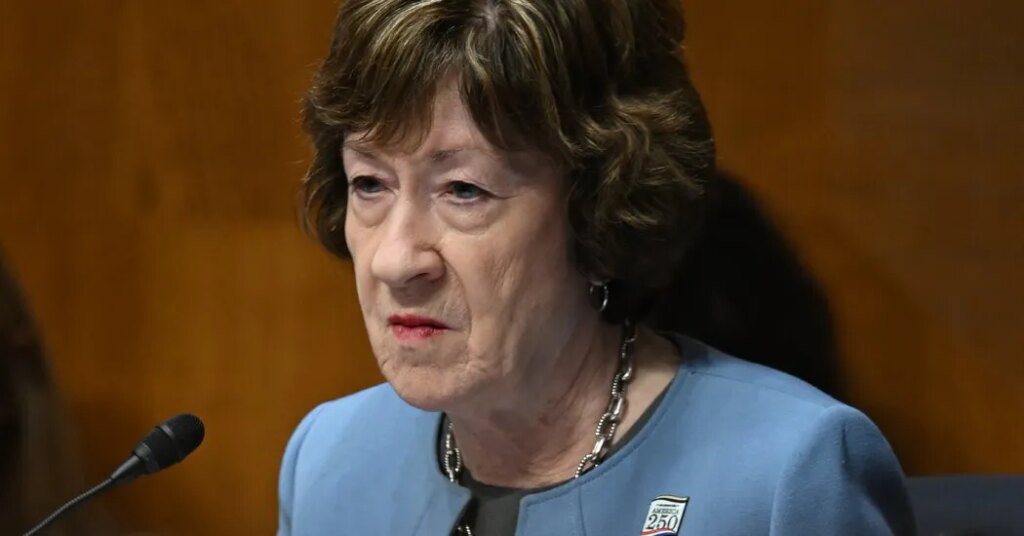
Senator Susan Collins, Republican of Maine, is facing a moment like no other in her three decades in office, one that is testing whether her moderate brand of politics can survive perhaps the most polarizing presidency in modern history.
Ms. Collins, a symbol of centrism and a paragon of decorum, has won five elections in a state that reliably votes for Democrats in presidential races by burnishing her reputation as an independent-minded Republican who delivers for Maine. But this year, she is battling forces that are squeezing her from several directions: a working-class rage about rising prices, a call for generational change and, above all, a burning desire among many voters to make a statement against President Trump’s divisive second term.
“I respect her,” Liz McCormack, 65, a Democrat and retired professor in the coastal college town of Brunswick, said one recent day as she cast a ballot for Ms. Collins’s Democratic challenger, Troy Jackson. Ms. McCormack voted for Ms. Collins in 2020, she said. But this time, she added, “it’s important to send a message.”
Ms. Collins’s predicament, as well as her enduring strength, were on display last week as she weaved through a crowded, sprawling fair in Fryeburg, Maine.
There were well-wishers who effusively thanked her for service. And children who flocked to her side. But then there was the emotional farmer, undecided in the Senate race, who stopped her to tell her how hard it was to make ends meet. And the young man who jeered her as she argued that Maine voters really were not all that hungry for change.
“There are always a few exceptions,” Ms. Collins said, smiling, as the heckler shouted at her that Mainers couldn’t “eat road salt,” a line Mr. Jackson had delivered in a debate in an effort to dismiss her work to exempt road salt from Mr. Trump’s tariffs.
Ms. Collins, 73, a skeptic of the president who is among the last of a nearly extinct breed of congressional Republicans, is in the fight of her political life, trying to win in a blue state where many voters are incensed with Mr. Trump and say that she has not opposed him strongly enough. With the Nov. 3 election approaching, the senator has been playing political Whac-a-Mole, pleading with administration officials to address Trump-inflicted challenges while straining to persuade voters that she is a check on his presidency.
Her race against Mr. Jackson — a progressive Democrat, logger and former state lawmaker who brought up Mr. Trump more than 15 times in their first debate — could determine control of the Senate during Mr. Trump’s last two years in office. Polls show a tight race.
Ms. Collins has managed to survive as a blue-state Republican in the Trump era by selectively breaking with the president and maintaining her image as a bridge builder. The last time she was on the ballot, in 2020, she triumphed by nine percentage points even as Mr. Trump fell in Maine by the same margin. In Maine, a state where about a third of the voters are unaffiliated, a Democratic-leaning share of the electorate has long stood by Ms. Collins, expressing appreciation for her independence, legislative acumen and work to secure resources for Maine as chair of the powerful Appropriations Committee.
But it’s not clear how many of those voters will stick by her this time around.
Some who supported the senator in the past say they remain furious, years later, over Ms. Collins’s connection to the overturning of Roe v. Wade. In 2018, Ms. Collins cast one of the deciding votes to confirm a Supreme Court justice, Brett M. Kavanaugh, who joined the Supreme Court’s 2022 decision erasing a federal abortion right. Ms. Collins, who supports abortion rights, has stood by her vote for Mr. Kavanaugh as it has become a central issue in the election.
Democratic-leaning voters who have supported her in the past were split as they cast ballots one recent morning in Lewiston, a working-class former mill town on the Androscoggin River that Ms. Collins carried in 2020 even as Mr. Trump lost it by 14 points.
Pauline Castonguay, a 78-year-old Democrat, said she was sticking with Ms. Collins.
“She’s done a good job,” Ms. Castonguay said. “I don’t always agree with her. But I think she does vote according to her conscience. I think she’s been a very dedicated employee.”
But Roger Caron, 78, a retired barber and an independent who backed Ms. Collins in the past, said that “this cycle” it was time for the senator to go.
“I’m not voting for any Republicans until Trump is out of office,” Mr. Caron said, expressing disgust with the president’s second term.
‘Not exactly his favorite senator’
In recent months, Ms. Collins has sought to resolve challenge after challenge posed by the president.
Faced with surging heating oil prices because of the war in Iran, Ms. Collins pushed the administration to expedite the release of federal heating assistance for lower-income Maine residents. (The president earlier this year sought to end the heating assistance program.)
Faced with a public outcry over the killing of an immigrant by an Immigration and Customs Enforcement agent in Maine in July, Ms. Collins said she had secured funding for body-worn cameras, de-escalation training for ICE officers and investigations into misconduct. (Before the killing, she had taken credit for pushing ICE agents to pull out of Maine in response to an earlier public outcry, only to watch the issue return.)
And faced with Mr. Trump’s suggestion that he was likely to visit Maine to campaign, Ms. Collins has sought to rule out the notion.
“I’m not exactly his favorite senator,” Ms. Collins said at one debate.
But some in Maine say that is not enough. They argue that Ms. Collins has voted with Ms. Trump when it matters, and that she has not done enough to curb his immigration crackdown, tariffs policies or the war in Iran, which she initially supported but has turned against.
“She has in my view been a disappointment in the past few years,” said Phyllis Blackstone, 77, of Brunswick, a Democrat and self-described former Collins voter casting a ballot for Mr. Jackson this year. “When it comes time to vote, she does as Trump would like her to do.”
A New York Times analysis of Ms. Collins’s voting record found that she voted against Mr. Trump’s policies more often than anyone else in her party, but that she seldom changed an outcome.
Ms. Collins has never voted for Mr. Trump, according to her campaign, and is one of just a few remaining Republican senators who voted to convict Mr. Trump of inciting an insurrection in his impeachment trial in 2021.
Now many voters in Maine say they’re desperate to respond at the ballot box to the Trump administration. And in contrast with 2020, when Ms. Collins won, this time those looking to vent frustration at Mr. Trump don’t have the option of splitting their tickets.
‘I don’t trust her’
At Bowdoin College in Brunswick, students lounging under a colorful canopy of changing leaves said the Trump administration and Maine’s role in the battle for Senate control made Ms. Collins’s race feel like one of grave importance.
Rosa K. Slack, 19, a sophomore and a lifelong Maine resident, said she might be open to voting for Republicans in the future but was eager to vote against Ms. Collins, because she felt it would mean removing an ally of Mr. Trump.
“I don’t like Trump,” Ms. Slack said, “so I don’t like that she’s willing to associate herself with that as a Mainer.”
Back in Lewiston, the working-class city where Mr. Trump was trounced and Ms. Collins prevailed in 2020, the statewide tug of war over Ms. Collins’s future was playing out in miniature as Carol and Dan Quinn, two 81-year-old independents, picked up absentee ballots.
Ms. Quinn, a retired teacher, said she was planning to vote against Ms. Collins, declaring that the senator was “under Trump’s thumb.” Mr. Quinn, however, said he expected to vote for Ms. Collins — and for Democrats on the rest of his Maine ballot.
“Generally I’d like to see the Democrats win,” Mr. Quinn, a retired businessman, said of the battle for Senate control. But he added that he was unimpressed by Mr. Jackson and still appreciative of the senator. “Susan Collins has done a lot for this state.”
Ms. Quinn jawed back.
“She’s too old,” she said. “I don’t trust her.”
Mr. Quinn replied that he disagreed.
Ms. Quinn chuckled, vowing to try to persuade her husband before he cast his ballot.
“We’re not,” she said, “going to be getting along the rest of the day.”
The post A Trump Backlash Endangers Susan Collins, the Only Blue-State G.O.P. Senator appeared first on New York Times.