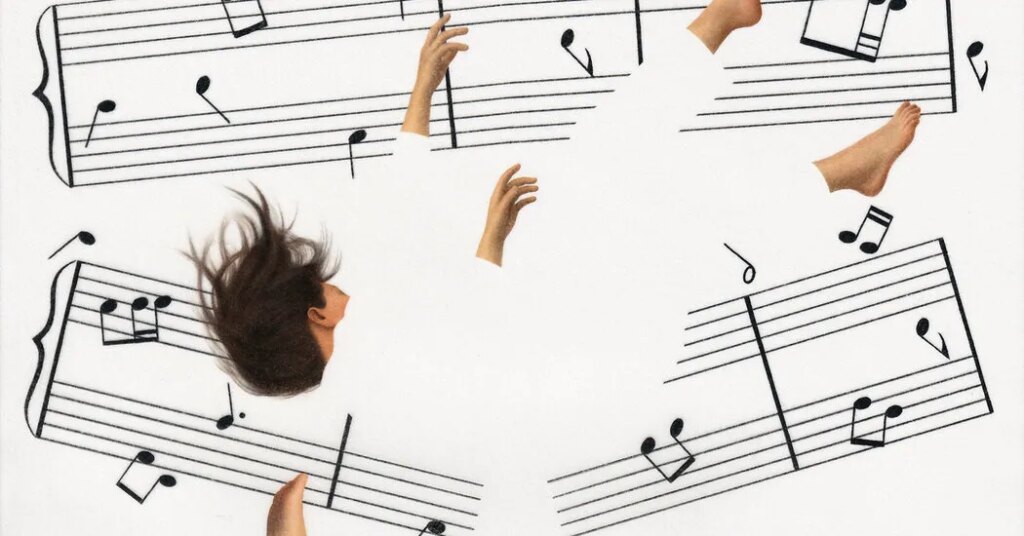
MUSIC AGAINST THE NIGHT, by Yiyun Li
Is it worse to come within grasping distance of a dream than never to have gotten close? In “Music Against the Night,” her new novel about the intertwined lives of two real-life classical musicians at the turn of the 19th century, Yiyun Li traces the arc of that dubious honor called minor fame. “All people are protagonists only in their own lives,” she writes. “Very few people are granted a line in a masterpiece or a footnote in history.” It’s success in a way, but only the kind you settle for.
Certainly John Field, the composer and pianist born in Dublin in 1782, wants to be more than a footnote. His violinist father and organist grandfather call him a genius, and train him up to be the next Mozart. But as a prodigy, he’s always a few years behind Salzburg’s prize pupil. Belatedness hangs over him as a perpetual condition. He isn’t even the first John in his family. His older brother, of the same name, died before he was born.
His eventual wife and narrative counterpoint, Adelaide Percheron, known by the nickname Percherette, is an orphan. Born to a mixed-race mother and a French father in Pondicherry, the French colony on the southeast coast of India, she pursues music not as an accomplishment in the Jane Austen sense — a drawing-room pastime for refined ladies — but with secret passion, as a way to express herself beyond her disadvantaged state.
As Li moves between their stories, similarities emerge. John and Percherette are outsiders on the European continent. Both shake off their pasts to advance their ambition. Music isolates them from their families, sometimes heartbreakingly; it motivates them, guides their movements and brings them inexorably toward each other.
Keeping time is a natural theme for the novel, and Li bends it to her will, often flashing forward to reveal events in her characters’ futures. John’s maestro in London, Signor Clementi, waves off the concept of fate so as not to foreclose on possibility, but fate is built into the structure of “Music Against the Night.” The novel’s first sentence concerns John’s last words. Adelaide, receiving the news of her estranged husband’s death, wastes no time in broaching a frequent preoccupation of Li’s and of literature’s: “What did it signify, to be remembered? When a life ends, night falls. All the daybreaks hence belong to others. Men die, nearly always to be forgotten.” We are acutely aware throughout the novel of the gulf between what these characters desire and what tragedies, major and minor, await them.
That absence of chronological suspense keeps us firmly rooted in the moment. Li focuses on John’s and Percherette’s comings of age, vividly portraying the sensory and emotional experience of two young people forged in a crucible of precocity. The child John — small for his age, burdened with a stutter and shouldering his family’s expectations of greatness — cuts an especially vulnerable figure.
It doesn’t help that as early as 7 he is treated to such truisms as, “What makes one musician different from another is not the notes he can play, but how to turn music into a commodity.” (In fairness, his grandfather has his best interests at heart.) Percherette learns charm and cynicism at the feet of her worldly-wise grandmother, Leonora, and adopts a protective shell so strong that it kept even this sympathetic reader at a distance, until a devastating loss cracks her open.
“Music Against the Night” dives freely into the discourse of art and commerce. In this novel, classical music is not a highbrow calling that floats above market forces; it’s a cutthroat vocation, governed by strategy, rivalry, scandal and survival.
Characters sound off on the virtue of originality (“When people dance, they don’t want to think. You must write music that feels familiar to them”); the balance between inspiration and ownership (John’s first composition owes a debt to Dublin’s chimney sweeps); the anxiety of influence (“If you want to be the next Mozart,” his father tells him, “you’ll have to be at least twice as good as he is. Why? Because all those positions on the ladder — you know the ladder I’m talking about — those rungs are occupied”); the importance of self-promotion (people “spend more to hear us because they’ve heard our names, and they hope it will reflect well on them”); and the technology of the instrument as a vehicle for technique (“Pianofortes are young — they still have a lot of growing to do”). I will be pondering for years to come the riddle Clementi poses to John: “Which came first, an organ or an organist, a harpsichord or a harpsichordist, a pianoforte or a pianist?”
In a quietly revelatory moment, Li deploys the title language of her Pulitzer Prize-winning memoir, “Things in Nature Merely Grow,” about the death of her younger son by suicide, six years after her older son died the same way. There, the phrase asserts that, clichés to the contrary, growth occurs unfreighted with meaning or intention, and Li’s garden “is not a metaphor for hope or regeneration.”
In the novel, the neutrality of growth applies to John’s future:
Things in nature merely grow: roses and hemlocks, beloved puppies and feral cats, prodigies and chimney sweeps, all expanding within their capacities, until they reach that turning point where the world is no longer new. Living then becomes a chore of marking time: hours, days, seasons.
Many children die young in “Music Against the Night,” upending our understanding of the order of things: “A child’s death is a negation of time, which no longer has now and then, now and again, now and later, only now and now and now and now.”
The sequence of “now”’s picks up directly from Li’s nonfiction, as if she were passing herself a baton — still carrying these themes, still rigorously thinking them through. We are lucky to be the beneficiaries of her process. I left this novel — her ninth work of fiction — keenly aware that I’d been in the presence of a world-class artist, and I am not talking about John Field.
The idea of negating time lands differently in the final scene, though. It’s a coda that doubles as a prelude, as the chapter title puts it, and it carries the surprise and optimism of a fresh start. In fiction, Li can reverse course, resuscitate voices and phrases from the past, and grant them a second chance to be heard.
“There would never be a novel about Adelaide Percheron,” Li writes some hundred pages in, ventriloquizing her heroine’s youthful frustration with her insignificance. Now there is one. And while I wrote about it, I listened for the first time to a recording of nocturnes by Field. I hadn’t known he invented the form; I only knew that Frédéric Chopin made it famous.
MUSIC AGAINST THE NIGHT | By Yiyun Li | Farrar, Straus & Giroux | 340 pp. | $29
The post A Major Novel About Minor Fame appeared first on New York Times.